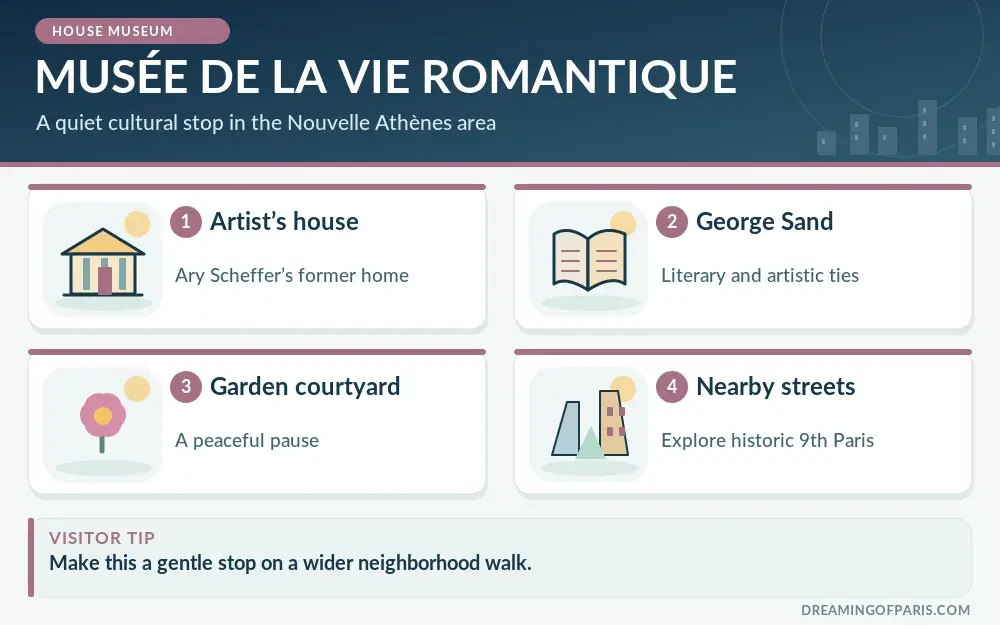
The Musée de la Vie Romantique is one of the easiest small museums to recommend in Paris because it asks for little time and gives back a strong sense of place. Hidden behind a courtyard at 16 rue Chaptal in the 9th arrondissement, the museum occupies the former home and studios of painter Ary Scheffer. Its permanent collection is free, and after a major renovation it reopened on 14 February 2026 with a redesigned visitor route.
This is not a museum about romantic love in the modern Valentine’s Day sense. “Romantic” refers to the nineteenth-century artistic and intellectual movement, and the museum connects painting, literature, music, nature, imagination and the social world around Scheffer and writer George Sand. The domestic scale makes those ideas feel personal rather than monumental.
Check tickets and Paris experiences
Compare current tours, timed-entry tickets and experiences before fixing your itinerary.
GetYourGuideTiqetsCivitatisViatorAffiliate links: we may earn a commission at no extra cost to you.
Opening hours and admission
The museum is at 16 rue Chaptal, 75009 Paris. It is currently open Tuesday to Sunday from 10:00 to 18:00 and closed Monday, 1 January, 1 May and 25 December. The permanent collection is free and normally does not require a ticket reservation, subject to capacity. Temporary exhibitions are paid and use separate ticketing.
Nearest Metro options include Saint-Georges on line 12, Pigalle on lines 2 and 12, and Blanche on line 2. The museum fits naturally into South Pigalle, making it an easy addition to our 9th arrondissement route rather than a destination that requires reorganizing your entire day.
What changed with the 2026 renovation
The museum closed for roughly seventeen months while the historic buildings were restored and the permanent route rethought. The project improved conservation, energy performance and visitor comfort while trying to preserve the atmosphere of a nineteenth-century artist’s home. That balance matters: the museum’s appeal depends on intimacy, so a renovation that made it feel like a neutral white-box gallery would have lost part of the story.
The new permanent route uses two floors. The ground floor focuses on the artistic life around Ary Scheffer and George Sand, while the upper rooms explore themes that fed Romanticism, including nature, emotion, literature and the fantastic. This thematic organization is easier for a general visitor than a purely biographical chronology.
Ary Scheffer and the rue Chaptal circle
Scheffer was born in Dordrecht in 1795 and moved to Paris with his family as a teenager. He became a successful painter and, from the 1830s, his rue Chaptal home and studios developed into a significant meeting place. Writers, musicians, painters and political figures moved through this circle, turning the address into a small center of Parisian cultural life.
The museum’s setting helps make that social history understandable. Instead of imagining Romanticism only through dramatic paintings, you encounter the idea of a salon: a place where art, music, literature and conversation mixed. Scheffer’s network included figures such as Delacroix, Chopin, Liszt, George Sand and others whose lives crossed the same neighborhood.
George Sand: more than memorabilia
George Sand never lived in the house, but she knew the place and participated in the artistic world around Scheffer. The museum’s Sand material includes portraits, jewelry, personal objects and works connected to her life. These pieces are most interesting when read alongside her career as a prolific novelist and public intellectual rather than as celebrity relics.
Sand’s choices—publishing under a male pen name, negotiating separation from her husband, participating in political and cultural debates—make her a useful lens on the constraints and possibilities of nineteenth-century life. The museum can therefore work well for visitors who are more interested in literature and social history than in painting.
How long do you need?
Plan about 60 to 90 minutes for the permanent collection. This is a small museum, and that is a strength. Because admission to the permanent route is free, you do not need to stretch the visit simply to justify a ticket price. Read what interests you, enjoy the house and courtyard, and leave while your attention is still good.
A temporary exhibition can extend the visit toward two hours. If a specific exhibition is your main reason for going, book or verify admission conditions in advance. Small museums can reach capacity quickly even when they are not globally famous because the rooms themselves are physically limited.
The courtyard and garden atmosphere
Part of the charm comes from entering through a courtyard that feels separated from the surrounding streets. The experience is especially effective after walking through busy Pigalle or the grands boulevards. You move from commercial Paris into a quieter domestic world without traveling far.
Treat the outdoor space as part of the visit, but remember that garden or café operations can change with seasons and weather. Do not build a meal plan around a café unless you have checked that it is operating on your date.
Best neighborhood combinations
The museum works beautifully with South Pigalle, Nouvelle Athènes and the streets around Saint-Georges. You can continue uphill toward Montmartre, but the Musée de Montmartre is a more substantial visit, so doing both in the same half-day may feel rushed if you also want to walk the hill.
Another strong pairing is the Musée Gustave Moreau, also in the 9th arrondissement. Together they create a focused day on nineteenth-century artists’ houses and Romantic/Symbolist Paris. Because both are relatively compact, the combination is more reasonable than pairing two giant national museums.
Accessibility and the renovated visitor route
One goal of the renovation was to improve visitor comfort and accessibility, but anyone with specific needs should still check the official access information. Historic artist houses often have constraints that modern museum buildings do not. Ask about the route that is actually available rather than assuming every historic room can be reached in the same way.
The compact size is an advantage for travelers who tire easily. There is less walking than in the Louvre or Orsay, and you can combine the museum with a neighborhood café or short outdoor route rather than another long indoor visit.
Who will enjoy it most?
- Literature lovers interested in George Sand and nineteenth-century cultural life.
- Art travelers who enjoy artists’ houses more than encyclopedic museums.
- Repeat visitors looking for a quieter museum with a strong sense of place.
- Budget travelers because the permanent collection is free.
- Visitors with only limited museum stamina because a meaningful visit can fit into about an hour.
What not to expect
Do not come expecting rooms of famous Romantic masterpieces on the scale of a national gallery. The museum is about an environment, a network and a set of ideas as much as individual star objects. Its intimacy is the point. If you want the largest possible collection for your museum day, choose another institution; if you want context and atmosphere, this is stronger.
Compare nearby activities
South Pigalle and Montmartre have many guided walks and evening activities. If you book one, use the museum as a flexible daytime stop rather than creating an unnecessarily tight sequence. The area rewards wandering, and the most interesting streets are often those between the named attractions.
Official information
Check the museum’s official practical-information page before visiting. The Tuesday–Sunday 10:00–18:00 hours, free permanent collection and post-renovation status in this guide were verified against current September 2026 information.
Frequently asked questions
Is the Musée de la Vie Romantique free?
The permanent collection is currently free. Temporary exhibitions are paid and may require a ticket, so distinguish between the two when planning.
Was this George Sand’s house?
No. It was the home and studios of painter Ary Scheffer. George Sand was connected to the artistic circle and lived nearby; objects relating to her form an important part of the collection.
How long was the museum closed?
It reopened on 14 February 2026 after roughly seventeen months of renovation work that began in 2024.
Can I combine it with Montmartre?
Yes. It sits below the hill in the 9th arrondissement, making it a natural cultural stop before walking toward Pigalle, Abbesses and Montmartre.
Final planning advice
The Musée de la Vie Romantique is ideal when you want Paris culture without a half-day commitment. Visit it for the house, Scheffer’s world, George Sand and the sense of stepping into a quieter nineteenth-century network. Then continue through the 9th arrondissement on foot. The museum’s greatest value is not that it competes with Paris’s largest collections, but that it makes the surrounding neighborhood feel more legible.
One more practical planning note
Because the permanent collection is free, this museum is ideal for flexible planning. Put it near another 9th-arrondissement activity but do not tie it to a non-refundable reservation. If the rooms are temporarily busy, take a short neighborhood walk and return later. Read a little about Ary Scheffer or George Sand before arriving; even ten minutes of context makes the portraits and personal objects more meaningful. The museum’s scale rewards prior curiosity far more than endurance.
Keep screenshots of any timed tickets, save the official address rather than only the attraction name, and verify public-transport changes shortly before departure. Paris itineraries often fail not because the attraction is disappointing but because a small operational detail—wrong entrance, luggage restriction, temporary closure or unrealistic transfer time—was ignored. Build at least fifteen to thirty minutes of slack around important reservations and allow more when you are crossing the city. That buffer protects the rest of the day and gives you freedom to stay longer when a museum or landscape turns out to be better than expected.