
Paris is much easier to enjoy when you stop treating it as a checklist. On a first trip, the biggest mistake is not missing a monument; it is spending half the day crossing the city, queueing twice for the same area, or trying to combine two exhausting museums with three viewpoints and a late dinner. A good first-time plan should give you the icons you came for, but it should also leave enough space to notice the streets, markets, riverbanks and small details that make Paris feel like Paris.
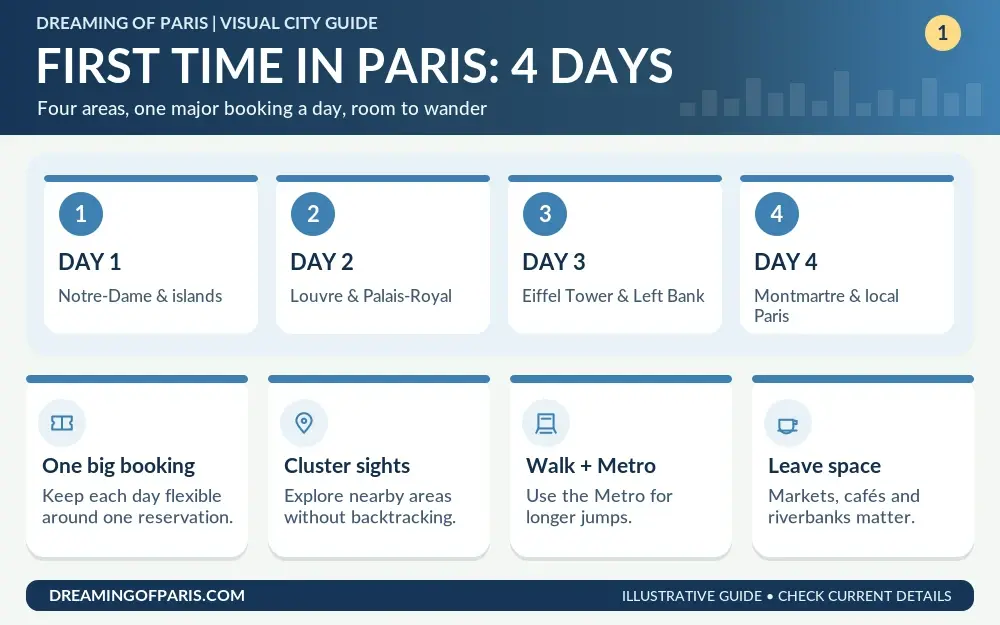
This four-day plan is designed around geography and energy. Each day keeps you in one broad part of the city, pairs one demanding reservation with more flexible wandering, and includes at least one place where the city feels less staged. If you have three days, compress it carefully; if you have five, slow it down rather than adding ten more attractions.
Book the practical parts of your Paris trip
Compare accommodation first, then check tickets and experiences for the fixed parts of your itinerary.
Check Paris hotelsGetYourGuideTiqetsCivitatisAffiliate links: we may earn a commission at no extra cost to you.
The three bookings to make before anything else
For most first-time visitors, three reservations deserve priority: the Eiffel Tower if you want to go up, the Louvre if it matters to you, and the Palace of Versailles if you plan a day trip. The exact order depends on availability. Book the hardest timed attraction first, then build the rest of the day around it. This is more effective than creating a perfect itinerary and discovering later that the only Eiffel Tower slot left is on the opposite side of town at the wrong time.
For the Eiffel Tower, use the official Eiffel Tower website and decide in advance whether you want the second floor or summit, stairs or elevator. For the Louvre, use the official Louvre booking information; the museum is closed on Tuesdays and has later opening on Wednesday and Friday. If Versailles is part of your trip, remember that the Palace is closed on Mondays and that the gardens and Trianon have their own rhythms. Our detailed Versailles from Paris guide explains how to avoid turning the day into a marathon.
Day 1: Historic Paris without overloading the first day
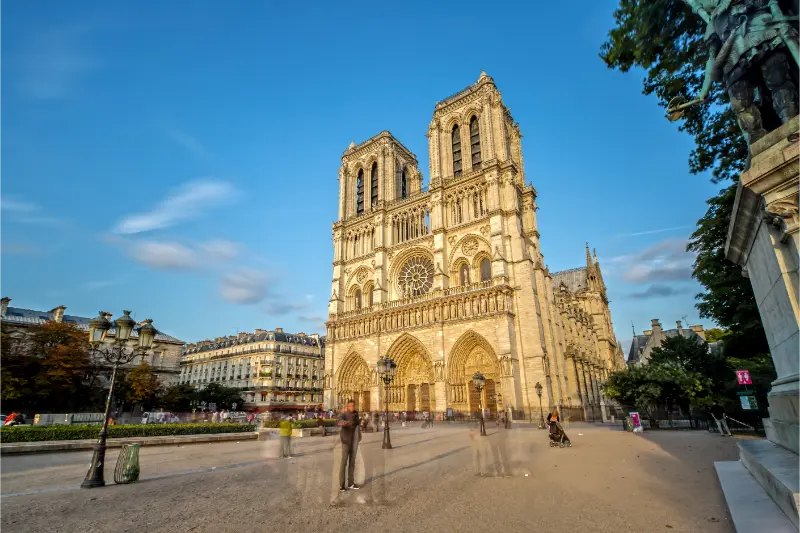
Start on the Île de la Cité. Notre-Dame is again the emotional center of this part of Paris, but the smarter way to experience the island is to walk its edges as well as its headline sights. Look at the cathedral, cross toward the quieter eastern tip, then use the Seine as your orientation line. If you arrive tired from an overnight flight, this is a forgiving first morning because you can shorten or extend the walk without breaking a timed itinerary.
Cross to the Latin Quarter rather than immediately racing to another monument. Rue de la Huchette is famous but crowded; a more rewarding first impression comes from the slopes around the Panthéon, the streets near the Sorbonne and the Jardin du Luxembourg. The garden works especially well as a recovery stop: benches, shade, formal terraces and enough space to reset after travel. If you are traveling as a family, see our Paris with kids guide for child-friendly pacing and practical stops.
In the late afternoon, walk west along the Seine rather than taking the metro for a short hop. This is one of the few times when “inefficient” transport is the better choice: you begin to understand how the Louvre, Tuileries, bridges and Right Bank fit together. Do not visit the Louvre on this first afternoon unless you have a specific reason. A tired, unplanned Louvre visit is one of the fastest ways to turn a great museum into an obligation.
Day 2: Louvre, Palais-Royal and the elegant center
Make the Louvre the single major indoor commitment of the day. The museum can absorb six hours, but a first visit does not have to. A focused two-to-three-hour visit is often more memorable than wandering until every gallery looks the same. Our Louvre strategy guide shows how to choose a route before entering and why the Mona Lisa should not dictate the entire visit.
After the museum, decompress outside. The Cour Carrée, Palais-Royal garden and the arcades around it are close enough to reach on foot. Continue into the 2nd arrondissement and you can discover a different layer of central Paris: the nineteenth-century covered arcades. Our covered passages walk links Galerie Vivienne with passages such as Panoramas, Jouffroy and Verdeau. It is excellent in rain and just as useful on a hot afternoon because much of the route is sheltered.
For dinner, resist the temptation to choose a restaurant solely because it faces a major monument. Walk a few streets away from the highest-traffic axis and look at menus before sitting down. Paris dining becomes much easier when you treat restaurants as part of the neighborhood rather than another attraction to “complete.”
Day 3: Eiffel Tower, Left Bank and a sunset that makes sense geographically
Reserve your Eiffel Tower slot for the morning, late afternoon or evening depending on your priorities. Morning usually gives you more usable day afterward; evening gives you atmosphere but can fragment the day if the slot sits in the middle of dinner time. Our Eiffel Tower guide compares the second floor, summit and stairs, and explains a detail many visitors discover too late: all visitors pass through security, and the Tower has no luggage storage for large bags.

After the Tower, stay on the Left Bank. Walk toward the Champ de Mars, École Militaire and Invalides rather than immediately boarding a metro. If you like museums, the Musée Rodin is a calmer alternative to another mega-museum and its garden changes the pace of the day. From there, Saint-Germain-des-Prés is reachable without a cross-city transfer. The point is not to trace the most direct line; it is to stay within a coherent slice of Paris.
For a classic evening view of the Tower, the Trocadéro area is obvious but often congested. You can also see the Tower from bridges and riverbank sections on both sides of the Seine. The useful trick is to separate going up the Eiffel Tower from seeing the Eiffel Tower in the skyline. They are two different experiences, and trying to combine every photo angle into the same hour creates needless rushing.
Day 4: Montmartre early, then choose your “second Paris”
Go to Montmartre early enough to experience the hill before the central lanes fill. Sacré-Cœur is free to enter and opens very early; the basilica itself is a functioning place of worship, so quiet behavior matters. Instead of staying only on the staircase and Place du Tertre, loop around rue Cortot, the vineyard, the Renoir gardens area and the northern side of the hill. Our Montmartre beyond Sacré-Cœur walk is deliberately designed to show the village-like side of the neighborhood.
Use the afternoon to choose what kind of Paris you want to remember. If you prefer canals, street life and a more contemporary local rhythm, follow our Canal Saint-Martin, Belleville and Buttes-Chaumont route. If you want grand architecture and shopping, go toward Opéra and the Grands Boulevards. If your priority is food, choose one market street and explore it slowly rather than bouncing between “viral” bakeries across six arrondissements.
How to use the metro without letting it control the trip
Paris public transport is excellent, but the shortest route on an app is not always the best travel decision. For two stops in the center, walking can be faster once you include stairs, corridors and waiting. For cross-city trips, the metro is invaluable. In 2026 the fare system is simpler than it used to be: a Metro-Train-RER ticket costs €2.55 and works across Île-de-France except airport journeys, while a Bus-Tram ticket costs €2.05. Airport rail/metro journeys use a specific €14 ticket. See our full Paris transport guide for 2026 before buying a pass; the most expensive “unlimited” option is not automatically the best value.
Where to stay for this itinerary
There is no single best arrondissement. For a short first trip, the most useful accommodation is usually one that gives you two good transport lines and a neighborhood you enjoy returning to at night. The 1st and 2nd are extremely central but often expensive. The Marais is atmospheric and convenient. The Latin Quarter and Saint-Germain put you on the Left Bank with easy walking access to the river. The 9th can be a strong compromise for transport, dining and access to Montmartre. The 10th and 11th can feel more local, but choose the exact street and metro access carefully. Our where to stay in Paris guide compares these areas by travel style rather than by a generic “best neighborhoods” ranking.
Compare hotels for your stay in Paris
Check current availability, location and prices before choosing the exact neighborhood.
Check Paris hotels on Booking.comAffiliate link: we may earn a commission at no extra cost to you.
Small practical details that save disproportionate time
- Carry a refillable bottle. Paris has public drinking fountains, including the distinctive Wallace fountains. Do not assume every decorative fountain is drinkable; use clearly designated drinking-water points.
- Know where public toilets are. Paris has hundreds of free automatic public toilets. This matters more than it sounds when you are traveling with children or walking all day.
- Do not schedule two giant museums back-to-back. The Louvre plus Musée d’Orsay can be physically possible and experientially poor.
- Keep one evening unbooked. Weather, fatigue and a neighborhood you unexpectedly love will often give you a better plan than a reservation made three months earlier.
- Check official sites the day before. Strikes, maintenance, weather and security measures can alter transport or monument access.
If you only have three days
Keep Day 1, combine the Louvre and covered passages on Day 2, and combine the Eiffel Tower with an early Montmartre start on Day 3 only if you are comfortable with a long day. Skip Versailles on a three-day first visit unless it is one of your main reasons for coming. Versailles deserves most of a day; treating it as a half-day add-on usually means rushing both the palace and Paris.
If you have five or six days
Add time rather than attractions. Give the Marais half a day, spend a morning in the 11th or around Canal Saint-Martin, explore Belleville, or add Versailles without sacrificing a Paris day. One of the best upgrades to a first trip is simply returning to a neighborhood at a different time: Montmartre at 8 a.m. and at 9 p.m. are not the same place; the Seine at noon and after dark does not feel like the same city.
First-time Paris FAQ
How many days do you really need in Paris?
Four full days is a strong minimum for a first visit that includes the major sights without constant rushing. Three days can work if you choose priorities. Five to six days gives you enough room for neighborhoods and one day trip.
Should I buy a city pass before arriving?
Only after listing the attractions you genuinely plan to visit and checking whether reservations are still required separately. A pass can be useful, but it should follow your itinerary, not determine it.
Is Paris walkable?
The central city is highly walkable, but distances accumulate quickly. A realistic day often combines 8–15 km of walking with metro rides. Comfortable shoes matter more than squeezing one more attraction into the schedule.
What is the best first view of Paris?
There is no objective answer. The Eiffel Tower offers the most iconic “I am in Paris” experience, Sacré-Cœur gives a broad view from the north, and river-level views are often more beautiful because landmarks sit within the city rather than below you.
The key idea: build your first Paris trip around a few fixed reservations and large geographic zones. The city rewards curiosity much more than speed.
Continue planning your Paris trip
If you are still organizing the logistics around this itinerary, continue with our Paris airports comparison, best day trips from Paris and Paris scams and planning mistakes guide.
Shorter first trip
If you have only three full days, use our 3 days in Paris itinerary, designed to reduce backtracking.
When should you plan this first trip?
Before fixing the itinerary dates, use our best time to visit Paris guide to compare daylight, weather, crowds and seasonal trade-offs.
If you have a fifth day
Our five-day Paris itinerary adds more neighborhood time without simply stacking another major attraction onto each day.
Choose the right Paris itinerary for your trip length
This four-day plan sits inside our itinerary cluster. For a compressed visit use one day in Paris or the 2-day weekend plan; for a little more space use the 3-day itinerary. Longer stays work better with our 5-day plan or one-week itinerary. Before locking the schedule, compare seasons in Best Time to Visit Paris and check which timed attractions deserve priority in our advance-booking guide.
If budget, season or travel style changes the plan, use our Paris on a budget, solo Paris, spring and autumn guides rather than forcing a standard itinerary.
How many days should you allow?
If you are still deciding the trip length before using this itinerary, compare the trade-offs in our how many days in Paris guide, which covers 1, 2, 3, 4, 5 and 7-day stays.