Paris can work brilliantly with teenagers if the trip stops treating them as passengers. Older children usually need more autonomy, stronger reasons for each stop and less forced enthusiasm for adult bucket lists. The solution is not to remove museums and monuments; it is to mix them with neighborhoods, food, viewpoints, shopping, music, sport or street art and to give teenagers a real vote in the plan.
Give them ownership of one choice per day
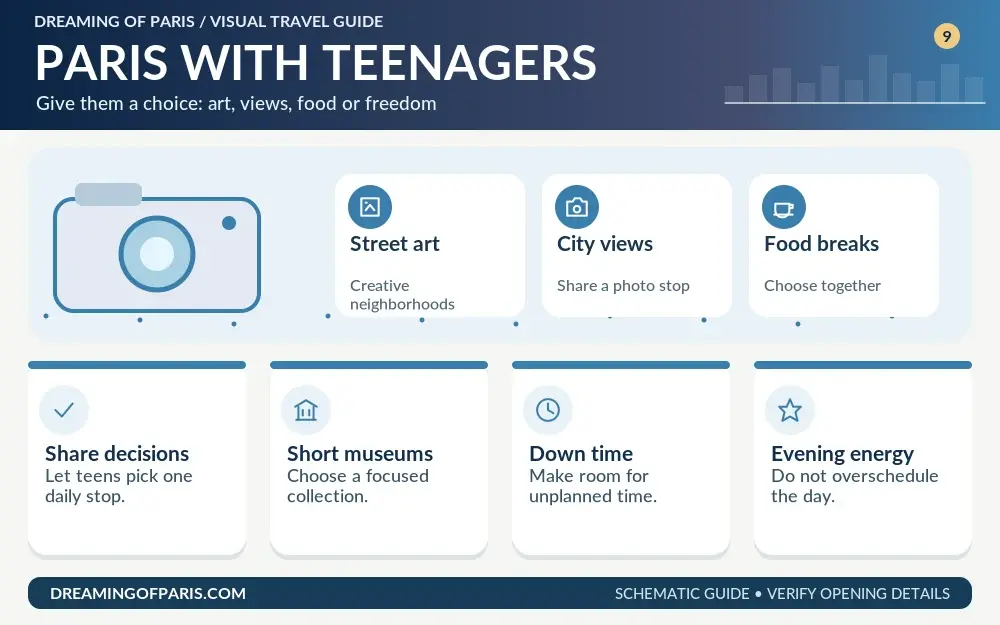
Before the trip, ask each teenager to choose one meal, neighborhood, museum or activity. The choice should be real, not a disguised selection between three options the adults already prefer. Ownership changes the tone of waiting, navigation and even early starts.
The most useful family schedule has fewer fixed stops than an adult sightseeing plan. Children and teenagers notice queues, hunger and dead travel time more than they notice whether a famous monument was skipped. Put one anchor experience in each half-day and let the spaces between anchors stay flexible.
Use views instead of endless monuments
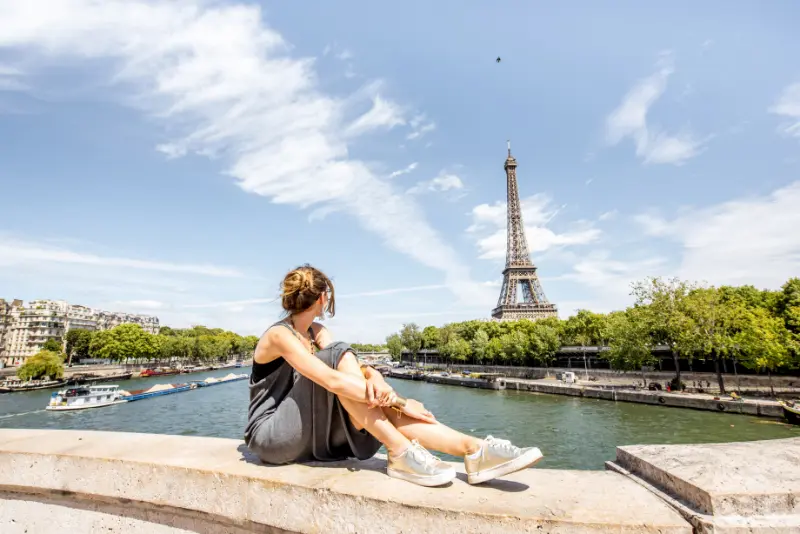
The Eiffel Tower, Arc de Triomphe and free hilltop viewpoints can create immediate visual context. Choose one paid high viewpoint rather than buying every rooftop ticket. A panorama early in the trip also helps teenagers understand how the neighborhoods connect.
Age matters more than the label ‘family friendly’. A six-year-old, a twelve-year-old and a sixteen-year-old can react very differently to the same museum. Explain the plan before you arrive, give older children some choice, and keep a nearby exit option for moments when the group has had enough.
Street art and neighborhoods
The 13th arrondissement, Belleville and Ménilmontant provide visual walks that feel less formal than a museum. Pair murals with a café, record shop, market or casual lunch. The objective is not to photograph every wall but to make walking through the city feel purposeful.
When booking timed attractions, leave a genuine buffer for transport and security. Paris journeys that look short on a map can become tiring with changes, stairs or crowded platforms. A calmer arrival almost always produces a better visit than squeezing in one extra stop.
Museums: shorter and more specific
Two focused hours at the Louvre or Musée d’Orsay often work better than a heroic half-day. Let teenagers choose a theme or a short list of works, then leave while attention is still intact. Smaller museums can be even more effective because the scale feels manageable.
Food, shopping and downtime
Build unstructured time into Le Marais, Saint-Germain, the grands magasins or a market area according to their interests. A pastry stop, bookstore or vintage browse can be part of sightseeing. Constant educational narration turns the city into a school trip; periods of independence and silence matter.
Evenings without overloading the day
A Seine walk, night cruise or illuminated monument can feel special without requiring another museum. If you want a later evening, lighten the afternoon and choose a hotel with an easy route home. Teenagers can stay up later than small children, but fatigue still compounds after several intensive days.
Useful connections on Dreaming of Paris
Start with our broader Paris with kids guide. For visual neighborhoods, use the Paris street-art guide and Paris at night.
How many major attractions should we plan each day?
Usually one major timed attraction per half-day is enough. Add flexible neighborhood time around it rather than another hard reservation.
Is Disneyland Paris still a good option with teenagers?
It can be, especially for families interested in rides, franchises and theme-park design. Let the teenager help decide whether it is worth a full day.
Which neighborhood is best for teens?
There is no universal answer. Le Marais, the 13th, Belleville, Canal Saint-Martin and central shopping areas appeal to different interests, so match the area to the teenager rather than to a generic ranking.
A final planning note
A successful teenage Paris trip feels shared. Keep the cultural highlights, but trade a little efficiency for choice, independence and time that is not narrated by adults. Those are often the moments older children remember most.
For Paris with teenagers, one more practical point is worth keeping in mind. Age matters more than the label ‘family friendly’. A six-year-old, a twelve-year-old and a sixteen-year-old can react very differently to the same museum. Explain the plan before you arrive, give older children some choice, and keep a nearby exit option for moments when the group has had enough. Use this as a decision rule rather than a rigid instruction: the best version of the day is the one that keeps the route coherent and leaves enough energy for the place itself.
For Paris with teenagers, one more practical point is worth keeping in mind. When booking timed attractions, leave a genuine buffer for transport and security. Paris journeys that look short on a map can become tiring with changes, stairs or crowded platforms. A calmer arrival almost always produces a better visit than squeezing in one extra stop. Use this as a decision rule rather than a rigid instruction: the best version of the day is the one that keeps the route coherent and leaves enough energy for the place itself.
For Paris with teenagers, one more practical point is worth keeping in mind. The most useful family schedule has fewer fixed stops than an adult sightseeing plan. Children and teenagers notice queues, hunger and dead travel time more than they notice whether a famous monument was skipped. Put one anchor experience in each half-day and let the spaces between anchors stay flexible. Use this as a decision rule rather than a rigid instruction: the best version of the day is the one that keeps the route coherent and leaves enough energy for the place itself.
Jardin d’Acclimatation
For a child-focused outdoor half-day in western Paris, see our Jardin d’Acclimatation family guide, including ride schedules and the Fondation Louis Vuitton pairing.
A museum for engineering-minded teenagers
The Musée des Arts et Métiers is especially strong for teens interested in aircraft, mechanics, inventions and Foucault’s pendulum.
Build the day around independence, not “teen attractions”
Teenagers often enjoy Paris more when the plan gives them meaningful choices instead of a sequence of places adults have already decided are educational. A practical system is to let each teenager choose one anchor for the trip—street art, a major viewpoint, fashion, football, a food stop, a science museum or a neighborhood—and then build nearby adult priorities around it. That produces a shared day instead of a reward system where young travelers endure museums in exchange for shopping later.
For example, pair the Musée des Arts et Métiers with the Marais or Canal Saint-Martin rather than adding it to a Louvre day. Pair street art in the 13th with Butte-aux-Cailles. If a rooftop matters more than another church interior, use the Arc de Triomphe or Eiffel Tower as the visual anchor and keep the rest of that half-day outdoors.
A realistic daily limit
Two fixed reservations are usually enough. One can be a major attraction; the other can be dinner, an evening experience or a second shorter visit. Leave a block of unassigned time for a café, shopping, photos or simply returning to the hotel. Teenagers who are old enough to navigate independently may also appreciate a short agreed period to browse a safe, busy area while adults do something nearby, provided the family is comfortable with that level of independence.
Night planning matters because older children can handle later hours but still become exhausted after a ten-hour sightseeing day. If you want an evening Seine cruise, cabaret-style show suitable for the age group, or illuminated monument, reduce the afternoon. Our Paris at night guide is a better match than stacking nightlife onto a full museum schedule.
Finally, be careful with “Instagrammable” promises. Some viral locations are small residential streets or working shops and are not designed for prolonged photo sessions. Giving teenagers room to create their own memories works well, while a little awareness of doorways, residents and barriers helps keep photo stops easy and unobtrusive. Paris becomes more enjoyable when the trip feels adult enough to be trusted, but structured enough that transport, meals and reservations do not fall apart.
A practical decision check for Paris with Teenagers
The best Paris-with-teens plan respects different interests inside the same family. Give each teenager one real choice and make at least one day contain an activity they selected themselves. Before you give it a fixed slot, compare that reason with the strongest alternative already on your itinerary. If the alternative matters more, move this stop to an optional block instead of forcing both into the same half-day. That simple choice keeps the article useful for different travelers rather than implying that every reader needs the same Paris.
A realistic way to fit it into the day
Use a morning anchor, a flexible lunch area and one afternoon choice. Finish early enough that an evening view, match, show or food stop still feels enjoyable rather than mandatory. Keep the previous and following stops close enough that a delay of twenty or thirty minutes does not create a cascade of missed reservations. Paris days become much easier when the route can absorb a longer lunch, a queue or a weather change without requiring a taxi across the city.
The trade-off worth making explicit
Long museum days fail more often than short visits to the wrong museum. The trade-off is depth versus autonomy: a focused 90-minute museum can leave enough energy for shopping, street art or a park. Making that trade-off deliberately is more useful than adding another item to a checklist. Ask what you would remove if this experience takes longer than expected; if the answer is “nothing,” the day is probably already too full.
Small details that prevent avoidable problems
Agree on phone battery, meeting points and what happens if the group separates briefly. Older teens often enjoy responsibility when the rules are clear before the day starts. Save the exact address or entrance you intend to use, keep enough phone battery for the return route and recheck any time-sensitive information on the official site. These are small steps, but they protect the part of the experience that actually matters from being swallowed by logistics.
Where it belongs in the wider Paris cluster
Street art pairs with the 13th or Belleville; science pairs with La Villette; fashion and cafés pair with the Marais. Keep Disneyland or a theme-park day separate from central sightseeing. Treat that pairing as a geographic or thematic cluster, not an obligation to complete everything. One strong connection is enough to make the day coherent; two or three distant add-ons usually reduce the value of the place you came to see.