
Paris transport became much easier to understand after the fare simplification, but visitors can still overpay by buying the wrong pass. In 2026 the core decision is straightforward: occasional travelers can use simple single tickets loaded onto a Navigo Easy pass or compatible smartphone, while heavy users should compare a day or multi-day product against the journeys they will actually make.
The most important change for visitors is that the old zone-based complexity for ordinary rail journeys has largely disappeared. A standard Metro-Train-RER ticket costs €2.55 in 2026 and can be used across Île-de-France on those networks, except for airport journeys. A separate Bus-Tram ticket costs €2.05. Travel to or from Charles de Gaulle by RER B, or Orly by Metro 14/Orlyval, uses the specific Paris Region <> Airports ticket at €14. These prices are published by Île-de-France Mobilités.
2026 Paris transport prices at a glance
| Ticket | 2026 full fare | Good for |
|---|---|---|
| Metro-Train-RER | €2.55 | Metro, train and RER journeys outside airport-specific travel |
| Bus-Tram | €2.05 | Bus and tram journeys |
| Paris Region <> Airports | €14.00 | CDG via RER B; Orly via Metro 14 or Orlyval |
| Navigo Day, all zones | €12.30 | Unlimited day travel, but airport access is excluded |
| Paris Visite 1 day | €30.60 adult | Unlimited travel including airport services |
Reduced fares exist for eligible passengers, and children may qualify depending on age and product. Always check the official rules rather than assuming that every child automatically pays half on every ticket type.
What is Navigo Easy and why most short-stay visitors should understand it
Navigo Easy is a reusable contactless pass that can hold certain tickets and passes. The important point is not the plastic card itself; it is that Paris transport is increasingly designed around contactless media rather than old disposable paper tickets. Depending on your phone and app compatibility, you may also be able to buy and load fares directly on a smartphone.
For a couple or family, remember that a Navigo Easy pass is personal while you are traveling: you cannot simply pass one card back through the gate to validate several people on the same journey. Each traveler needs a valid fare medium. This is a small detail that prevents confusion at the first station.
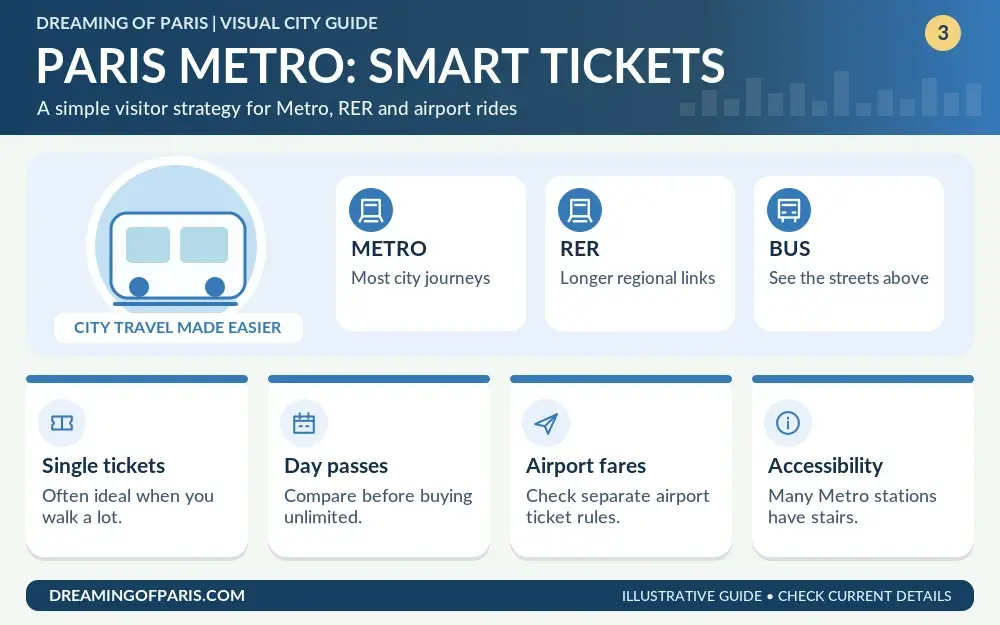
When single tickets are the smartest choice
If you stay centrally and walk a lot, single tickets are often underrated. On a typical sightseeing day you might take the metro to the first neighborhood, walk for hours, then take one ride back. Buying an unlimited pass for “freedom” can cost more without giving you a better trip.
For example, a traveler making four standard Metro-Train-RER journeys in one day pays €10.20 at the 2026 single rate. That is still below the €12.30 all-zone Navigo Day fare. At five journeys, the day pass begins to become interesting, assuming all trips are covered and you are not relying on the airport journey. The calculation is simple, but your itinerary matters. If you are following our four-day Paris itinerary, several days are intentionally built to be walked within one area, so unlimited transport is less essential.
Navigo Day: useful, but airports are the trap
The all-zone Navigo Day fare is €12.30 in 2026 and can be excellent on a day when you plan many rail or bus journeys across the region. However, airport travel is not included. This is exactly the kind of exception that can make a pass look more comprehensive than it is.
If you are landing at CDG in the morning, riding into central Paris and then making several city journeys, do not assume one Navigo Day product covers the entire sequence. Price the €14 airport ticket separately.
Paris Visite: expensive for some travelers, genuinely useful for others
Paris Visite is a visitor-oriented unlimited pass and, unlike Navigo Day, it can include airport travel. In 2026 the all-zone adult price is €30.60 for one day, €45.40 for two days, €63.80 for three days and €78 for five days. Children from 4 to under 10 have half-price versions according to the official fare table.
Whether it is worth buying depends on how much you value simplicity and how many trips you will make. A first-time visitor who walks extensively may spend less with single tickets plus separate airport travel. A traveler staying outside central Paris, using the network frequently and going to the airport within the pass period may value the all-inclusive structure more. There is no universal winner.
Charles de Gaulle Airport to Paris in 2026
The RER B remains the main rail route between Charles de Gaulle Airport and central Paris. The 2026 Paris Region <> Airports ticket costs €14 at full fare. It can be loaded onto a Navigo Easy pass or smartphone according to Île-de-France Mobilités. Central RER B stations include Gare du Nord, Châtelet-Les Halles and Saint-Michel–Notre-Dame, making the line useful for many hotel areas.

The practical issue is not only journey time but luggage. Châtelet-Les Halles can be enormous, and a theoretically optimal connection may involve long corridors and stairs. If your hotel is not directly on RER B, compare one simple transfer with a route that saves three minutes but forces two changes. After a long flight, simplicity wins.
Orly Airport to Paris in 2026
Metro Line 14 has transformed Orly access. The airport is connected directly to the metro network, and the specific Paris Region <> Airports fare applies. Orlyval is also covered by the airport ticket framework. Because Line 14 crosses major central interchanges, it can be especially convenient if your hotel is near a station on the line or requires only one easy transfer.
Do not buy a standard €2.55 Metro-Train-RER ticket for the airport segment. The airport journey requires the €14 airport product unless you hold a pass that explicitly includes it.
Metro, RER and train: what is the difference for a visitor?
The Metro is the dense urban network you will use for most central trips. The RER is a faster regional railway that crosses Paris and continues into the suburbs; lines can branch outside the center, so the destination shown on the platform matters. Regional trains can take you farther into Île-de-France. For ticketing in 2026, the standard Metro-Train-RER product simplifies many journeys across these systems, but airport travel remains a special case.
For Versailles, RER C to Versailles Château Rive Gauche is one common route from Paris, though other stations and train services can also be useful depending on your starting point. Our Versailles day-trip guide explains how to choose the route based on where you stay rather than blindly following one station name.
Bus: slower on paper, better for seeing the city
The bus is not just a backup when the metro is closed. It can be a better sightseeing tool when you are tired of underground corridors, traveling with someone who dislikes stairs, or moving along a route where the street view is part of the experience. A 20-minute bus ride may feel more enjoyable than a 14-minute metro journey if it saves multiple station changes.
The Bus-Tram ticket is a separate product from the Metro-Train-RER ticket, priced at €2.05 full fare in 2026. Do not assume one single ticket is interchangeable across all networks in all circumstances; check the transfer rules in the official app if your journey combines modes.
Accessibility: do not assume every metro station has step-free access
Paris Metro accessibility is improving, but the historic network includes many stairs and stations that are difficult with wheelchairs, large strollers or heavy luggage. Line 14 and newer infrastructure are generally easier, while older stations can require multiple staircases. If step-free travel is essential, plan each route using official accessibility information rather than relying on a generic map.
This also affects families. A compact stroller is often easier than a bulky travel system. On the Eiffel Tower, only foldable strollers are accepted, and large luggage is not allowed; our Eiffel Tower guide covers those restrictions.
How to read a Paris metro route like a local
Metro lines are identified by number and direction is shown by the name of the line’s terminal station. Before descending, identify both your line number and the terminal in your direction. At transfer stations, follow the colored line number signs rather than relying only on “correspondance.” It sounds basic, but it prevents the classic mistake of boarding the correct line in the wrong direction.
On RER lines outside central Paris, check the train’s destination and stopping pattern because branches matter. For central tourist trips, apps make this easier, but platform displays are still worth reading.
Three strategies that work for most visitors
Strategy 1: central hotel + lots of walking
Use single tickets, keep an airport ticket separate, and buy a day pass only on a transport-heavy day. This is often the simplest choice for a four-day first trip.
Strategy 2: hotel outside the core + multiple daily rides
Compare the daily pass or multi-day products carefully. Your accommodation savings may still be worthwhile, but transport becomes a larger part of the trip. See our where to stay in Paris guide before booking far from the center purely on price.
Strategy 3: family that wants minimum ticket decisions
Price the visitor pass against single fares and airport journeys, including child rules. Sometimes paying a little more for a simpler product is reasonable when you are managing children, luggage and multiple devices. The cheapest theoretical option is not always the best practical option.
Common transport mistakes
- Buying an unlimited pass before counting realistic journeys.
- Assuming an all-zone day pass automatically includes airports.
- Using one contactless pass for multiple people.
- Choosing a hotel beside a station without checking which lines actually serve it.
- Taking the metro for one or two central stops when walking is faster and more interesting.
- Forgetting that service can change because of works, strikes or special events.
Best official tools to check before traveling
Use the Île-de-France Mobilités website and official app for fares, network changes and journey planning. RATP also publishes live service information. Check again on the day you travel, especially for airport routes, late-night connections and weekend engineering works.
Paris transport FAQ
Can I use a €2.55 Metro-Train-RER ticket to CDG or Orly?
No. Airport journeys to CDG via RER B and Orly via Metro 14 or Orlyval use the specific Paris Region <> Airports ticket, €14 full fare in 2026.
Does Navigo Day include the airports?
No. The all-zone Navigo Day fare is €12.30 in 2026 but excludes airport access.
Is Paris Visite always a bad deal?
No. It is often more expensive than a few single tickets, but it can make sense for heavy users who value unlimited travel and airport coverage. Compare it with your actual itinerary rather than judging it by reputation.
Do I need the metro every day?
Probably not. Central Paris rewards walking. Use public transport to connect major zones, then explore within each zone on foot. This is both efficient and more enjoyable.
Bottom line: in 2026, the transport system is simpler than many old Paris guides suggest. Start with your itinerary, count likely journeys, keep airport travel separate in your calculations, and choose the least complicated product that covers what you truly need.
Airport transport cluster
For airport-specific routes, see our Paris airports overview, CDG to Paris and Orly to Paris.
Cycling as a transport option
For short journeys, compare Metro and walking with our Paris by bike and Vélib’ guide.
Accessibility and railway arrivals
For mobility needs, use our accessible Paris guide. Travelers arriving by rail can compare terminals in the Paris train stations guide.
Paris transport cluster: continue with the route you actually need
For rail arrivals, our Paris train-stations guide explains Gare du Nord, Gare de Lyon, Montparnasse and the transfers that matter. Travelers who need step-free routes should use the separate accessible Paris guide, because historic Metro accessibility is not uniform. For short journeys, compare public transport with the Vélib’ and cycling guide.
More practical transport planning
For days when the network does not run normally, read our Paris strikes and transport disruptions guide. If a car is the better tool for luggage or an early flight, compare taxis and VTCs in Paris.
Should you drive instead?
For road-trip travelers, our driving and parking in Paris guide explains the central ZTL, parking strategy and why a car is rarely useful for daily sightseeing.