Disclosure: This article contains affiliate links or booking widgets. If you book through them, Dreaming of Paris may earn a commission at no extra cost to you. How our affiliate links work.
The best time to visit Paris is not a single month. It depends on what you dislike most: short winter days, summer heat, crowds at major monuments, higher hotel prices, or the risk of rain. A useful planning guide therefore starts with trade-offs rather than declaring April or October universally “best.” Paris works year-round, but the same itinerary feels very different in January, May, August and December.
This month-by-month guide is designed around real trip decisions: how much daylight you get, how much time you expect to spend outdoors, whether gardens matter, how sensitive you are to heat and cold, and whether you are trying to visit high-demand attractions such as the Eiffel Tower, Louvre or Versailles. Weather remains variable in every season, so treat climate averages as context rather than a promise.
Paris by season: the quick decision
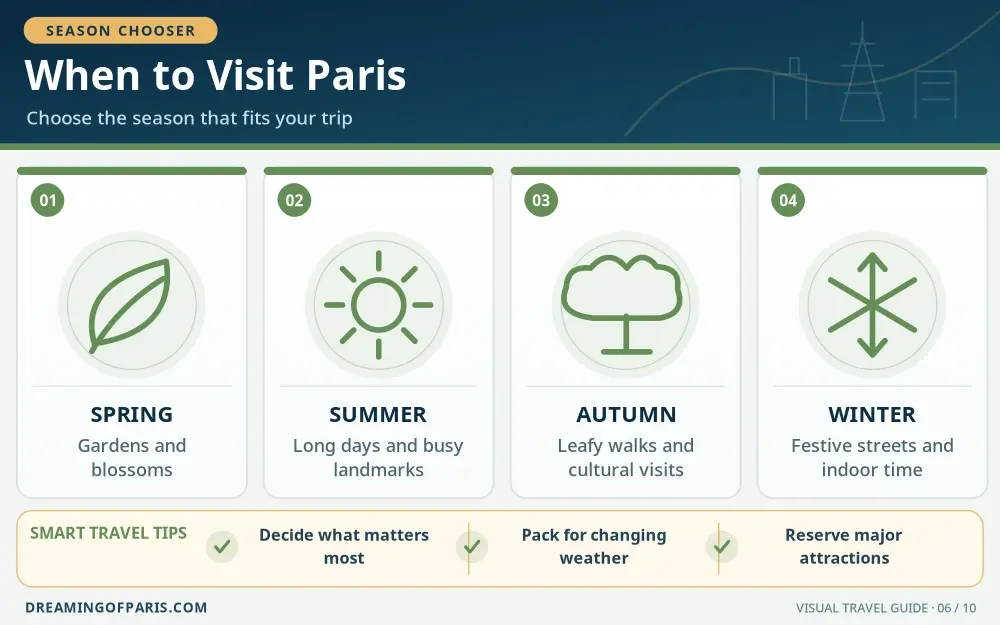
Spring is excellent for gardens, long walks and a city that is becoming brighter by the week, but rain and sudden temperature swings are normal. Summer gives you the longest days and the easiest evening sightseeing, while also bringing the strongest risk of heat, peak demand and a quieter local rhythm in parts of August. Autumn is strong for walking, museums and food-focused trips, with shorter days and more changeable weather as the season progresses. Winter is best for travelers who prioritize museums, cafés, covered passages and atmosphere over parks in full bloom.
Paris je t’aime, the city’s official tourism office, describes a temperate climate with weather that can shift quickly. That is the practical lesson to remember: pack layers and plan one indoor alternative for every weather-sensitive half-day. A rigid “sunny itinerary” is more likely to fail than a flexible neighborhood plan.
| Period | Best for | Main trade-off |
|---|---|---|
| January–February | Museums, lower-key city breaks, indoor culture | Cold, short daylight, some gardens at their least expressive |
| March–April | Walking, blossom season, mixed indoor/outdoor days | Unpredictable rain and temperature swings |
| May–June | Gardens, long evenings, first trips | High demand and increasingly busy headline sights |
| July–August | Long days, evening walks, family schedules | Heat risk, peak tourism, August business closures |
| September–October | Walking, culture, food, second trips | Shortening days and variable rain |
| November–December | Museums, lights, Christmas atmosphere | Early darkness, cold and holiday closures |
January and February: Paris for museums, cafés and deliberate pacing
The first two months of the year suit travelers who are comfortable building the day around indoor anchors. The Louvre, Musée d’Orsay, Orangerie, Invalides, small museums and covered passages become the backbone; riverside walks and viewpoints are added when the weather cooperates. The city can feel less relentlessly “scheduled” than in high season, although major icons still attract visitors every day.
Do not underestimate daylight. An itinerary that looks reasonable on paper can feel compressed when outdoor photography, a park and a viewpoint are all pushed into a short afternoon. Our Paris in winter guide goes deeper into cold-weather pacing and seasonal closures.
March and April: the most variable version of Paris
Early spring is attractive because you can begin to use parks and terraces again without committing to summer heat. It is also one of the easiest periods to pack badly for. A mild afternoon can follow a chilly morning, and rain can arrive in short bursts. The smartest approach is not to carry your entire wardrobe but to use a light waterproof layer and shoes that remain comfortable on wet stone.
This is a particularly good period for itineraries that alternate neighborhoods with museums. Montmartre, the Latin Quarter, Le Marais and the Seine can be paired with one timed indoor visit. If rain settles in, our Paris in the rain plan gives alternatives that do not simply send you to the Louvre with everyone else.
May and June: long days and the easiest all-round first trip
For many first-time visitors, late spring offers the broadest range of options. Gardens are fully part of the itinerary, daylight supports long neighborhood walks, and evenings can extend naturally to the Seine or a viewpoint. The trade-off is demand: do not interpret pleasant weather as a low-crowd secret season. Popular sights can be extremely busy, and hotel rates often reflect that demand.
If you are planning a first trip, this is when geographical clustering matters most. Use our 3-day Paris itinerary or 4-day first-time plan rather than adding one more reservation every time you discover a new attraction.
July: maximum daylight, maximum flexibility — and possible heat
July makes evening Paris easy. You can visit a museum, rest in the late afternoon, and still have useful daylight for a long walk. That can transform a trip if you naturally prefer slower mornings. The downside is that heat can turn exposed spaces such as large squares, the Champs-Élysées or long queues into poor choices at midday.
Use heat as a scheduling variable. Put parks, markets and outdoor neighborhoods early; reserve air-conditioned or shaded activities for the hottest hours; return outside later. Our Paris in summer guide covers heat, crowds and long-day planning in more detail.
August: still worth visiting, but a different city rhythm
The old cliché that “Paris closes in August” is too simplistic. Major museums, monuments, hotels and visitor infrastructure continue to operate, while some independent restaurants, bakeries and neighborhood businesses take annual holidays. The important distinction is between tourist Paris and everyday local Paris: the first remains active; the second can be noticeably quieter in some areas.
That makes August surprisingly good for visitors who plan around confirmed opening hours and enjoy evening walks. It is less good for a trip built around a long wishlist of specific small restaurants or shops. Check every must-have independent address shortly before the trip rather than assuming last year’s August schedule still applies.
September and October: strong walking months with fewer daylight hours
Early autumn is one of the easiest periods for mixing museums, neighborhoods, markets and parks. Temperatures are often comfortable for long walks, cultural programming is active and the city has a more everyday rhythm after the main summer holiday period. By October, however, sunset arrives earlier and weather becomes more variable.
This is an excellent season for deeper neighborhoods: Ménilmontant and Belleville, Butte-aux-Cailles or Batignolles. You can give more of the day to walking without treating every hour as a race between attractions.
November and December: atmosphere wins, daylight loses
November is a culture-first month. December adds lights, decorated department stores, seasonal events and Christmas atmosphere, but also holiday demand and special opening schedules. Plan important museums and monuments first, then place seasonal wandering around them. Do not assume Christmas Day or New Year’s Day behaves like an ordinary sightseeing day.
If Christmas is central to the trip, read our winter and Christmas guide before booking. It explains why a December trip should not simply reuse a June itinerary with a heavier coat.
Crowds: month matters less than time of day and attraction strategy
A supposedly quiet month will not make the Mona Lisa room empty at noon. Conversely, a busy month can still produce calm experiences if you use early mornings, late openings, residential neighborhoods and pre-booked time slots intelligently. Crowd strategy should happen at the attraction level, not only at the calendar level.
For example, use our focused Louvre route, Eiffel Tower strategy and Versailles day-trip plan instead of expecting season alone to solve queueing and fatigue.
Prices: when season affects the budget
Accommodation prices respond to demand, events, weekends and large trade fairs as much as to simple “high season/low season” labels. A random midweek date can occasionally cost more than a famous holiday weekend because of a major event. Compare exact dates before committing to flights, especially if hotel quality matters to you.
If your dates are flexible, compare two or three nearby weeks before booking. You can compare Paris hotels on Booking.com, then cross-check the neighborhood with our where to stay in Paris guide. A cheaper room that adds two awkward transfers every day is not always a saving.
So, when should you go?
Choose May–June if this is a first trip and you value gardens and long days; September–early October if you want long walks with a more local rhythm; winter if museums and indoor culture dominate your list; and summer if you can adapt to heat and value late evenings. Those are planning profiles, not rankings.
The strongest date is the one that fits the experiences you care about and the compromises you tolerate. Paris does not need perfect weather. It needs an itinerary that still works when the weather changes.
Frequently asked questions
What is the least crowded month in Paris?
There is no reliably empty month for the major sights. January and parts of February can feel calmer overall, but the Louvre, Eiffel Tower and other icons remain popular. Time slots and day-of-week strategy matter more than chasing a mythical crowd-free month.
Is August a bad time to visit Paris?
No. It can be hot and some independent businesses close for holidays, but major attractions operate and long evenings are valuable. August works best when you verify small-business opening dates and avoid building the trip around a fixed restaurant wishlist.
What month is best for gardens?
Late spring into early summer is the safest choice if gardens are a major priority, while early autumn can also be beautiful. Specific flowering periods vary each year with weather conditions.
How far ahead should I book?
For high-demand travel periods, book the hotel and any non-negotiable timed attractions as soon as your dates are firm. Avoid pre-booking every hour; flexibility is part of a good Paris plan.
Season-by-season planning
For detailed shoulder-season planning, continue with Paris in spring and Paris in autumn, including month-by-month pacing, weather strategy and outdoor priorities.
Timing guides that matter after you choose the month
Once the season is fixed, the day-to-day timing still matters. Use Early Morning in Paris for places that are genuinely better before the crowds and our Paris on Sunday guide for weekly closures and different neighborhood rhythms.
Prepare for the dates, not only the weather
Once you choose a season, use our Paris packing guide and check public holidays and closures for the exact travel dates.
Check the event calendar before choosing your dates
Weather and crowds are only part of the timing decision. Use our Paris events calendar to check festivals, sport, fashion, public celebrations and heritage weekends that can change hotel demand or transport.