Disclosure: This article contains affiliate links or booking widgets. If you book through them, Dreaming of Paris may earn a commission at no extra cost to you. How our affiliate links work.
Compare hotels for your stay in Paris
Check current availability, location and prices before choosing the exact neighborhood.
Check Paris hotels on Booking.comAffiliate link: we may earn a commission at no extra cost to you.
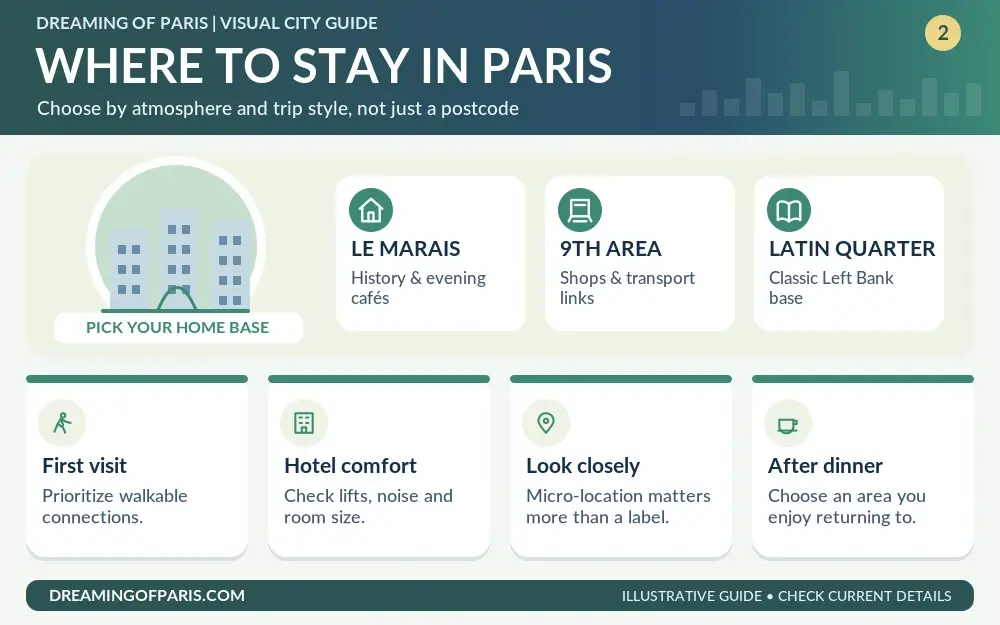
Choosing where to stay in Paris is not really about finding the “best arrondissement.” It is about finding the right compromise between atmosphere, transport, nightly noise, price and the parts of Paris you most want to experience. Two hotels in the same arrondissement can feel completely different if one is beside a busy station and the other is on a residential street fifteen minutes uphill.
For a short visit, I would prioritize three things: a metro station you will actually use, a pleasant evening radius around the hotel, and no daily dependence on a single awkward connection. Paris is compact on a map but not frictionless. Long station corridors, stairs and transfers can turn a cheap hotel on the edge of the city into a false economy if every day begins with forty minutes of transport.
Quick comparison: the areas most visitors should consider
| Area | Best for | Main advantage | Trade-off |
|---|---|---|---|
| 1st–2nd | Very short first trips | Walk to major sights | High prices, less residential feel |
| Marais (3rd–4th) | Couples, design, history | Atmosphere day and night | Busy streets, variable room size |
| Latin Quarter (5th) | First-timers, families | Central Left Bank base | Touristy pockets |
| Saint-Germain (6th) | Classic Paris, couples | Beautiful and very walkable | Premium pricing |
| 7th | Eiffel Tower priority | Elegant, quiet, landmark access | Can feel sleepy at night |
| 9th | Balanced city break | Transport, food, Montmartre access | Some busy commercial streets |
| 10th–11th | Food, nightlife, local rhythm | Energy and restaurants | Street feel changes block by block |
| Montmartre (18th) | Romance, repeat visitors | Village atmosphere and views | Hills and tourist congestion |
| 14th–15th | Families, longer stays | Residential, often better value | Less instant postcard Paris |
1st arrondissement: unbeatable convenience, but you pay for it
If you want to walk out of the hotel and reach the Louvre, Tuileries, Palais-Royal and the Seine almost immediately, the 1st is difficult to beat. It is especially practical for a first trip of two or three nights, when centrality has real value. Châtelet-Les Halles also creates many transport options, though the station itself is large enough to be confusing if you expected a simple two-platform metro stop.
The trade-off is price and atmosphere. Parts of the 1st become quiet after shops and offices close, and a room facing a major street can feel very different from one tucked into a side street. If your fantasy is “Paris outside my window,” check the exact street rather than assuming the arrondissement label guarantees charm.
2nd arrondissement: central without living directly beside a monument
The 2nd is one of my favorite practical compromises for a first trip. You can walk to the Louvre, Palais-Royal, Opéra and many covered passages, yet some streets feel more like working Paris than a museum district. The Montorgueil area has food shops and pedestrian energy; the western side places you close to the historic arcades. If rainy-weather exploration appeals to you, our covered passages route starts naturally from this part of the city.
The Marais: historic streets, strong evening atmosphere, little need to commute for dinner
The Marais, spanning much of the 3rd and 4th arrondissements, works well for travelers who value the neighborhood itself as much as monuments. Place des Vosges, hôtels particuliers, museums, boutiques and café-lined streets create a dense day-to-night environment. It also puts you within walking range of the Seine, Île Saint-Louis and central Right Bank.
The weakness is not location; it is intensity. Weekends can be extremely busy and some streets remain lively late. Room sizes in historic buildings can be small, and elevators are not guaranteed in older properties. If silence matters, read reviews specifically for street noise and interior soundproofing rather than only overall hotel ratings.
Latin Quarter: the easiest Left Bank base for many first-time visitors
The 5th arrondissement offers one of the most versatile locations in the city. You can walk to Notre-Dame, the Seine, Panthéon, Jardin du Luxembourg and parts of Saint-Germain. The area also has enough cafés, bakeries and casual restaurants that you do not have to plan every meal in advance.
Do not judge the entire Latin Quarter by the most touristy lanes close to Saint-Michel. A few blocks uphill, the atmosphere changes. Around rue Mouffetard, Place Monge and the Panthéon, you can still be central without having souvenir menus under every window. Families often appreciate the proximity to gardens and straightforward access to major sights; see our Paris with kids guide for realistic family pacing.
Saint-Germain-des-Prés: the classic Left Bank dream, at a premium
If your idea of Paris is cafés, galleries, elegant streets, bookshops and evening walks back from the Seine, the 6th delivers. It is excellent for couples and short city breaks because the neighborhood itself is part of the experience. The Luxembourg Garden sits close by, and the Louvre is reachable on foot across the river.
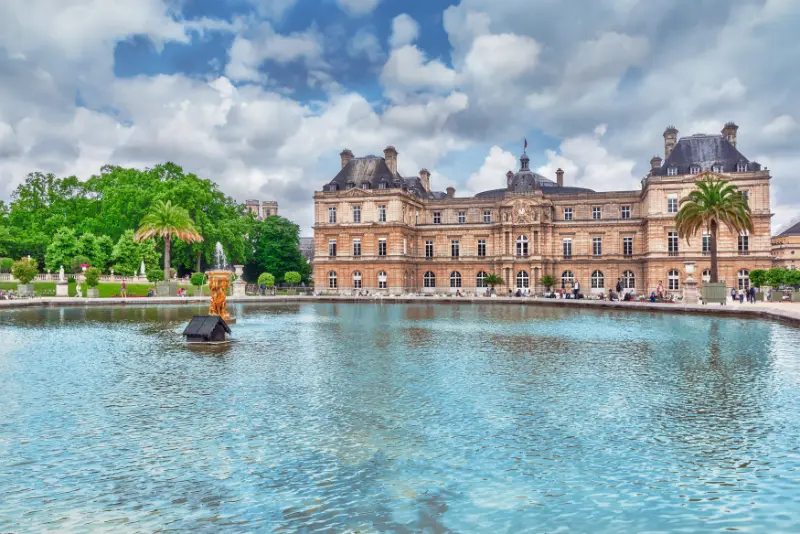
The obvious drawback is cost. “Saint-Germain” is also used loosely in hotel marketing, so check the map. A property may use the name while sitting farther south or west than you expect. This is not necessarily bad, but the exact walk to the river or your preferred metro line matters more than the branding.
7th arrondissement: stay here for the Eiffel Tower, not because it is automatically the best first base
The 7th is elegant, calm and visually unmistakable. For travelers who dream of early or late walks around the Eiffel Tower, Champ de Mars and Invalides, it can be perfect. It is also useful for families or couples who prefer quiet evenings to nightlife.
However, the 7th is not the geometric center of everything visitors do. Depending on the hotel, reaching the Marais, Montmartre or eastern Paris can take more time than you expect. Some streets have limited late-night dining compared with the 5th, 9th, 10th or 11th. Stay here because you want this specific part of Paris, not simply because the Eiffel Tower is famous. Before booking the landmark visit itself, read our Eiffel Tower planning guide.
9th arrondissement: one of the strongest all-round choices
The 9th is often overlooked by travelers searching only for the Louvre, Eiffel Tower or “Saint-Germain” on a hotel map. That is a mistake. Around Opéra, Grands Boulevards, rue des Martyrs and the lower slopes toward Pigalle, you get useful transport, restaurants, theaters, shopping and quick access to both central Paris and Montmartre.
The neighborhood changes significantly from south to north. Near Opéra it feels grand and commercial; farther north it becomes more intimate and food-oriented. For a four- or five-day trip, this variety can be an advantage because your evening radius is large enough to keep discovering new streets without taking transport.
10th arrondissement: Canal Saint-Martin charm, but inspect the micro-location
The Canal Saint-Martin side of the 10th has a relaxed, contemporary atmosphere with waterside walks, independent shops, cafés and bars. It suits repeat visitors and travelers who want to feel part of a lived-in neighborhood rather than sleep beside a landmark. Our Canal Saint-Martin to Belleville route shows why this part of Paris deserves more than an evening detour.
The 10th also contains Gare du Nord and Gare de l’Est, major transport hubs whose immediate surroundings are busier and less postcard-like. That can be practical if you have an early train, but a “10th arrondissement hotel” tells you too little. Look at the actual street, station entrance and route you will use at night.
11th arrondissement: restaurants, nightlife and a more local base
The 11th is strong for food-focused travelers, groups of friends and visitors who prefer lively evenings. Bastille, Oberkampf and streets east of the Marais give you many dining choices without forcing a return to the tourist center for every meal. Metro connections are generally good, but the arrondissement is large enough that line access varies.
This is not the place to choose if your highest priority is opening the curtains onto a famous monument. It is a good choice if you want Paris to continue after 7 p.m. when many sightseeing areas begin to empty.
Montmartre: magical when you choose the right side of the hill
Montmartre is one of Paris’s most atmospheric neighborhoods, but staying directly beside Sacré-Cœur is not the only option. The streets around Abbesses and Lamarck-Caulaincourt can feel more residential than the busiest tourist axis. Hills are the practical issue: a hotel that looks “five minutes away” on a map may involve steep streets or stairs.

If mobility is a concern, inspect elevation as well as distance. If the hills do not bother you, early mornings are a major reward: you can see streets that become crowded later almost empty. Our Montmartre walking route is built around that quieter version of the hill.
14th and 15th arrondissements: sensible choices for families and longer stays
These large residential areas can offer better room value, neighborhood markets and a more normal daily rhythm. They are particularly useful when you need a larger room, apartment-style accommodation or less nightlife noise. The 14th gives access to Montparnasse and southern Paris; the 15th can work well for the Eiffel Tower and convention areas depending on the exact location.
The trade-off is psychological as much as geographic: you will not step outside into the most cinematic Paris every morning. But with a good metro line, the extra distance can be modest. For a week-long trip, saving money on accommodation while gaining neighborhood bakeries and supermarkets can improve the overall experience.
Areas near major stations: convenience can be worth it, but do not book blindly
Gare du Nord, Gare de l’Est, Gare de Lyon and Montparnasse can be excellent logistical bases if your trip includes trains. The immediate station environment is often noisier and busier than residential streets a few blocks away. If you are arriving late, proximity may matter more than charm on the first night. If you are staying five nights, you may prefer a hotel one or two metro stops away with a better evening atmosphere.
How to evaluate a Paris hotel on a map
- Check the nearest metro entrance, not just the station name. Large stations can have entrances several blocks apart.
- Look at your likely return route at night. A direct line from your evening neighborhoods can be more valuable than being 500 meters closer to a monument.
- Inspect street noise. Bars, bus corridors, schools and delivery streets all create different sound patterns.
- Verify elevator and air-conditioning details. Historic buildings do not always offer what a modern hotel tower would.
- Read the newest reviews for construction. Paris constantly renovates streets and buildings; a perfect location can temporarily be noisy.
Which area for a first four-day trip?
If you want maximum simplicity, look first at the 1st, 2nd, 5th, 6th, Marais or 9th. Then compare actual hotel prices and transport rather than deciding the neighborhood before seeing your options. A strong hotel in the 9th beside two useful lines can be a better base than a mediocre property in the 1st that consumes your budget.
Which area for families?
The Latin Quarter, parts of the 6th, 14th and 15th can work particularly well, but family suitability is more about the building and street than the arrondissement. You may value an elevator, larger room, nearby supermarket and quiet night more than a fashionable address. Also consider how easy it is to return for an afternoon break; children often enjoy Paris more when every day is not eight uninterrupted hours outside.
Which area for a romantic trip?
Saint-Germain, the Marais and Montmartre are obvious choices because the neighborhood itself creates evening atmosphere. But romance is subjective. A quiet hotel near the Canal Saint-Martin or a room overlooking a side street in the 9th may feel more personal than a famous address surrounded by tour groups.
Final rule: choose the neighborhood you want to come home to
Tourists spend a surprising amount of time near their accommodation: breakfast, late dinner, a quick drink, the walk back after the metro closes or simply an hour when plans change. That is why the best Paris base is not necessarily the one closest to the most attractions. It is the one that makes the beginning and end of every day easy.
If this is your first visit, pair your hotel decision with our four-day first-time Paris itinerary and 2026 public transport guide. Once you see where your days naturally cluster, the right accommodation area becomes much easier to recognize.
Arrival and practical planning
Once you have chosen an area, compare CDG, Orly and Beauvais and use our Paris shopping guide if shopping location is part of your hotel decision.
Use neighborhood guides before choosing a hotel
The arrondissement number alone does not tell you how a stay will feel. Compare the central historic atmosphere of Le Marais, the Left Bank around the Latin Quarter and Saint-Germain-des-Prés, and quieter residential options such as Batignolles or Passy and Auteuil. For restaurants and nightlife, also compare the 11th/Oberkampf.
Once you know the area that suits the trip, you can compare Paris accommodation on Booking.com. Check the exact map location and nearest Metro/RER stop rather than relying only on a hotel name that says “central Paris.”