
Disclosure: This article contains affiliate links or booking widgets. If you book through them, Dreaming of Paris may earn a commission at no extra cost to you. How our affiliate links work.
Paris with a baby or toddler is not a smaller version of an adult itinerary. The distances, stairs, meal timing, naps and need for open space change what “efficient sightseeing” means. A day with two excellent experiences and a calm nap can be far more successful than a famous six-stop itinerary that leaves everyone exhausted.
Paris is genuinely workable with very young children, but the city rewards families who plan around neighborhoods rather than attractions. The Metro has many stairs, old buildings are not uniformly stroller-friendly, and restaurant schedules do not always match toddler routines. None of those are reasons to avoid Paris; they are reasons to build a different rhythm.
The biggest decision: stroller, carrier or both?
A lightweight stroller is useful for long walks, naps and parks, but Metro stairs can be frustrating. A carrier is easier on stairs and inside crowded sites, but becomes tiring during a full walking day. Families who have the option often do best with a compact stroller plus a soft carrier for difficult sections.
Do not choose equipment for Paris that your child has never used. Familiar sleep and comfort matter more than having the theoretically perfect travel stroller.
Metro reality with a stroller
Paris Metro accessibility is uneven. Some stations and newer lines are easier, while many older stations involve stairs, narrow passages and crowded transfers. Buses can be more stroller-friendly for certain journeys, and walking may be faster than making a two-line Metro transfer with a sleeping child.
Our Paris public transport guide explains current fares and airport tickets. For toddler trips, add one extra rule: minimize transfers even if the route is a few minutes longer.
Build days around one anchor, not a checklist
Choose one main activity for the morning, one flexible neighborhood or park for the afternoon, and let meals/naps determine the exact order. A timed Eiffel Tower visit plus Louvre plus Seine cruise may look efficient on a map but gives a toddler no recovery space.
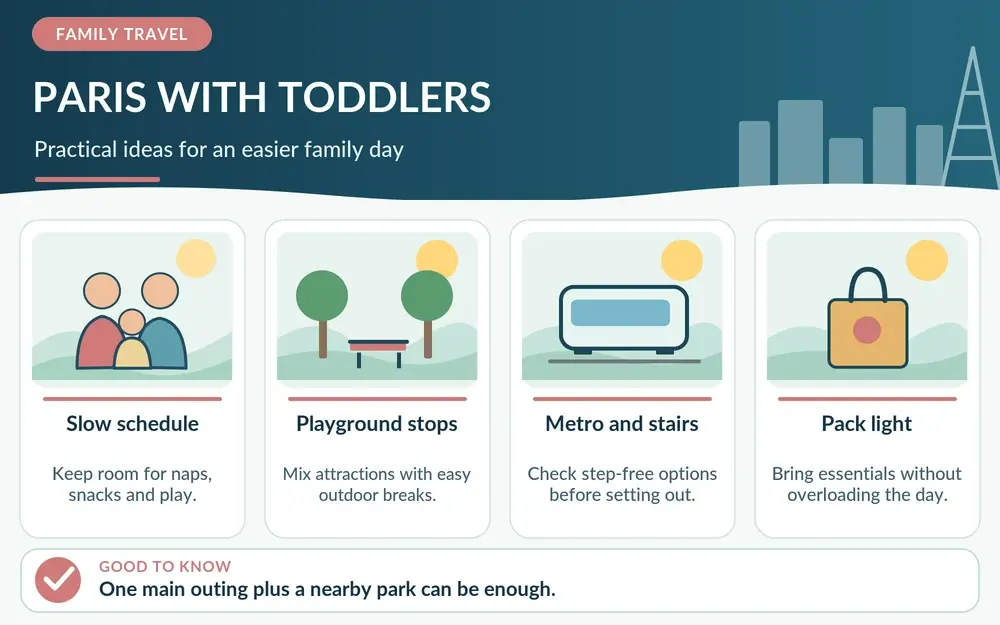
A better example is Luxembourg Gardens in the morning, lunch on the Left Bank, nap during a stroller walk, and one short museum or river activity later. Flexibility is not wasted time; it is what keeps the day functioning.
Best outdoor resets for very young children
Luxembourg Gardens, Jardin des Plantes, parts of the Tuileries, Parc Monceau, Bois de Vincennes and neighborhood squares can all provide the open-space reset that toddlers need. The value is not “seeing a park”; it is giving the child time to move without being told to stay beside a museum display.
Use our Luxembourg Gardens guide and Bois de Vincennes guide for two very different options.
Indoor activities that work better than adult museums
Cité des Sciences has a dedicated Cité des enfants program including a 2–6 age range, making it far more developmentally appropriate than dragging a toddler through a major painting collection. Aquariums, child-focused workshops and story spaces can also rescue a rainy day.
Our Cité des Sciences with kids guide explains how to use timed sessions without overloading the rest of the day.
Jardin d’Acclimatation for active toddlers and preschoolers
The Jardin d’Acclimatation is particularly useful when children need rides and play rather than cultural interpretation. Not every attraction suits every height or age, but the overall environment gives families a child-first half-day in western Paris.
Read our Jardin d’Acclimatation family guide and check age/height rules before travel.
Restaurants, high chairs and early meals
Paris restaurants vary widely in space and equipment. Do not assume every small bistro has a high chair, changing table or room for an open stroller. For important meals, contact the restaurant directly and reserve earlier than the classic late dinner period.
Lunch is often easier than dinner with toddlers. Bakeries, markets and casual cafés also provide flexible options when a child’s hunger does not align with your reservation. Our Paris restaurant etiquette guide explains service, tap water and meal customs for adults.
Diapers, changing and toilets: plan before the emergency
Carry a compact changing kit and do not rely on finding a dedicated changing table in every café or historic attraction. Major museums, department stores and family venues are generally better bets for facilities than tiny independent restaurants or old monuments.
The practical strategy is to use reliable “base points” during the day: a museum with family facilities, a department store, your hotel or a known family attraction. That reduces the stress of searching at the last minute.
Where to stay with a baby or toddler
The best area is usually the one that reduces daily transfers. Saint-Germain/Latin Quarter can work well for central walking; the Marais offers compact sightseeing but can be busy; the 15th and parts of the 16th can provide a more residential rhythm. The perfect arrondissement is less important than elevator access, room layout and proximity to useful transport.
Compare hotels for your stay in Paris
Check current availability, location and prices before choosing the exact neighborhood.
Check Paris hotels on Booking.comAffiliate link: we may earn a commission at no extra cost to you.
Use our where to stay in Paris guide and verify whether the hotel elevator actually reaches your floor and can fit your stroller.
Bookable family activities: when they help
A short cruise, family-oriented tour or timed child activity can give structure to the day, but avoid stacking reservations. The widget below can surface current family experiences; choose one that matches your child’s age and nap rhythm rather than the most famous product.
For babies and toddlers, cancellation flexibility and duration matter as much as the attraction itself. A 60-minute activity with easy exit is often more valuable than a three-hour tour.
A realistic sample day
Start around 9:30 with an outdoor garden or neighborhood walk while energy is high. Have an early lunch around noon, then use the stroller nap for a scenic walk or adult café stop. Choose one indoor family activity in mid-afternoon, return to the hotel for a reset, and keep dinner close to your accommodation.
The principle is deliberately simple: one adult priority, one child priority, and enough empty space for real life. That is how Paris remains enjoyable instead of becoming a logistics exercise.
Official family resources
Paris je t’aime maintains current family information, including a dedicated 2026 page for babies and toddlers and updated family-outing suggestions. Use those resources to check workshops and age-specific events close to your travel dates.
For children beyond toddler age, continue with our broader Paris with kids guide and Paris with teenagers guide.
Airport transfers with very young children
The cheapest transfer is not automatically the best after a long flight. Consider luggage, car-seat needs, stair-heavy rail connections and arrival time. Our CDG and Orly transfer guides compare public transport and regulated taxi options; families should add the cost of stress and carrying equipment to the calculation.
Nap strategy by neighborhood
A stroller nap is easiest when the next adult activity is outdoors or flexible: Seine walk, covered passages, a park edge or café terrace. It is hardest when the next activity requires security, folding the stroller or waking the child. Build nap windows into geography instead of hoping they occur between timed tickets.
A final planning rule
A useful final test for Paris with toddlers is whether the visit improves the day around it. Paris itineraries become weaker when every famous name is treated as mandatory. Check opening hours, place the visit beside nearby sights, leave time for security and walking, and keep one flexible block in the half-day. That small amount of margin is what protects the plan when queues, weather or energy levels differ from expectations. If a ticket is timed, arrive early enough to find the correct entrance without turning the previous activity into a race. If admission is free or flexible, use that flexibility rather than creating an artificial deadline. The goal is not to maximize the number of doors you enter; it is to remember what you saw and still enjoy the streets between attractions.
Museums with a sleeping toddler
A sleeping child can create an unexpected museum window, but only if the venue allows the stroller through the relevant galleries and security process. Do not assume this. Large museums may require route changes, lifts or stroller restrictions in certain spaces. If the nap is fragile, use it for a river walk, covered passage or neighborhood route instead. Save the museum for a time when waking the child will not ruin the next two hours.
What “family-friendly hotel” should actually mean
Ignore vague marketing labels and ask practical questions: Is there a lift from street level to the room? Will the stroller fit? Is a cot guaranteed or merely “on request”? Can breakfast be taken early? Is there a supermarket, bakery or pharmacy within a few minutes? Are rooms separated enough that adults can stay awake after the child sleeps? These details matter far more than a hotel adding a teddy bear to its website. Location and room function are the real family amenities.
Frequently asked questions
Is Paris stroller-friendly?
It is workable but uneven. Streets and parks are generally manageable, while many older Metro stations have stairs and some historic venues have limited access.
Should I bring a stroller or carrier?
A compact stroller plus a carrier is the most flexible combination if your child is comfortable with both.
What is the best Paris activity for toddlers?
There is no single best choice, but gardens, Cité des enfants, child-focused workshops and Jardin d’Acclimatation are stronger than long adult museum visits.
How many attractions should we plan each day?
Usually one main timed attraction plus flexible neighborhood or park time is enough for a successful toddler day.
Toilet planning with young children
For street sanisettes, museums, stations and changing-day strategy, see our public toilets in Paris guide.