Disclosure: This article contains affiliate links or booking widgets. If you book through them, Dreaming of Paris may earn a commission at no extra cost to you. How our affiliate links work.
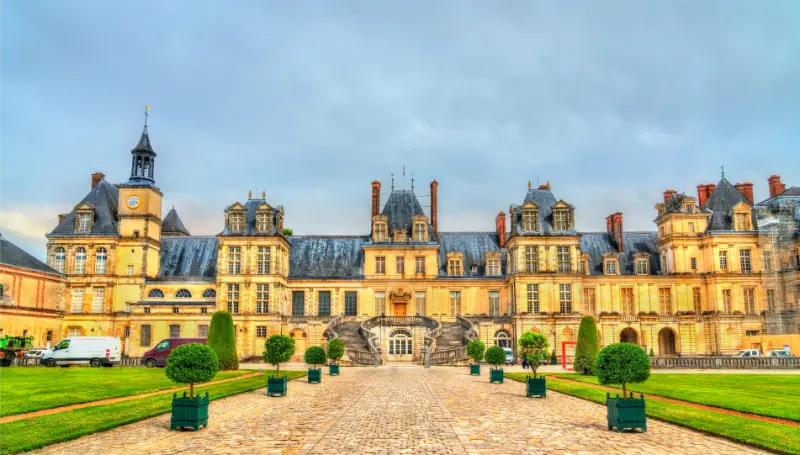
Fontainebleau is one of the best Paris day trips for visitors who want royal history without repeating Versailles. The château has a much longer and more layered story, while the surrounding town and forest let you build a day that is not entirely about gilded rooms. It is especially good for a second visit to Paris, for architecture lovers, and for travelers who want a palace day with more flexibility.
Check tickets and Paris experiences
Compare current tours, timed-entry tickets and experiences before fixing your itinerary.
GetYourGuideTiqetsCivitatisViatorAffiliate links: we may earn a commission at no extra cost to you.
Why Fontainebleau feels different from Versailles
Versailles is inseparable from Louis XIV and the theatrical scale of court life. Fontainebleau evolved across centuries and reigns, with Renaissance decoration, imperial associations and rooms altered by successive rulers. The result feels less like one monumental statement and more like a physical timeline. If you have already visited Versailles, Fontainebleau adds rather than duplicates.
Getting there from Paris
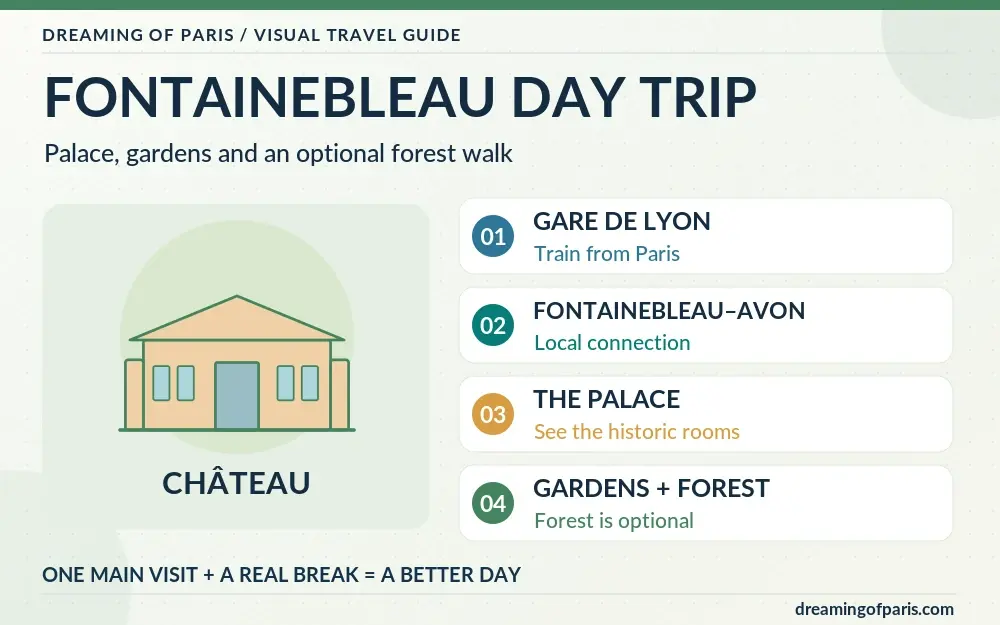
The standard public-transport pattern is a train from Paris Gare de Lyon toward Fontainebleau-Avon, followed by local transport to the château. The station is not at the palace gates, so the last connection matters. Check the official route planner on the day, especially on weekends when engineering work can alter rail patterns.
How much time to give the château
For a first visit, allow at least two to three hours inside if you enjoy history and decorative interiors. Fontainebleau rewards attention to sequences of rooms rather than sprinting to a single “must-see” hall. The François I Gallery, ceremonial apartments, chapel spaces and Napoleonic rooms create different historical layers; reading a little before you go makes the chronology much easier to follow.
Do not skip the gardens just because Versailles has bigger ones
Fontainebleau’s outdoor spaces are part of the palace story but do not require the same endurance as Versailles. Depending on your route, you can use the gardens as a visual break between interior sections or as the bridge toward lunch in town. In good weather, this creates a more balanced day than spending five straight hours indoors.
Add the forest only if you genuinely want it
The Forest of Fontainebleau is enormous and deserves respect as its own destination. You do not need a serious hike to say you “did” Fontainebleau. If you want a forest component, choose a clearly defined, accessible route and leave enough daylight. If the palace is your main interest, a shorter walk near town is more sensible than adding a complicated trail just because the forest is famous.
Fontainebleau with children
Children who struggle with long palace interiors often benefit from a simple mission: choose the strangest room, look for royal symbols, compare beds or find details linked to Napoleon. Break the interior visit with outdoor time. The day is generally easier when you do not attach a long forest hike to an already substantial château visit.
Lunch strategy
Fontainebleau is a real town, so you are not confined to palace catering. This is an advantage over excursions where every visitor eats inside the same estate. A relaxed lunch in town can reset the day before gardens or a second walk. Check opening days for any specific restaurant you care about rather than assuming a famous address is open every day.
Fontainebleau or Versailles?
Choose Versailles for the iconic court of Louis XIV, Hall of Mirrors and enormous formal estate. Choose Fontainebleau for a deeper chronological mix, a palace-town relationship and the possibility of adding forest. If you have enough days, they complement one another. If not, use our day-trip comparison to choose based on interest rather than fame.
A realistic day plan
- Morning train from Gare de Lyon.
- Local connection from Fontainebleau-Avon to the château.
- Focused palace visit before lunch.
- Lunch in town.
- Gardens and courtyards.
- Optional short forest or town walk if weather and daylight allow.
- Return to Paris without a major evening reservation.
What to verify before leaving Paris
- The château’s opening day and any room closures.
- Train service to Fontainebleau-Avon.
- The last local connection you plan to use.
- Weather if you want the forest.
- Whether your chosen ticket or pass covers the rail journey under current rules.
Frequently asked questions
Can you visit Fontainebleau from Paris without a car?
Yes. The usual route combines a train from Gare de Lyon to Fontainebleau-Avon with a local bus or other last-mile connection to the château.
Is Fontainebleau better than Versailles?
They are different. Versailles emphasizes Louis XIV, court spectacle and scale; Fontainebleau covers more periods and can be paired with town and forest.
How long should I spend at Château de Fontainebleau?
Two to three hours inside is a useful first-visit baseline, plus time for gardens, lunch and transport.
Can I combine Fontainebleau and Vaux-le-Vicomte independently in one day?
It can be done with careful transport planning, but it creates a more complex day. For most first-time visitors, giving Fontainebleau itself enough time is more satisfying.
Is the forest necessary?
No. It is a separate attraction and should be added only if nature or hiking is part of your goal.
How this fits into our Day Trips from Paris cluster
This guide is designed to connect with the rest of the site rather than sit alone. Continue with Versailles, day-trip comparison and second-trip Paris ideas. Internal links are placed where the next decision naturally appears, so you can move from transport to neighborhood, attraction, season or day trip without rebuilding the plan from scratch.
The decision that matters most
Fontainebleau is strongest when you let it be its own destination. Do not visit it merely as a less-crowded substitute for Versailles. Its value is the accumulation of royal and imperial layers, plus the option to step back into a living town and forest landscape.
Where this day trip fits in a Paris itinerary
Fontainebleau from Paris: A Palace Day Trip That Is Not “Versailles Lite” works best when it replaces a full Paris sightseeing day rather than being squeezed between major city reservations. Put it after a lighter evening and avoid scheduling a high-effort Paris morning immediately after the return. The excursion should add contrast to the trip: gardens after museum days, a medieval town after Haussmann Paris, Champagne and cathedral architecture after several monument-heavy days, or Disney when family entertainment is a genuine priority.
Booking order that avoids timetable traps
Book the element with the least flexibility first: a timed palace entry, cellar tour, garden admission, park ticket or specific high-speed train. Only then choose the connecting transport around it. Leave margin between independent transport legs and reservations. A day trip can fail even when every individual booking is valid if the sequence assumes perfect connections. Keep one activity optional so a delayed train does not force you to rush through the attraction you traveled to see.
The lunch decision matters more than it seems
Decide whether lunch is part of the experience or simply fuel. If it matters, reserve somewhere that fits the route. If it does not, choose a flexible local option and protect the best sightseeing hours. Long formal lunches can be wonderful, but they change how many monuments or neighborhoods realistically fit afterward. Families should eat before everyone is hungry; adults on tasting-focused days should make food and hydration a non-negotiable part of the plan.
Weather backup without wasting the ticket
Check the forecast one or two days before travel and identify what remains worthwhile in bad weather. Palace interiors and city museums retain value in rain; gardens, viewpoints and forest walks change much more. In heat, move exposed outdoor portions earlier or later and use lunch or interiors at midday. If a ticket cannot be changed, adjust the order rather than abandoning the day.
Energy and footwear
A “day trip by train” can still mean 15,000–25,000 steps once stations, estates, old towns and gardens are included. Wear shoes for the walking surface, not for the train. Carry less than you would for an airport day and identify where you can sit. Travelers with children or reduced stamina should choose two priorities rather than trying to complete every included attraction simply because a pass makes them available.
Return-to-Paris strategy
Know the next two realistic return departures, not only one perfect train. This gives you the freedom to leave early if the weather turns or stay longer if the day is going well. Keep dinner back in Paris flexible unless the return timing is exceptionally reliable. Arriving hungry at 21:30 after a delayed excursion is easier to solve with a neighborhood meal than with a missed fixed reservation across town.
When to skip the excursion entirely
If your Paris visit is only three or four days and this excursion is not one of your strongest interests, staying in the city can be the better choice. Paris neighborhoods themselves provide enormous variety. Day trips are most valuable when they deepen a theme you care about or give a deliberate change of scenery, not when they are added because a list says you “must” leave Paris once.
How to protect the main reason for the excursion
Identify the one experience that would make the trip worthwhile even if something else went wrong: the palace rooms, Monet’s garden, one cellar tour, the medieval upper town, a Disney land or a specific exhibition. Put that experience in the safest part of the schedule and make secondary activities flexible around it. This prevents a day trip from becoming a chain of equal-priority tasks where one late train causes everything to fail. A strong excursion has one anchor, two supporting experiences and enough slack to enjoy the place rather than merely arrive there.
What to carry for a day outside Paris
Take less than you think: water, a small snack, weather protection, a charged phone, portable battery if needed, reservation confirmations and only the valuables you genuinely need. Heavy day bags become more annoying on station stairs and long estate walks. If the destination has no luggage storage, this matters even more. Families should add whatever prevents an avoidable crisis—small snacks, a simple activity for train time and a layer for temperature changes—without turning one adult into the group pack mule.
How to judge whether the day was worth it
Do not measure Fontainebleau from Paris by how many sub-attractions you completed. Ask whether the excursion gave you a different historical period, landscape, artistic context or family experience from Paris itself. If the answer is yes, leaving one museum room, garden corner or secondary stop unseen is not a failure. In fact, stopping before fatigue usually makes the return to Paris better and preserves the final evening. The point of a day trip is contrast and depth, not total coverage.
Compare Fontainebleau tours and day-trip options
The live options below are useful if you want a guided visit, reserved experience or packaged activity for this specific part of the trip. Compare the exact inclusions, meeting point, language and cancellation terms before booking.