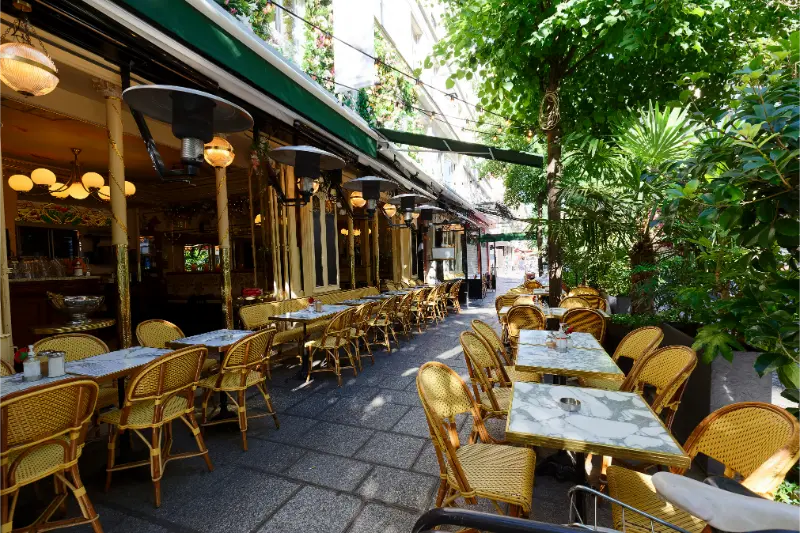
The point of a Paris café is not to complete a famous-address checklist. It is to understand how a small table can function as breakfast room, office, meeting place, neighborhood observatory and evening pause.
Quick planning summary
Why terrace culture feels different
Paris cafés are designed for staying. A drink can buy you time as well as liquid, especially outside peak meal periods. That does not mean every table is yours indefinitely during a packed lunch service, but it explains why sitting alone with a coffee and a book feels normal. The best way to enjoy the ritual is to stop treating the table as wasted sightseeing time.
Counter, room or terrace
Some establishments historically priced service differently depending on where you drank, although practice varies today. More important is the atmosphere: the counter is quick, the interior can be calmer, and the terrace is about street life. Choose based on what you want from the break. A cold windy terrace beside traffic is not more authentic than a warm room just because the chairs face the pavement.
Coffee vocabulary that is actually useful
An espresso is the default small coffee. An allongé is longer; a café crème or similar milk coffee is closer to what many visitors want in the morning. Exact naming varies by establishment, so do not turn vocabulary into a test. If milk quantity matters, clarify. Expect smaller cups than in many North American chains and remember that café culture is as much about the pause as the caffeine.
Breakfast at a café versus a bakery
A café breakfast buys a seat, service and time; a bakery breakfast usually buys better value and often better viennoiserie. Decide what you need. If you want to start slowly, people-watch and plan the day, a café earns its higher price. If you are heading to a timed museum entry, pick up a croissant and coffee near your route instead of paying for an experience you cannot enjoy.
Paying and asking for the bill
In many cafés you pay after ordering or at the end depending on the setup. If the server is managing a large terrace, catching attention may take patience. Ask for l’addition rather than assuming the bill will appear as soon as you finish. Card minimums are less common than they once were but small independent businesses can have their own practices. Carrying a little cash remains useful.
Smoking on terraces
Outdoor café terraces in Paris can be smoky, a detail many visitors underestimate. If smoke bothers you, inspect the neighboring tables before sitting or choose an indoor non-smoking area. A picturesque terrace loses its appeal quickly if you spend the break uncomfortable. This is one reason hidden courtyards, garden cafés and wider pavements can be better choices than the most famous corner tables.
Famous cafés versus neighborhood cafés
Historic cafés are worth visiting when their history matters to you, not because every coffee is objectively better there. In Saint-Germain-des-Prés, literary associations are part of the product. Elsewhere, a neighborhood café may offer a more ordinary and revealing slice of daily Paris. A strong itinerary can include one institution and several anonymous stops rather than trying to make every break iconic.
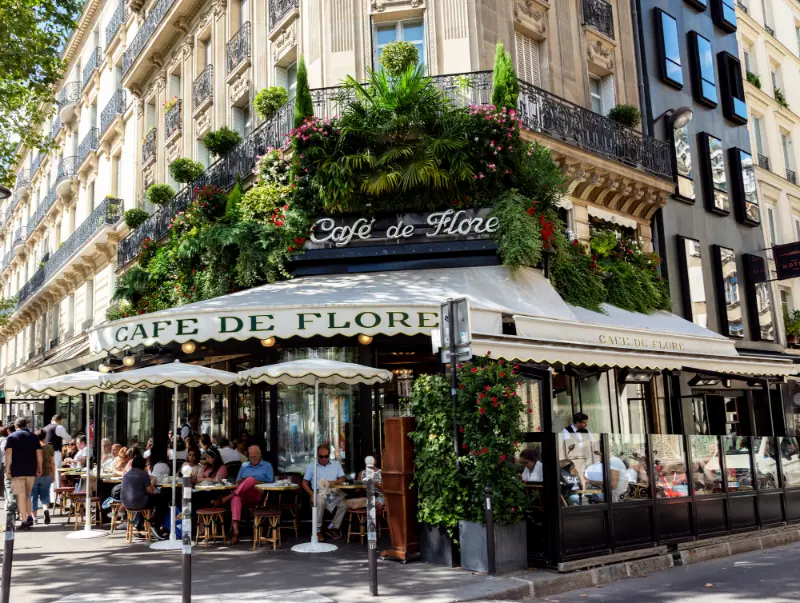
When cafés become bars
Many cafés shift naturally into aperitif mode in late afternoon. This is useful for travelers because you do not need a separate nightlife venue every evening. A glass, soft drink or small plate can bridge the gap between sightseeing and dinner. In Oberkampf, Canal Saint-Martin and Bastille, that transition can lead into a much livelier night; in quieter residential districts, it remains low-key.
Working from a café
Laptop culture exists, but not every café welcomes a computer occupying a prime table for hours. Read the room. Large modern cafés are often better suited to work; tiny traditional places may rely on quick turnover at lunch. If you need to work, order regularly, avoid the busiest meal period and choose a table that does not block larger groups.
The useful café test
A café is worthwhile when it improves the rhythm of the neighborhood around it. Sit where you would otherwise rush. Use the stop to review the next two hours, watch the street and notice details you miss while walking. That is a more Parisian use of the café than collecting famous names.
How this article fits into the Dreaming of Paris cluster
For a deeper plan, continue with Eating in Paris, Saint-Germain-des-Prés, Canal Saint-Martin, Montmartre. These guides are linked because they share geography or a real planning decision, not simply because they mention Paris.
Official information
For the details most likely to change, use the Paris je t’aime terrace guide. Recheck it shortly before the visit rather than relying on a screenshot saved weeks earlier.
Practical checklist before you leave the hotel
- Recheck opening hours, closures or transport work.
- Save the exact entrance or meeting point, not only the attraction name.
- Carry water and keep enough phone battery for navigation.
- Know one nearby alternative in case the main plan changes.
- Allow more time if you have luggage, children or reduced mobility.
- Avoid scheduling another major timed attraction immediately afterward.
Do I have to tip in Paris cafés?
Service is included; a small extra tip is optional for good service rather than mandatory.
Can I sit for a long time with one coffee?
Often yes outside busy meal periods, but use judgment when tables are in demand.
Are Paris terraces non-smoking?
Many outdoor terraces permit smoking, so choose seating carefully if smoke bothers you.
Is breakfast better in a café or bakery?
A bakery is usually better value for pastry; a café is better when you want a seat, service and time.
Final planning advice
The best way to use this guide to Paris cafe culture is to place it inside a coherent day rather than treat it as an isolated checklist item. Paris becomes easier when every reservation has a reason, every journey has a nearby second purpose and at least one part of the day remains flexible. That approach protects you from queues, weather changes and simple fatigue while leaving space for the unplanned café, street or view that often becomes the strongest memory.
Terrace, counter or table: the seat changes the experience
Paris café culture is partly about understanding what kind of stop you are making. A quick espresso at the counter, a coffee at an indoor table and an hour on a terrace are different uses of the same business. Choose the seat that matches your time. If you need Wi‑Fi, a power outlet and two hours of laptop work, a traditional café during lunch service may be the wrong setting; if you want to watch the street for forty minutes, the terrace is exactly the point.
Prices can differ by service format in some establishments, and busy cafés may expect tables to turn at meal times. You do not need to rush a drink simply because you are a tourist, but you should read the room: occupying a four-person table with one coffee through the lunch peak is different from lingering at 3 p.m. when half the terrace is empty.
Ordering without turning it into a language test
A greeting matters more than perfect French. Start with bonjour or bonsoir, order simply and ask questions if the menu is unclear. “Un café” normally means an espresso-style coffee, not a large filter coffee. If you want milk, specify the drink. Tap water with a meal can be requested as a carafe; bottled mineral water is a different order.
Use cafés as pauses between nearby sights. Saint-Germain, the Marais, Montmartre and Montparnasse each produce a different street-watching experience, but no famous café is mandatory. Our Eating in Paris guide covers meal etiquette in more detail; this article is about the smaller ritual of stopping, ordering and letting the city continue around you.
A practical decision check for Paris Café Culture
Cafés are most enjoyable when you choose them for a pause, not because a list says a particular terrace is mandatory. Before you give it a fixed slot, compare that reason with the strongest alternative already on your itinerary. If the alternative matters more, move this stop to an optional block instead of forcing both into the same half-day. That simple choice keeps the article useful for different travelers rather than implying that every reader needs the same Paris.
A realistic way to fit it into the day
Use a quick morning coffee, a longer mid-afternoon terrace stop and perhaps one historic café you genuinely care about. Those are three different experiences. Keep the previous and following stops close enough that a delay of twenty or thirty minutes does not create a cascade of missed reservations. Paris days become much easier when the route can absorb a longer lunch, a queue or a weather change without requiring a taxi across the city.
The trade-off worth making explicit
The trade-off is location versus price. Famous corners can cost more for a view and history; neighborhood cafés often offer a more ordinary rhythm. Making that trade-off deliberately is more useful than adding another item to a checklist. Ask what you would remove if this experience takes longer than expected; if the answer is “nothing,” the day is probably already too full.
Small details that prevent avoidable problems
At busy meal times, the same table may be intended for diners. Ask before setting up a laptop or occupying a large table with one drink. Save the exact address or entrance you intend to use, keep enough phone battery for the return route and recheck any time-sensitive information on the official site. These are small steps, but they protect the part of the experience that actually matters from being swallowed by logistics.
Where it belongs in the wider Paris cluster
Café culture fits naturally with Saint-Germain, Montparnasse, Montmartre and the Marais. Pair the stop with a neighborhood rather than traveling solely for coffee. Treat that pairing as a geographic or thematic cluster, not an obligation to complete everything. One strong connection is enough to make the day coherent; two or three distant add-ons usually reduce the value of the place you came to see.
Food to pair with café culture
For mornings, continue with the Paris breakfast guide; for a more substantial all-day meal, compare the Paris brasserie guide and the city’s classic foods in what to eat in Paris.