Literary Paris becomes much more interesting when you stop treating writers as plaques to collect. The city has layers of publishing, bookselling, cafés, universities and residential history that extend far beyond a handful of famous addresses. A strong literary day mixes one or two historical associations with places where books are still sold, read and discussed now.
Start where books are still part of the street
The Latin Quarter remains the obvious starting point because universities, specialist bookshops and the Seine’s bouquinistes create an active book geography. The famous storefronts are photogenic, but the morning becomes more interesting if you also browse and notice which subjects cluster around different streets.
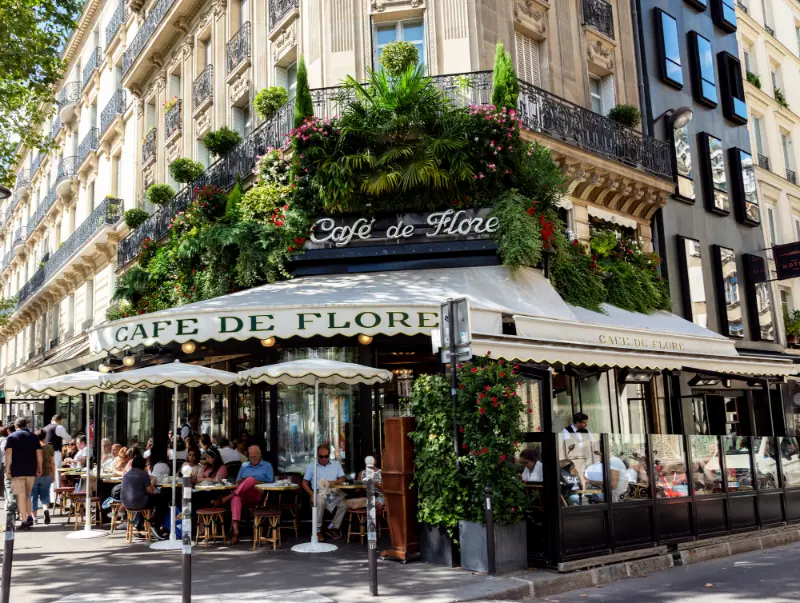
Saint-Germain and the mythology of café culture
Saint-Germain’s literary reputation is real but heavily packaged. The useful approach is to understand the cafés as part of a broader network of publishers, intellectual life and postwar mythology, then walk surrounding streets rather than treating one expensive coffee as historical reenactment.
Libraries and quiet reading spaces
Public libraries and cultural institutions show that literary Paris is not only commercial. Access rules differ, and many reading rooms are working spaces rather than tourist attractions. If you visit, the atmosphere is closer to a working reading space than to a conventional tourist attraction.
The bouquinistes as working booksellers
The green boxes along the Seine form a distinctive bookselling tradition. Inventory varies from old books and prints to more tourist-oriented material. The pleasure is in browsing without expecting every box to contain a rare discovery.
Follow a writer selectively
Choose one author connected to Paris and build two or three stops around that person’s actual geography instead of trying to cover centuries in one day. The result is more coherent and gives context to neighborhoods that would otherwise be only names.
Buy a book for the trip
One of the simplest ways to make the theme meaningful is to buy a book in Paris and read part of it there: in a garden, café or hotel. It turns literary tourism from retrospective sightseeing into a present activity.
Useful connections on Dreaming of Paris
Use our Latin Quarter walk and Saint-Germain-des-Prés guide as the geographic backbone.
Is Shakespeare and Company the only literary bookshop worth seeing?
No. It is famous and historically significant in its modern form, but Paris has many independent and specialist bookshops. Treat it as one stop, not the entire theme.
Are the Seine bouquinistes open every day?
Individual sellers keep their own rhythms and weather affects opening, so do not plan around a guarantee that every box will be open.
Can literary Paris work for non-French speakers?
Yes. International bookshops, translated literature and the physical geography of publishing and writers make the theme accessible even if you do not read French fluently.
A final planning note
A literary itinerary should leave you wanting to read, not simply proving that you stood where someone famous once sat. Let bookshops, streets and one carefully chosen writer give the day its structure.
For literary Paris, one more practical point is worth keeping in mind. Timed entry solves only part of the crowd problem. Security, cloakroom restrictions, stairs and the natural bottlenecks around famous works still shape the experience. Arriving prepared for those small frictions is more useful than searching for a mythical completely empty hour. Use this as a decision rule rather than a rigid instruction: the best version of the day is the one that keeps the route coherent and leaves enough energy for the place itself.
For literary Paris, one more practical point is worth keeping in mind. Do not judge value only by visit duration. Some of Paris’s strongest cultural sites are compact. A focused ninety minutes with enough attention is often more rewarding than extending a visit simply because a ticket cost money. Use this as a decision rule rather than a rigid instruction: the best version of the day is the one that keeps the route coherent and leaves enough energy for the place itself.
For literary Paris, one more practical point is worth keeping in mind. A museum or monument is more memorable when it is connected to the streets around it. Before or after the visit, spend twenty minutes in the immediate neighborhood: the change in scale, materials and street pattern often explains more than another room of labels. Use this as a decision rule rather than a rigid instruction: the best version of the day is the one that keeps the route coherent and leaves enough energy for the place itself.
Build a literary route around one question
“Literary Paris” becomes vague very quickly because almost every central neighborhood can claim writers, publishers or famous cafés. A stronger walk begins with one question: do you want bookshops that still function as bookshops, the geography of one writer, the history of publishing, or places where you can actually sit and read? Choosing one thread prevents the day from becoming a list of plaques with no connection between them.
For bookshops, combine one famous stop with at least one ordinary independent shop. Browse long enough to see what the store actually specializes in. If you buy a book, consider a bilingual edition, a short work set in Paris or a title you can read during the trip. That turns the purchase into part of the journey rather than a souvenir with a logo.
Use cafés carefully
The literary reputation of Saint-Germain is real, but the famous cafés are also businesses in a contemporary neighborhood. Visit because you want to sit there, not because a historical association guarantees an “authentic” experience. A coffee at a lesser-known café followed by a walk through the streets connected to publishing can feel more literary than waiting for a particular terrace table.
The bouquinistes along the Seine work best as a slow browsing stop between Île de la Cité and Saint-Germain. Opening is weather- and vendor-dependent, so do not build an itinerary around every box being open. If you want a quieter reading interval, use a garden or public library that welcomes visitors rather than trying to read in the middle of a busy tourist corridor.
For geographical context, connect this article with the Latin Quarter and Saint-Germain-des-Prés. The best literary itinerary is selective: one neighborhood, one author or theme, one bookshop purchase and enough unstructured time to read a few pages somewhere that is not famous at all.
A practical decision check for Literary Paris Without the Clichés
Literary Paris is strongest when you choose a theme—bookshops, one writer, publishing, cafés or reading spaces. Without a theme, the route becomes a collection of plaques. Before you give it a fixed slot, compare that reason with the strongest alternative already on your itinerary. If the alternative matters more, move this stop to an optional block instead of forcing both into the same half-day. That simple choice keeps the article useful for different travelers rather than implying that every reader needs the same Paris.
A realistic way to fit it into the day
Start with one bookshop, walk a historically relevant neighborhood, stop somewhere you can actually read, then end with a second bookshop or café. Three meaningful stops are enough. Keep the previous and following stops close enough that a delay of twenty or thirty minutes does not create a cascade of missed reservations. Paris days become much easier when the route can absorb a longer lunch, a queue or a weather change without requiring a taxi across the city.
The trade-off worth making explicit
The trade-off is mythology versus present-day culture. Famous cafés preserve stories, while ordinary bookshops show what people are reading now. A good route includes both layers. Making that trade-off deliberately is more useful than adding another item to a checklist. Ask what you would remove if this experience takes longer than expected; if the answer is “nothing,” the day is probably already too full.
Small details that prevent avoidable problems
If following a writer, verify addresses and dates before the trip; many buildings have changed use or disappeared. Treat plaques as context, not proof that the interior is visitable. Save the exact address or entrance you intend to use, keep enough phone battery for the return route and recheck any time-sensitive information on the official site. These are small steps, but they protect the part of the experience that actually matters from being swallowed by logistics.
Where it belongs in the wider Paris cluster
Latin Quarter and Saint-Germain are the strongest first cluster. Add the Seine bouquinistes as a connector, but keep Montparnasse for a separate writer-and-artists route. Treat that pairing as a geographic or thematic cluster, not an obligation to complete everything. One strong connection is enough to make the day coherent; two or three distant add-ons usually reduce the value of the place you came to see.
Make one reading stop part of the route
Instead of photographing a bookshop and leaving, buy or bring something short and spend twenty minutes reading in a nearby garden or café. The act changes the pace of the day and connects the literary theme to something you are actually doing. It also gives you a useful filter for souvenir purchases: a book you start in Paris is more personal than a generic literary tote bag.