Disclosure: This article contains affiliate links or booking widgets. If you book through them, Dreaming of Paris may earn a commission at no extra cost to you. How our affiliate links work.
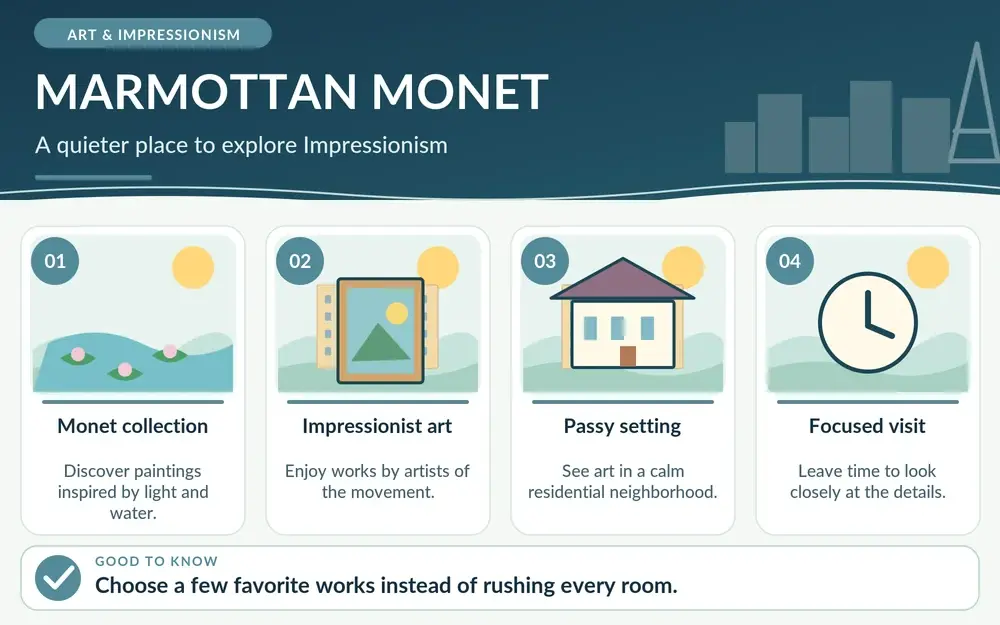
Musée Marmottan Monet is the Paris museum to prioritize when Monet matters more to you than checking off the biggest institutions. Tucked into the 16th arrondissement near the edge of the Bois de Boulogne, it holds the world’s largest collection of works by Claude Monet, along with an important Berthe Morisot collection and other art accumulated through major bequests.
Check tickets and Paris experiences
Compare current tours, timed-entry tickets and experiences before fixing your itinerary.
GetYourGuideTiqetsCivitatisViatorAffiliate links: we may earn a commission at no extra cost to you.
Its location is less convenient than Orsay or Orangerie, which is exactly why many first-time visitors miss it. For an Impressionism-focused trip, however, the extra Metro ride can be more rewarding than adding another general museum.
Why Marmottan is different from Orsay and Orangerie
Orsay gives the broad panorama of nineteenth-century and early modern art. Orangerie gives you Monet’s monumental Water Lilies in an immersive architectural setting. Marmottan gives you depth: a larger concentration of Monet, including works that help trace changes in his technique and subject matter.
The museums are complementary. If you only have one Paris museum afternoon, choose according to your priority. If you love Monet specifically, Marmottan deserves to move much higher on the list than generic “top ten” rankings suggest.
Opening hours and Thursday late night
The museum currently opens Tuesday to Sunday from 10 a.m. to 6 p.m., with last admission at 5 p.m. Thursday has a late opening until 9 p.m., with later last admission. Monday is closed under the regular schedule.
The Thursday evening can be particularly useful because the museum is outside the central tourist axis. Spend daylight walking Passy or the Bois de Boulogne area, then use the late opening for art when other neighborhood activities are winding down.
How much time do you need?
Allow around 90 minutes for a focused visit and two hours if Monet and Morisot are major interests. The museum is more manageable than the Louvre or Orsay, but that does not mean it should be rushed. Its strength is close looking rather than scale.
If a major temporary exhibition is running, add time and consider booking. Temporary shows can materially change visitor flow in a museum whose spaces are more intimate than the giant national institutions.
The Monet collection: what makes it worth the trip
Marmottan’s Monet holdings came largely through the bequest of Michel Monet, the artist’s son. The collection includes works from different periods and allows visitors to see how the artist repeatedly returned to light, atmosphere, water and serial observation.
Rather than hunting only for the famous title on your checklist, look for changes in surface, brushwork and color across rooms. The value of a concentrated collection is comparison: you can notice development more easily than when one artist is dispersed through a vast museum.
Berthe Morisot: do not treat her rooms as an appendix
Marmottan also holds an exceptional group of works connected to Berthe Morisot. Visitors who arrive only for Monet often discover that this becomes one of the museum’s strongest surprises. Build enough time into the visit to see her work as a major part of the collection, not a corridor on the way out.
If you are building an Impressionism itinerary, this creates a richer story than simply repeating Monet at three museums.
Marmottan + Giverny: the current double-ticket logic
The museum currently offers a combined ticket with the Fondation Monet at Giverny. This can be useful if both are definitely in your trip, although you should still plan the visits on separate half-days or days because Giverny requires travel outside Paris.
Read our Giverny day-trip guide before buying around a fixed schedule. The garden is seasonal and transport timing matters more than saving a small amount on admissions.
Marmottan + Passy/Auteuil
The museum sits in a part of Paris that many visitors otherwise ignore. Pair it with our Passy and Auteuil walking guide for residential streets, architecture and a different rhythm from the central arrondissements.
This is an especially good second-trip day: one specialist museum plus a neighborhood that feels more local than the Seine-side monument circuit.
Tours and current exhibition tickets
A guided experience is most useful if you want an art-historical thread connecting Monet, Morisot and Impressionism across Paris. If you simply want the permanent collection, the museum is easy to visit independently. The widget below can surface current Impressionism and Monet experiences for comparison.
Always compare third-party offers with the official museum ticket and confirm whether a product includes museum admission, Giverny transport, or only a city walking component.
Official information
Use the official Musée Marmottan Monet website for current hours and exhibitions. The museum also publishes timed online tickets and a Thursday late-night schedule.
For autumn 2026, the institution has announced a major landscape exhibition beginning September 24. If you are traveling around an exhibition changeover, verify gallery access before choosing your day.
Museum Pass caveat
Do not assume a specialist private museum is covered by the same passes as national monuments. Check the official Paris Museum Pass list before calculating value. Marmottan’s own ticketing and any Giverny combination may be more relevant for a Monet-focused itinerary.
Why Thursday can improve a packed itinerary
Late opening shifts art into a time when gardens and neighborhood shopping are less useful. On a short trip, that lets you use daylight for Passy, the Bois de Boulogne or an outdoor route, then visit the museum after the busiest sightseeing hours.
A final planning rule
A useful final test for Musée Marmottan Monet is whether the visit improves the day around it. Paris itineraries become weaker when every famous name is treated as mandatory. Check opening hours, place the visit beside nearby sights, leave time for security and walking, and keep one flexible block in the half-day. That small amount of margin is what protects the plan when queues, weather or energy levels differ from expectations. If a ticket is timed, arrive early enough to find the correct entrance without turning the previous activity into a race. If admission is free or flexible, use that flexibility rather than creating an artificial deadline. The goal is not to maximize the number of doors you enter; it is to remember what you saw and still enjoy the streets between attractions.
A three-museum Monet strategy
If Monet is central to your Paris trip, think of Orsay, Orangerie and Marmottan as three different chapters. Orsay places him among the Impressionists and the broader nineteenth century. Orangerie is about scale and immersion through the Water Lilies. Marmottan offers concentration and biographical depth. Visiting all three on consecutive days is unnecessary for most people, but spreading them across the trip can create a coherent art theme. Add Giverny only if you also want landscape and the artist’s home environment, not simply another Monet label.
Why the 16th-arrondissement setting matters
Marmottan does not sit in the dense tourist core, and that can be an advantage. The surrounding streets give you a calmer transition into and out of the museum. Instead of racing back to the center, walk toward Passy, Ranelagh or Auteuil and notice how western Paris differs from the Marais or Latin Quarter. Specialist museums become more rewarding when the neighborhood around them is allowed to shape the day.
Day-of-visit check
Before leaving the hotel, recheck the official website for the day rather than relying on a screenshot saved weeks earlier. Paris institutions can change rooms, access routes, security rules or opening times for events. Keep the reservation email accessible offline, arrive with only the bags you need, and know the nearest alternative activity in the same neighborhood. This small preparation is especially useful during strikes, exceptional closures or exhibition changeovers. It also protects your internal itinerary: if one venue changes, you can remain in the same district instead of losing an hour crossing the city.
A realistic Impressionism day without museum fatigue
If you want an art-focused day, do not automatically schedule Marmottan and Orsay back-to-back. A better sequence is Marmottan in the morning, lunch and a neighborhood walk in Passy, then one lighter cultural stop or viewpoint later. Save Orsay for another day when you can approach its much broader collection with fresh attention. If your trip is very short and you must combine museums, pair Marmottan with Orangerie rather than Orsay: the second visit is more compact and the Water Lilies create a distinct experience. The objective is contrast. Seeing more Monet does not always mean understanding more Monet; spacing the museums gives you time to compare memory, scale and atmosphere instead of letting one set of canvases blur into the next.
Keep the itinerary flexible
For Musée Marmottan Monet, one more practical habit improves the visit: decide in advance what would make you leave early. That might be crowding, a tired child, a temporary gallery closure or simply discovering that another part of Paris interests you more. A travel plan should give permission to change course. Keep nearby alternatives saved, avoid non-refundable back-to-back bookings, and remember that walking the surrounding neighborhood is often part of the cultural experience. This approach is especially useful in Paris because major attractions sit inside districts that are worth exploring in their own right. A shorter, attentive visit followed by an unhurried walk is often more memorable than staying until every room has been covered.
Frequently asked questions
Does Marmottan have the largest Monet collection?
Yes, the museum describes its holdings as the world’s largest collection of works by Claude Monet.
Is Musée Marmottan Monet open on Monday?
No, the regular schedule is Tuesday to Sunday.
Is there a late opening?
Yes. Thursday currently extends to 9 p.m.
Should I visit Marmottan or Orangerie?
Choose Marmottan for depth across Monet’s work; choose Orangerie for the monumental Water Lilies environment. Art lovers should consider both.