Disclosure: This article contains affiliate links or booking widgets. If you book through them, Dreaming of Paris may earn a commission at no extra cost to you. How our affiliate links work.
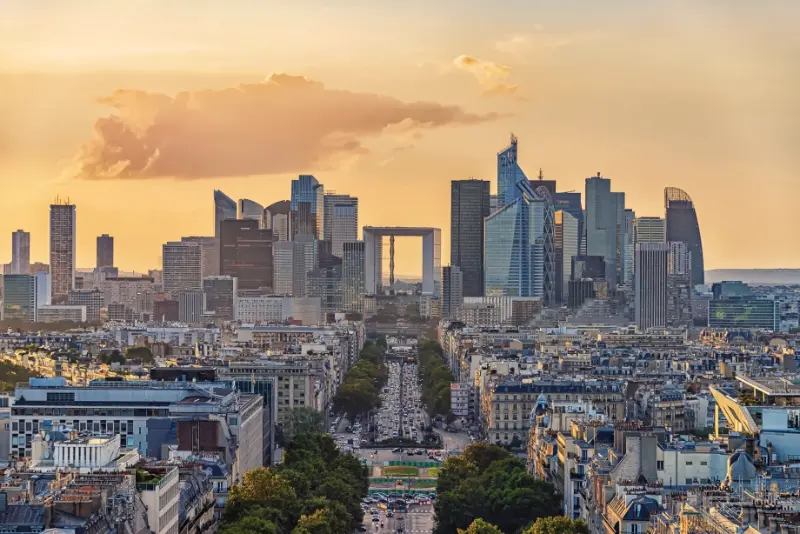
La Défense is one of the clearest ways to see that Paris is not only Haussmann façades and limestone monuments. The business district sits on the same historic axis that runs west from the Louvre through the Tuileries, Place de la Concorde and Arc de Triomphe, then continues toward the Grande Arche. That geometric relationship is the reason to visit—not shopping malls or office towers alone.
Check tickets and Paris experiences
Compare current tours, timed-entry tickets and experiences before fixing your itinerary.
GetYourGuideTiqetsCivitatisViatorAffiliate links: we may earn a commission at no extra cost to you.
The district is technically outside the City of Paris, but it is minutes from the center by RER A or Metro Line 1. For architecture, urbanism and photography travelers, it can be a much more distinctive half-day than another checklist attraction.
What makes La Défense worth a visit
| Reason | Why it matters |
|---|---|
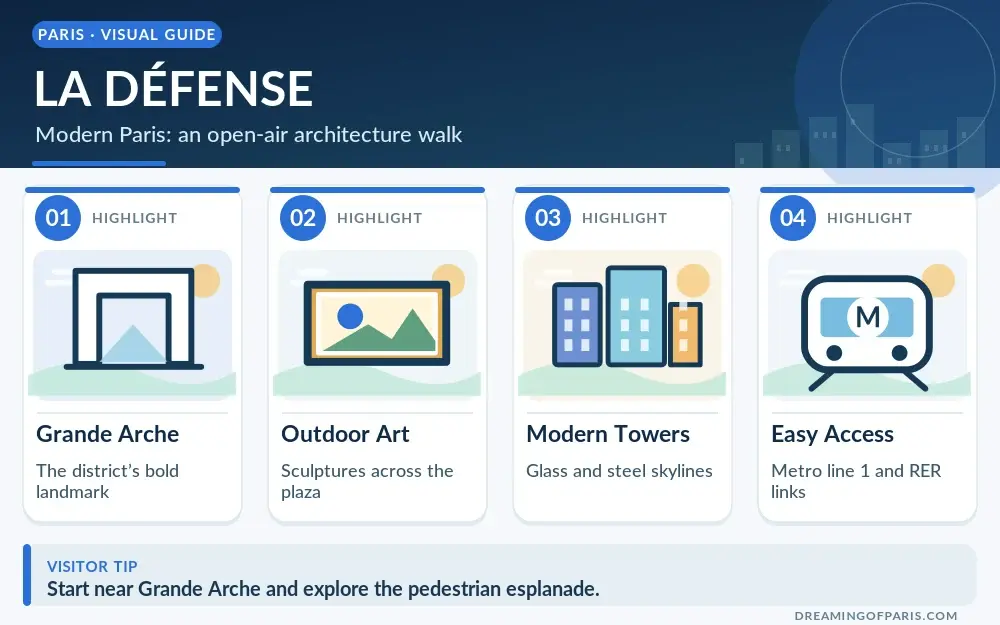
| Grande Arche | A 110 m open-cube landmark completed in 1989 on the historic axis |
| Public art | More than 60 contemporary works displayed outdoors and free to see |
| Architecture | Multiple generations of French and international office-tower design |
| Pedestrian space | A huge deck separating much pedestrian movement from roads below |
| 2026 change | Major landscape works are transforming the central esplanade toward a 5-hectare park planned in phases through 2028 |
Start with the historic axis, not the mall
Stand on the central esplanade and look east. The visual relationship with the Arc de Triomphe explains La Défense better than any brochure. The Grande Arche was conceived as a modern terminus or “window” on this long urban perspective. If you visit the Arc de Triomphe on another day, remember that you are seeing the same axis from the opposite direction.
The Grande Arche: architecture first
The Grande Arche was inaugurated in 1989, the bicentenary year of the French Revolution. Johan Otto von Spreckelsen won the design competition; Paul Andreu later oversaw completion after Spreckelsen left the project. The structure reads as a monumental open cube, roughly 110 m high, but its slight rotation and engineering respond to the dense infrastructure under the site.
Do not build your day around the assumption that every historical rooftop attraction described in an old blog post is operating exactly as before. Access arrangements at the Arche have changed over time. Treat the exterior, axis and surrounding architecture as the guaranteed experience and verify any interior/rooftop offer on the official district site before traveling.
Use the public art collection as your route
Paris La Défense describes the district as an open-air museum with more than 60 monumental works. This is the best way to prevent the walk from becoming “tower, tower, tower.” Search for pieces associated with artists such as Alexander Calder, Joan Miró, Takis and César, and notice how sculpture is used to break up the enormous scale of the deck.
The official website lets you filter works by route and neighborhood. That makes La Défense unusually easy to self-guide: pick six works rather than trying to “see everything.” Official public-art collection map.
A 2-hour self-guided walk
- 1. Grande Arche: begin at the western end and understand the axis before walking east.
- 2. Parvis: use the open space to compare tower generations rather than focusing only on height.
- 3. Public art: choose a short official art route and let sculptures pull you away from the straight central line.
- 4. CNIT / Les 4 Temps area: note the contrast between the early CNIT structure and later commercial layers.
- 5. Eastward viewpoint: finish by looking back toward the Arc de Triomphe, especially near late afternoon when the axis becomes visually clearer.
2026: expect construction in the central landscape
The district is in the middle of a major landscape transformation. Paris La Défense’s “Park” project is converting parts of the esplanade into a 5-hectare green space, with western works running into early 2027, eastern works through 2027 and the central phase extending toward 2028. In summer and autumn 2026, some routes and views are therefore affected by construction.
This is not a reason to skip La Défense if you care about urbanism; in fact, the construction makes the district a live case study in how a 20th-century business center is being adapted for heat, biodiversity and pedestrian comfort. It is a reason to check the current works map before following an old walking route.
Photography: use scale and compression
A telephoto view east toward the Arc de Triomphe compresses the historic axis; a wider lens works for the Grande Arche and plaza scale. Reflections on glass towers change rapidly with cloud cover. Weekends can feel emptier and more architectural; weekdays show the district functioning as a workplace. Neither is “better”—they tell different stories.
Families and teenagers
Teenagers interested in architecture, photography or contemporary art may find La Défense more engaging than another church. Younger children often appreciate the open pedestrian space but may not care about the architectural narrative. Combine it with a specific objective—find five artworks, photograph reflections, compare the old axis with the new—rather than dragging children through an abstract urbanism lecture. See Paris with teenagers for more ideas.
How to combine La Défense with western Paris
A coherent sequence is Arc de Triomphe in the morning, then Metro Line 1 to La Défense, followed by the architecture walk. Alternatively, combine it with Fondation Louis Vuitton on a modern-architecture day, but allow transport time because the two sites are not adjacent despite both being west of central Paris.
Who should go
- Architecture and urban-planning travelers.
- Photographers who want a visual break from historic Paris.
- Repeat visitors looking for a sharply different landscape.
- Anyone interested in free contemporary public art.
Official information
Paris La Défense tourism information and current Park project.
Bottom line
La Défense is not “the part of Paris with skyscrapers.” It is the western continuation of a centuries-old urban axis, layered with late-20th-century monumental architecture, free public art and a major 2020s landscape redesign. Give it two focused hours and a theme—architecture, art or photography—and it becomes one of the most specific non-classic experiences in Greater Paris.
Frequently asked questions
Is La Défense actually Paris?
It is outside the municipal City of Paris, mainly in communes such as Puteaux and Courbevoie, but it is integrated into the metropolitan transport network and minutes from the center.
Do I need a ticket to see the public art?
No. The outdoor collection of more than 60 works is free to view.
How long should I stay?
Two hours is enough for a focused architecture-and-art loop; add more only if you plan shopping, a meal or a special event.
Use current construction as part of the story
The 2026 park works expose the engineering logic of the slab more clearly than a finished landscape will. Detours can be annoying, but they also reveal how soil, waterproofing, utilities and planted areas are being layered above transport infrastructure. If you care about cities, photograph the transition rather than editing every crane out of the frame.
A public-art route with specific works to look for
Instead of wandering until every tower blends together, pick named anchors from the district’s official collection. Alexander Calder’s large red sculpture, Joan Miró’s colorful figures, César’s monumental work and Takis’s kinetic/light-based interventions represent very different approaches to public art. The exact display environment can shift with construction, so use the current official art map rather than an old blog screenshot.
Why the pedestrian deck feels so strange
Much of La Défense separates pedestrian life from roads and transport infrastructure below. That produces the unusual experience of walking through a dense business district with vast car-free surfaces, abrupt level changes and towers apparently rising from one continuous platform. The current park project is partly an attempt to soften that hard mineral landscape with deeper planting, shade and ecological functions.
Weekday vs weekend is a real choice
Weekday: you see La Défense functioning—commuters, lunch crowds, office entrances and the contrast between monumental planning and daily work. Weekend: the esplanade can feel dramatically emptier, which is better for architecture photography and understanding scale. If your objective is “what is this district actually like?”, choose weekday. If the objective is clean urban compositions, choose weekend morning.
A sunset/blue-hour option without promising a rooftop
The western location and long sightline toward the historic axis can be excellent near sunset, but do not confuse the outdoor esplanade with an always-open observation deck. Access to the Grande Arche interior/roof has changed over time. Build your plan around public outdoor space and treat any ticketed interior viewpoint as a bonus only after verifying current official access.
How much time is enough?
Two hours is ideal for a first architecture-and-art walk. One hour works if you only want the Grande Arche, axis and a handful of artworks. Three hours makes sense if you are photographing seriously, eating there or studying the park works. More time is rarely necessary for a general visitor unless you add shopping or an event.
Final planning notes
Before you leave the hotel, check the attraction’s official page for the day’s opening status, temporary closures and the exact ticket attached to your time slot. Paris monuments can change room access for services, conservation, weather or events without making the entire site “closed.” Build one nearby alternative into the same neighborhood so a partial closure changes the order of your day rather than ruining it.
Keep the rest of the day geographically coherent. The biggest planning error is often not the attraction itself but the unnecessary cross-city transfer attached to it. One major timed visit, one nearby secondary sight and unstructured walking usually create a better day than three famous reservations in three different arrondissements. Use the internal links in this guide to build that local cluster before adding another ticket.
Malmaison nearby
After modern La Défense, you can continue west to Château de Malmaison for Joséphine and Napoleon in a much more intimate setting.