Disclosure: This article contains affiliate links or booking widgets. If you book through them, Dreaming of Paris may earn a commission at no extra cost to you. How our affiliate links work.
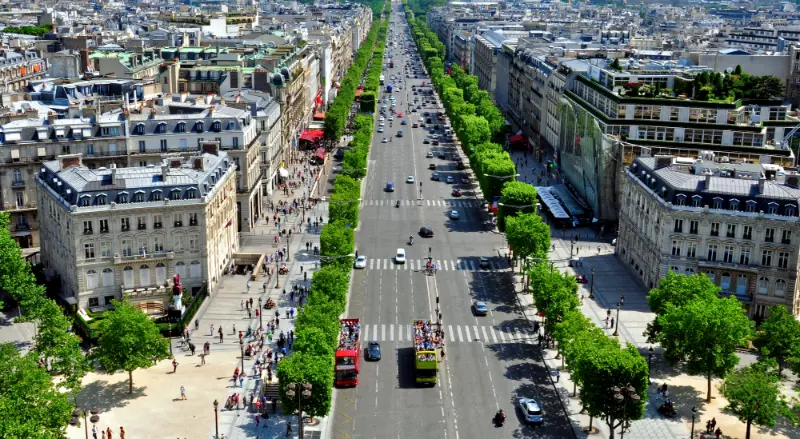
The Champs-Élysées is famous enough to disappoint people who arrive expecting every metre to feel cinematic. The avenue is 1.9 km long, but its personality changes sharply between the landscaped lower section near Place de la Concorde and the commercial upper section climbing toward the Arc de Triomphe. Treating it as one long shopping street misses the part that is actually most pleasant to walk.
Check tickets and Paris experiences
Compare current tours, timed-entry tickets and experiences before fixing your itinerary.
GetYourGuideTiqetsCivitatisViatorAffiliate links: we may earn a commission at no extra cost to you.
The useful way to visit is to choose a direction, understand what deserves a stop and give the Arc de Triomphe its own time rather than using the monument as a background prop. Paris je t’aime notes that the avenue receives roughly 300,000 visitors a day, which explains why crowd management matters as much as the list of sights.
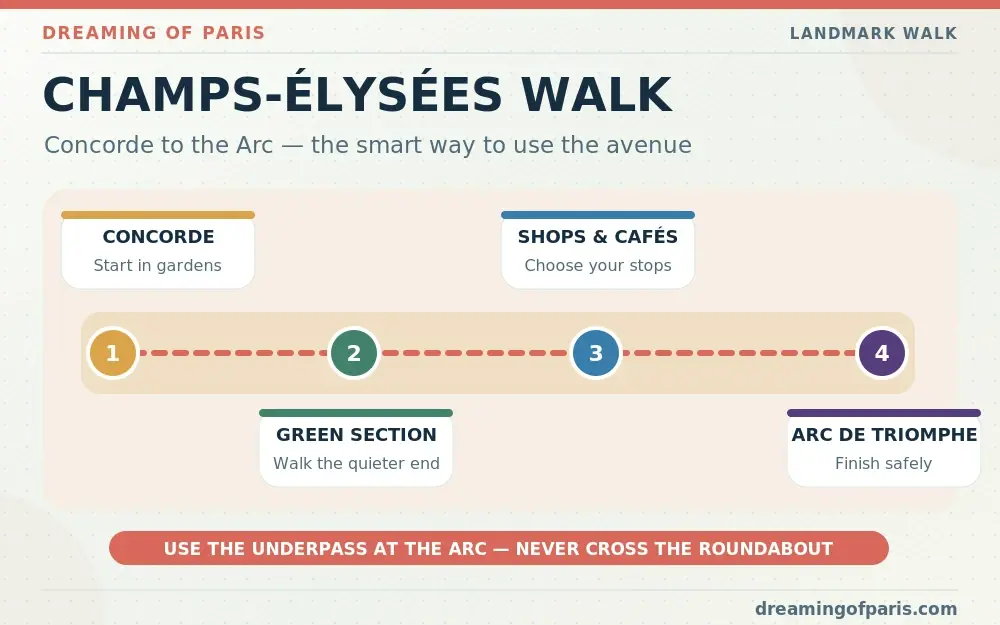
The route I recommend: Concorde to Étoile
Start at Place de la Concorde and walk west. This direction gives you the Arc de Triomphe as a visual anchor and lets the walk build from gardens to commercial spectacle. Before stepping onto the avenue, look back toward the Tuileries and the Louvre axis: the Champs-Élysées is part of a much longer east–west composition, not an isolated boulevard.
The first section crosses the Champs-Élysées gardens. This is where many visitors walk too fast. The green spaces, pavilions and cultural buildings around Grand Palais and Petit Palais make the lower avenue more varied than the flagship-store zone farther uphill. If you are already visiting the Petit Palais or Grand Palais, place that visit here rather than returning later.
Where the avenue becomes commercial
Around Rond-Point des Champs-Élysées the character changes. From here toward George V and Étoile you get global flagships, car showrooms, restaurants, cinemas and heavy foot traffic. This is the stretch that can feel generic if you simply move from brand to brand. The trick is to decide in advance whether shopping is part of your day. If it is not, walk the avenue for the urban scale, façades and views, then leave it without guilt.
If shopping is the goal, compare this area with the department-store experience in the Paris shopping guide. Galeries Lafayette/Printemps and the Champs serve different purposes: the former concentrate many brands and architecture under one roof, while the avenue is more about flagship presentation and street atmosphere.
Do not cross the traffic circle to reach the Arc
At Place Charles-de-Gaulle, use the underground pedestrian passage for the Arc de Triomphe. The multi-lane roundabout is not a normal street crossing. Once under the monument, decide whether you want only the tomb of the Unknown Soldier at ground level or the rooftop terrace as well. Every evening the flame at the tomb is rekindled, a ceremony that gives the monument a living commemorative role.
For the roof, use our Arc de Triomphe guide rather than improvising at the end of a long day. The terrace is especially good for understanding the geometry of the twelve radiating avenues and for looking back down the exact route you have just walked.
Morning, afternoon or evening?
Morning is best if you want cleaner photographs and a calmer lower avenue. Late afternoon works if the Arc rooftop is your sunset target. Evening is best for lights and atmosphere but weakest for appreciating the gardens. In winter, the avenue’s seasonal lighting can justify a second short pass after dark even if you walked it by day.
A concrete 2.5-hour version
- 0:00–0:20 — Place de la Concorde and the start of the gardens.
- 0:20–0:55 — Lower Champs-Élysées, with a detour toward Petit Palais/Grand Palais exteriors.
- 0:55–1:30 — Walk the commercial section, stopping only at stores you actually chose in advance.
- 1:30–1:45 — Use the underground passage at Étoile and see the memorial level.
- 1:45–2:30 — Arc de Triomphe rooftop if ticketed; otherwise continue into the quieter 8th/17th-arrondissement streets.
Specific events that change the experience
The Champs-Élysées is not an ordinary boulevard during major civic and sporting events. The 14 July military parade, the final stage of the Tour de France and large New Year gatherings can transform access, security and transport. If your visit coincides with one of these dates, do not assume the normal walking plan applies; check official city and transport notices before you set out.
Who will enjoy it most
First-time visitors should see the avenue because it connects several core monuments and explains Parisian urban scale. Repeat visitors who dislike flagship shopping can keep the walk short and concentrate on the gardens, Petit Palais and Arc terrace. Families may find the lower gardens easier than the crowded upper pavements; shoppers should allow far more time than the walking distance suggests.
Choose the avenue by purpose, not by distance
If you mainly want the urban axis, give the walk roughly 60–90 minutes from Concorde to Étoile and keep moving. If shopping is part of the plan, choose one or two stores in advance and allow two to three hours. For architecture and views, the strongest half-day combines the lower gardens and Grand/Petit Palais area with the Arc de Triomphe terrace rather than spending the entire block inside shops.
This distinction matters because the avenue is almost two experiences stitched together: a greener lower section around the gardens and a much more commercial upper section. A visitor who dislikes luxury retail can still enjoy the route by spending more time at the western edge of the Tuileries/Concorde axis and less time around flagship stores.
Where the Champs-Élysées loses value
The avenue becomes disappointing when it is treated as a restaurant recommendation in itself. A terrace can be useful when convenience or people-watching is the goal, but do not assume a famous address automatically means the best meal. If lunch quality matters more than the view, step into the surrounding streets before choosing.
Another common mistake is walking both directions just to say you completed the avenue. Use the Metro or a side-street return so the second half of your time adds something new.
Three logical endings to the walk
For monuments: finish at the Arc de Triomphe and go up only if the panoramic view is a priority. For a quieter contrast: continue toward Parc Monceau. For another iconic view: take the Metro toward Trocadéro instead of attempting a long surface walk across western Paris.
Frequently asked questions
How long is the Champs-Élysées?
The avenue runs for about 1.9 km between Place de la Concorde and Place Charles-de-Gaulle/Arc de Triomphe. Allow more than the walking time because crossings, gardens and stops slow the route.
Which direction is better?
For a first walk, Concorde to the Arc gives the clearest visual progression and ends with the strongest viewpoint.
Is the Champs-Élysées worth visiting if I do not shop?
Yes, but focus on the urban axis, gardens, monuments and Arc rather than spending hours in the commercial middle.
Can I combine it with the Eiffel Tower?
Yes, but not on foot as one continuous sightseeing line. Finish at the Arc and use Metro 6 toward Trocadéro if you want an Eiffel Tower view.
Where should I check current events and closures?
Use the official Paris tourism and city transport information, especially around 14 July, Tour de France weekend and New Year.
How the avenue fits the historic axis
Stand near the Arc and look east: the avenue aligns through Place de la Concorde toward the Tuileries and Louvre; look west and the line continues toward La Défense. This is one reason the rooftop of the Arc is more informative than a generic high viewpoint. You can read successive periods of Parisian power and planning in one line of sight.
If modern urbanism interests you, save La Défense for another half-day rather than continuing there immediately. The visual axis makes the connection obvious, but the pedestrian experience changes so completely that it deserves its own visit.
A shopping reality check
A flagship on the Champs can be useful for exclusive displays, late hours or simply seeing how a global brand presents itself in Paris. It is not automatically the cheapest or most “Parisian” place to buy something. For food gifts, independent shops and markets often offer more local context; for fashion breadth, department stores consolidate comparison. Go inside because a specific flagship interests you, not because the avenue’s fame implies every store is essential.
Three ways to use the avenue depending on your trip
First trip: walk it once from Concorde to the Arc and treat the rooftop as the payoff. Shopping trip: reverse the priority—make a short list of specific flagships and let the avenue connect them. Repeat trip: use only the lower gardens and cultural buildings, then peel away into the side streets of the 8th instead of repeating the retail corridor.
This distinction matters for SEO-style “best things to do” lists too: the Champs-Élysées is not one attraction with one correct duration. A visitor who wants Louis Vuitton, Guerlain or car showrooms may spend three hours in 500 metres; someone who wants the urban axis can understand it in 60–90 minutes. Plan by purpose, not fame.
Where the walk becomes quieter
The quickest way to escape the heaviest crowd is often to step one block off the avenue. Around the lower section, the gardens and side streets immediately change pace. Near the upper section, streets running toward Parc Monceau or the Golden Triangle offer a different feel. This is useful at lunch: five to ten minutes away from the central stream can change both atmosphere and menu choices.
A Champs-Élysées-specific planning check
- Start at Concorde if you want the avenue to build toward the Arc; reverse the direction if downhill walking matters more than the reveal.
- Check whether a parade, ceremony, road closure or large event changes access on your date.
- Decide before arrival whether shopping, architecture or the Arc viewpoint is the main purpose; that choice determines how much time you need.
- Use the pedestrian underpass for the Arc de Triomphe rather than trying to cross the traffic circle.
- Keep at least one side-street food option saved if you do not want to pay mainly for an avenue location.
The best version of this walk is selective: understand the historic axis, enjoy the parts that match your interests, and leave before the commercial repetition starts to dominate the day.