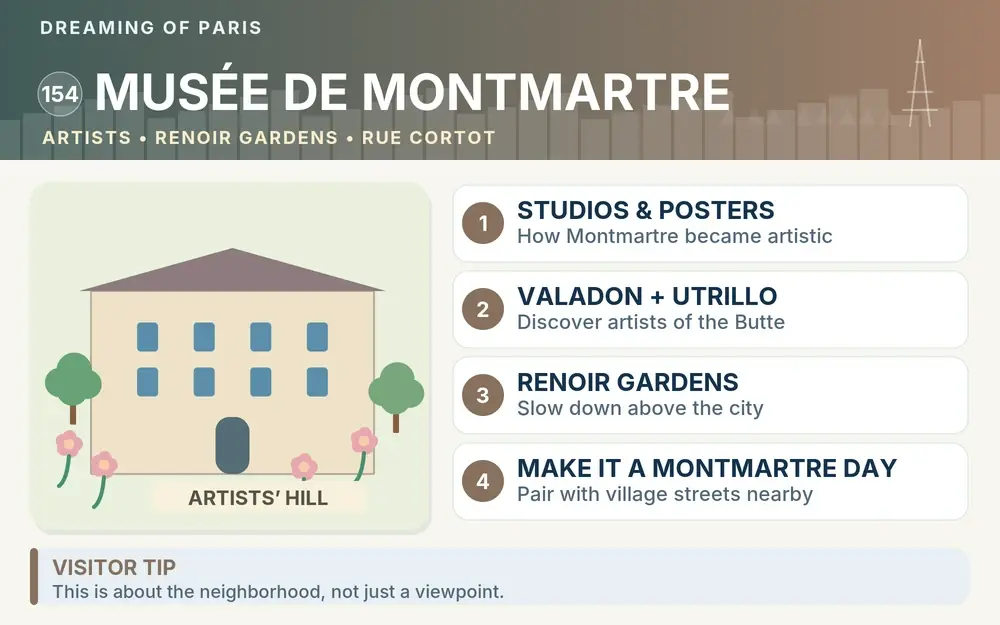
The Musée de Montmartre is one of the few attractions on the hill that actually explains why Montmartre became famous. Instead of giving you another viewpoint or postcard façade, it connects the neighborhood to the artists, cabarets, studios and social changes that created its mythology. The museum occupies historic buildings at 12 rue Cortot and includes gardens, period rooms, the reconstructed studio associated with Suzanne Valadon and Maurice Utrillo, temporary exhibitions and Café Renoir.
That combination makes it particularly valuable on a Montmartre day. The hill can become exhausting when you move only between Sacré-Cœur, Place du Tertre and crowded souvenir streets. The museum slows the pace and gives historical meaning to places that otherwise risk feeling like a themed backdrop.
Check tickets and Paris experiences
Compare current tours, timed-entry tickets and experiences before fixing your itinerary.
GetYourGuideTiqetsCivitatisViatorAffiliate links: we may earn a commission at no extra cost to you.
2026 opening hours, tickets and location
The Musée de Montmartre is at 12 rue Cortot, 75018 Paris. It is currently open every day from 10:00 to 19:00, with last admission 45 minutes before closing. During the exhibition period, the current full-price self-guided ticket is €16; outside an exhibition period, the museum lists a lower full rate of €14. Children under 10 are currently free, with separate reduced rates for several groups.
The museum also sells garden-only access at a lower rate when available, but a first-time visitor should normally choose the full museum because the story of Montmartre is the reason to come. There is no conventional luggage room, so do not arrive with suitcases. The nearest practical Metro options include Lamarck-Caulaincourt on line 12 and Anvers on line 2, although each creates a different uphill approach.
Why rue Cortot matters
The museum was created in 1960 in the Maison du Bel Air, one of the oldest buildings on the Butte. Artists lived or worked here, and the address is associated with names including Auguste Renoir, Suzanne Valadon, Maurice Utrillo, Émile Bernard and others. This is not a museum that was arbitrarily placed in Montmartre; the site itself belongs to the artistic history it interprets.
That authenticity changes the visit. Rooms, windows, gardens and the slope of the hill help you imagine how artists experienced this part of Paris before mass tourism. You do not need to romanticize poverty or bohemian life to understand why cheap rents, semi-rural edges, nightlife and a community of artists made Montmartre culturally important.
The permanent collection: posters, paintings and the history of the Butte
The permanent displays use paintings, drawings, posters and archival material to tell the story of Montmartre’s transformation. Pay attention to images of the hill before dense urban development. Windmills, quarries, gardens and village-like streets make clear that late-nineteenth-century Montmartre was physically and socially different from central Paris.
The cabaret material helps explain another side of the district. Places such as the Chat Noir were not just nightlife venues; they brought together performers, writers, illustrators and audiences in a culture where poster art and popular entertainment became part of modern visual life. This context makes the commercial Montmartre of today easier to read critically.
Suzanne Valadon and Maurice Utrillo
The studio linked to Suzanne Valadon and Maurice Utrillo is one of the most atmospheric parts of the museum. Valadon’s career is particularly compelling because she moved from working as an artists’ model to becoming a serious painter in her own right. Her story challenges the simplistic image of Montmartre as a place populated only by celebrated male geniuses.
The studio reconstruction works best if you have already looked at the collection rather than racing there for photographs. Notice the light, working surfaces and relationship to the surrounding buildings. An artist’s studio is useful not because it freezes a perfect historical moment but because it reminds you that art was produced through daily work in real rooms.
The Renoir Gardens
The gardens are a major reason to choose this museum in good weather. They are inspired by the environment Renoir knew when he worked on the site and offer a rare pause on a hill where public space can feel crowded. Views toward the Clos Montmartre vineyard and the northern side of Paris give the museum a strong sense of place.
Do not assume every garden area is always accessible. The museum occasionally announces partial or exceptional garden closures, and weather can affect the experience. If the gardens are the main reason for your visit, check the official site on the morning you go.
Café Renoir: worth planning around?
Café Renoir opens separately within the museum complex and can turn the visit into a longer break. It is particularly appealing when the garden terrace is comfortable, but treat café hours as independent from museum hours because they can change for events or operational reasons. If your itinerary depends on lunch here, verify the day’s schedule rather than assuming food service lasts until museum closing.
How long to spend
Allow 90 minutes to two hours for the museum and gardens, longer if you stop at the café or a temporary exhibition is especially relevant. This is not a giant museum, but its value comes from atmosphere and context. Rushing through in 40 minutes to “tick it off” defeats the reason to visit.
If you are doing a full Montmartre walking day, the museum makes a good midpoint. Use our 18th arrondissement guide to approach from the quieter northern side, then continue toward Sacré-Cœur and the busier summit afterward. This sequence often feels more natural than climbing straight from Anvers with the largest crowds.
Accessibility: an important limitation to understand
The museum states that temporary-exhibition spaces are accessible to people with reduced mobility by lift, but access to the permanent-collection building can be more difficult for wheelchair users because of paving, small steps and stairs. That distinction is important. “Accessible museum” is not a useful yes/no label when different buildings within the same site have different conditions.
If mobility is a concern, contact the museum before purchasing and ask which areas you can access on your date. Montmartre itself is steep, so the route to the museum matters as much as the building. Bus 40 can reduce the amount of climbing compared with some Metro approaches.
Is it good for a first trip to Montmartre?
Yes, especially if you want the neighborhood to be more than Sacré-Cœur and street portraits. The museum helps separate Montmartre’s actual artistic history from the tourist image that grew around it. After visiting, streets such as rue Cortot, rue des Saules and the lanes around the vineyard carry more meaning.
Travelers who have only one hour on the hill should not force the museum into an impossible schedule. But if Montmartre occupies half a day or more, it is one of the best paid attractions to add because it deepens the neighborhood rather than pulling you away from it.
A better Montmartre sequence
- Morning: arrive via Lamarck-Caulaincourt or a bus route that reduces the steepest climb.
- Late morning: visit the Musée de Montmartre while your attention is still fresh.
- Lunch or break: use Café Renoir if the setting appeals and current hours fit.
- Afternoon: continue toward Sacré-Cœur, then explore side streets rather than staying only around Place du Tertre.
- Evening: descend toward Abbesses or South Pigalle, where transport and dinner options are easier.
Compare bookable Montmartre experiences
If you also want a guided walk, food tour or evening show, avoid booking it immediately after the museum. Montmartre walking times are deceptive because hills, crowds and photo stops slow you down. Leave a buffer and confirm the meeting point carefully.
Official information
Use the official practical-information page for current hours, rates, garden notices and café updates. The 10:00–19:00 schedule and €16 exhibition-period full rate in this guide were checked against the museum’s September 2026 information.
Frequently asked questions
Is the museum the same as Sacré-Cœur?
No. It is a separate paid museum on rue Cortot, focused on the history and artists of Montmartre. Sacré-Cœur is a basilica on the summit of the hill.
Can I visit only the gardens?
The museum currently lists a garden-only ticket, but availability and access can vary. First-time visitors usually get more context from the full museum and studio route.
Is the museum good in bad weather?
Yes for the indoor collection, but the gardens are a substantial part of the experience. If heavy rain is forecast, consider whether another day would give you more value from the site.
Which Metro station is easiest?
Lamarck-Caulaincourt reduces some of the classic uphill tourist approach, while Anvers works well if you want to combine the museum with Sacré-Cœur and the funicular. The best station depends on your walking route.
Final planning advice
The Musée de Montmartre is most rewarding when you use it as the historical core of a neighborhood day. Give the collection time, sit in the gardens if they are open, and then return to the streets with a clearer sense of the hill’s artistic and social history. That turns Montmartre from a series of famous photo stops into a place you can actually interpret.
One more practical planning note
Montmartre is easier when you plan the direction of travel rather than a list of stops. Decide whether you want to finish at Sacré-Cœur, Abbesses or Pigalle, then place the museum near the middle of that route. Wear shoes suitable for cobbles and slopes, carry only a small bag because there is no normal luggage room, and reserve enough time for the gardens. If rain is intermittent, use the indoor rooms during the worst period and the gardens when it clears instead of abandoning the visit entirely.