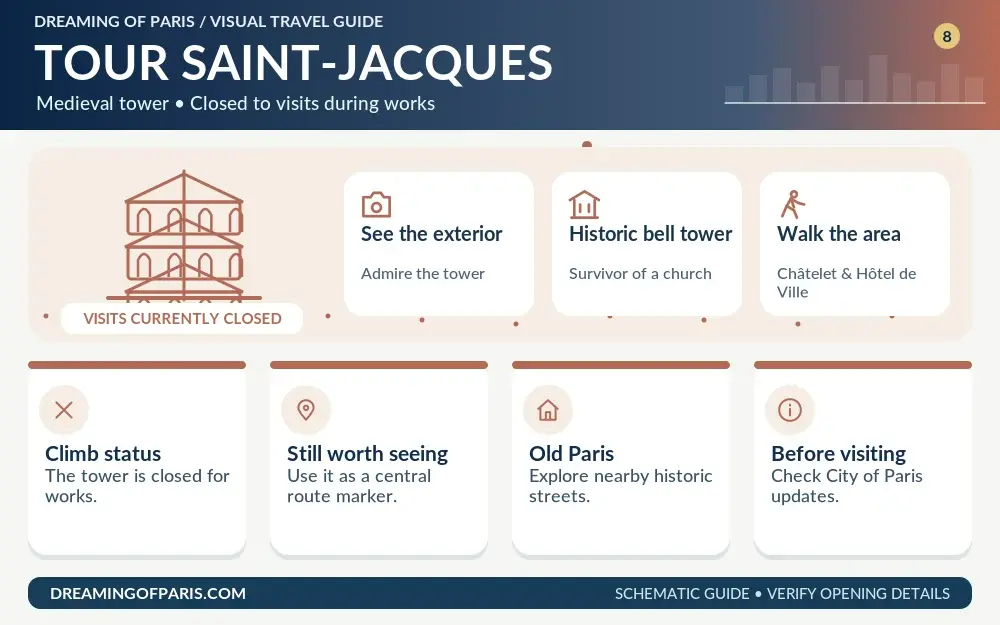
Tour Saint-Jacques is one of central Paris’s strangest landmarks: a flamboyant Gothic bell tower standing alone in a small public square, with no church attached. In normal years, limited guided visits have allowed small groups to climb the narrow interior stairs for a high central-city view. In 2026, however, the practical situation is simple: the tower is closed to visits because of works, until further notice.
You can still see the exterior from the square and understand why it matters historically. Because the tower sits between Châtelet, Hôtel de Ville and the Seine, it remains worth including in a central walking route. What you should not do is plan a climb, buy an unofficial “tower access” promise, or treat old seasonal visiting information as current.
Current 2026 status
The City of Paris currently lists Tour Saint-Jacques as closed to visits due to construction work. The official place page shows no regular public opening hours and indicates closure until further notice. That overrides older articles describing seasonal weekend tours.
The tower is at 88 rue de Rivoli, 75004 Paris, in Square de la Tour Saint-Jacques. You can view the monument from outside while walking between the Châtelet transport hub, Hôtel de Ville, the Marais and the Seine. There is no need to make a separate journey if your itinerary already covers central Paris.
Why is there a tower without a church?
Tour Saint-Jacques is the surviving bell tower of the former church of Saint-Jacques-de-la-Boucherie. The church itself was sold and demolished after the French Revolution, leaving the tower as the principal surviving element. Its isolation today is therefore the result of urban and political change, not an original design decision.
The tower’s late Gothic decoration is easiest to appreciate from the edges of the square, where you can step back and see the vertical composition. Look for the dense tracery, pinnacles and sculptural details rather than treating it only as a background for a photograph.
A landmark linked to pilgrimage
The Saint-Jacques name connects the site to the tradition of pilgrimage toward Santiago de Compostela. Paris was one of the places from which travelers could join long routes heading southwest across France. This association is part of the tower’s historical identity even though the modern city around it now feels intensely urban.
That contrast is useful: imagine a pilgrimage landmark where today you have buses, shops, the large Châtelet interchange and constant pedestrian movement. Central Paris is full of these layered sites where medieval functions survive only in fragments.
Blaise Pascal and scientific memory
The tower also became associated with scientific history. Blaise Pascal’s work on atmospheric pressure inspired experiments connected with height, and later commemorations tied his name to the monument. The City of Paris recounts this scientific layer as part of the tower’s post-medieval story.
This is a good example of how monuments accumulate identities. Tour Saint-Jacques has been a church tower, an isolated urban ruin, a scientific reference point and a restored heritage monument. The most interesting interpretation is not choosing one “true” period but seeing how each era reused what survived.
What the climb was like—and why accessibility was limited
When guided ascents operated, visitors climbed a large number of narrow steps through a historic vertical structure. The City currently lists the tower as not accessible to people with reduced mobility. Even if visits resume in the future, travelers should expect significant physical requirements unless a major access system is introduced.
This matters because many old travel articles describe the view without emphasizing the climb. If the tower reopens, check the official health, age and stair conditions before booking. Historic towers are fundamentally different from modern observation decks with elevators.
What you can do now: use the tower as a route marker
In 2026, the best use of Tour Saint-Jacques is as a waypoint in a central walking day. From the square, you are a short walk from Hôtel de Ville and the Marais to the east, the Seine and Île de la Cité to the south, and Les Halles to the west. This is one of the densest sightseeing areas in Paris.
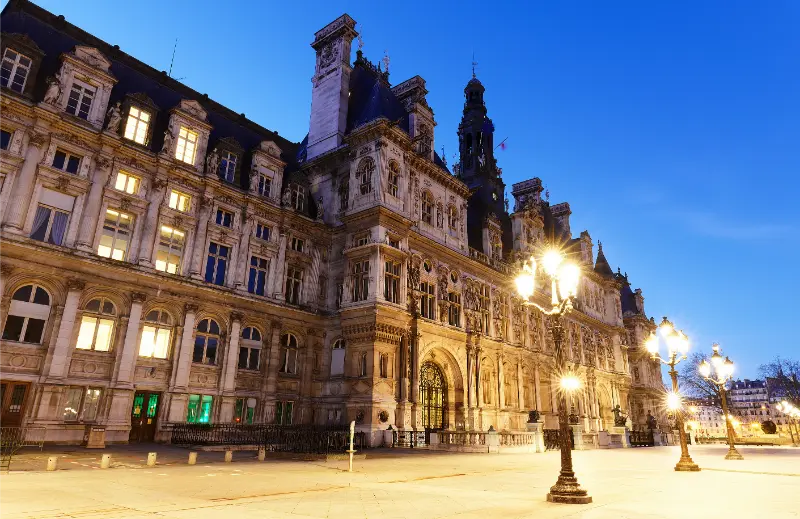
Our 4th arrondissement guide can structure the next section of the day around Hôtel de Ville, Notre-Dame, Île Saint-Louis and the Marais. If you are coming from the Louvre side, the 1st arrondissement guide creates a natural west-to-east continuation.
A practical walking route around the closed tower
Start at Tour Saint-Jacques early enough to see the façade without peak foot traffic. Walk toward Hôtel de Ville, then cross to Île de la Cité for Notre-Dame or continue into the Marais. Another option is to head southwest to the Seine, walk along the river, then cross toward the Latin Quarter.
This route works because the tower does not need an admission slot. You can photograph it in ten minutes or spend longer looking at the detail, then keep moving. In a city full of reservations, a flexible landmark can be useful rather than disappointing.
Should you visit specifically at night?
The tower can look dramatic under evening lighting, but the square and surrounding central area change character after shops and offices close. If you are already nearby for dinner or a Seine walk, it can be worth passing again. There is no need to construct a separate late-night journey solely for the tower while the interior remains closed.
For photography, the best conditions depend on the angle of light, foliage and seasonal decorations around the square. A cloudy day can actually help with stone detail by reducing harsh contrast.
What to do instead if you wanted the view
If your main reason for researching Tour Saint-Jacques was the rooftop panorama, choose another currently open viewpoint. The closure of the Montparnasse Tower observatory in 2026 means you should verify every viewpoint rather than relying on old lists.
Arc de Triomphe, the Eiffel Tower, Montmartre and selected rooftops provide different alternatives. Pick based on the view you want, mobility requirements and reservation tolerance. Tour Saint-Jacques was special because of its central position, but there is no exact substitute.
Who should still seek it out?
- Architecture lovers who want to see late Gothic detail in the heart of Paris.
- History travelers interested in surviving fragments of demolished buildings.
- Pilgrimage-history enthusiasts tracing Saint-Jacques and Santiago traditions.
- Photographers who enjoy the contrast between medieval stone and modern central Paris.
- Everyone else can simply include it on a walk rather than treating it as a stand-alone attraction while visits are suspended.
Nearby activities and tours
Central Paris is ideal for walking tours, Seine cruises and Île de la Cité visits. If you book one, do not select a product just because it mentions Tour Saint-Jacques in the description; that may mean an exterior stop, not tower entry. Read inclusions carefully.
Official information
Use the official City of Paris Tour Saint-Jacques page for reopening news. As of September 2026, the City states that the tower is closed to visits because of works and provides no normal visiting schedule.
Frequently asked questions
Can I climb Tour Saint-Jacques in 2026?
No. The City of Paris currently says the tower is closed to visits due to works, until further notice.
Can I still see the tower?
Yes. The exterior remains visible from the surrounding square and nearby streets. The closure concerns public visits inside the monument.
Is it wheelchair accessible?
The City currently lists the tower as not accessible to people with reduced mobility. Historic stair conditions were a major part of the former guided visit.
How long should I spend there now?
Ten to twenty minutes is enough for most travelers while the interior is closed, unless you are studying the architecture in detail. The tower works best as part of a longer central walk.
Final planning advice
Tour Saint-Jacques is still worth seeing, but in 2026 you should think of it as an exterior monument and walking-route anchor. Let it connect Châtelet, the Seine, Hôtel de Ville and the Marais, and save your viewpoint reservation for an attraction that is actually operating. When the City announces renewed visits, the climbing conditions and ticket system will need to be checked again from scratch.
One more practical planning note
The tower’s closure can actually simplify a central day because you no longer need to coordinate a limited guided slot. Use the square as a flexible waypoint between reserved attractions. If the monument reopens in the future, expect the visit to require advance planning because historic towers have small capacity and physical stair constraints. Recheck age, health, language and weather rules from the City before booking any renewed ascent.
Keep screenshots of any timed tickets, save the official address rather than only the attraction name, and verify public-transport changes shortly before departure. Paris itineraries often fail not because the attraction is disappointing but because a small operational detail—wrong entrance, luggage restriction, temporary closure or unrealistic transfer time—was ignored. Build at least fifteen to thirty minutes of slack around important reservations and allow more when you are crossing the city. That buffer protects the rest of the day and gives you freedom to stay longer when a museum or landscape turns out to be better than expected.