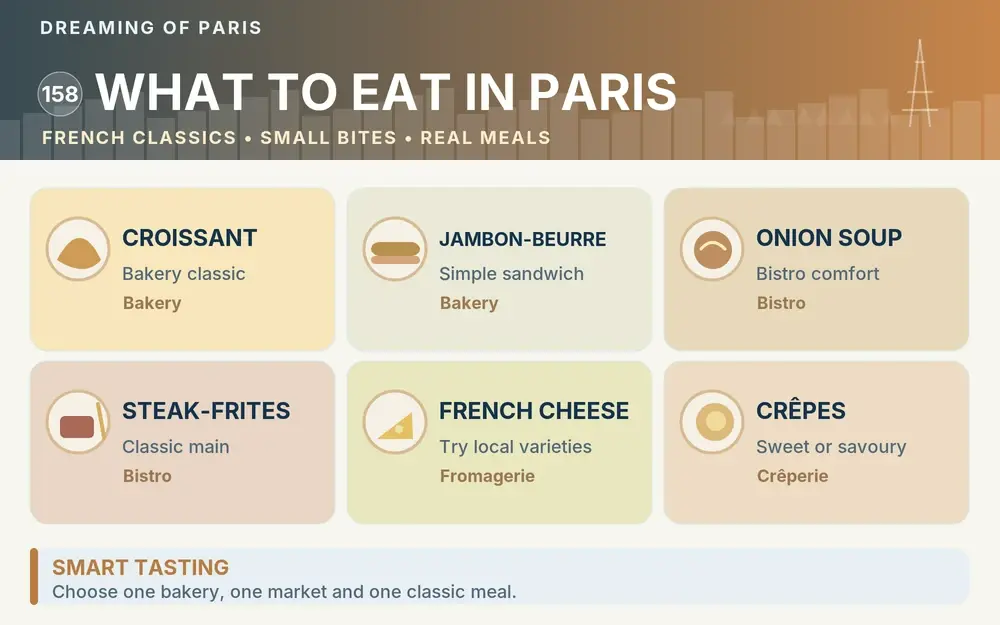
Paris is not a city where you need a checklist of fifty dishes to eat well. It is a city where a few simple foods — bread, butter, cheese, eggs, potatoes, chocolate and carefully made sauces — become memorable because of technique, timing and the place where you eat them. A good first food plan therefore mixes everyday Paris with classic French cooking: one bakery breakfast, one market or food street, one bistro meal, one cheese stop and a pastry or chocolate tasting are more revealing than trying to reserve famous restaurants for every meal.
This guide focuses on what to eat in Paris, not on ranking restaurants. For the practical side of ordering, tipping and reservations, use our restaurant etiquette guide; for bread and pastry shopping, continue with Paris boulangeries and pâtisseries. The aim here is to understand the foods themselves, which ones are genuinely Parisian or Île-de-France specialties, and which French classics simply make sense to try while you are in the capital.
Is there really such a thing as Parisian food?
Yes, but it is narrower than “French food.” Paris developed dishes of its own, absorbed products from the surrounding Île-de-France region and became the national stage where regional cooking was served, refined and popularized. That is why a Paris menu may move from Burgundy snails to Breton buckwheat galettes, Alsatian choucroute and Provençal vegetables without contradiction. The capital has always been a meeting point for cooks, markets and provincial specialties.
For a traveler, the useful distinction is not whether every dish was invented inside the city limits. Ask instead whether the food belongs naturally to the Paris eating experience. A jambon-beurre eaten on a bench, oeufs mayonnaise in a bistro, Brie de Meaux from a fromagerie and a carefully made Paris-Brest all tell you something different about how the city eats.
1. Baguette tradition
A baguette tradition is one of the simplest things worth seeking out. Under French rules, the “tradition” designation is tied to a short ingredient list and production method, so it is usually the better reference point than a generic baguette. Look for a loaf with a deep golden crust, irregular blistering and an interior that is moist rather than cottony. Buy it shortly before eating; even an excellent baguette changes quickly over the day.
The best way to understand bread culture is to compare a plain piece first, then use it with cheese or a meal. Our bakery guide explains how to recognize a true boulangerie and why time of day matters.
2. Croissant au beurre
A croissant should be light but not hollow, crisp at the edges and clearly buttery without feeling greasy. The laminated dough creates thin layers rather than a cake-like crumb. “Au beurre” is the phrase to look for when you want the classic butter version. A fresh croissant is best in the morning and does not need jam, chocolate or an elaborate coffee order to justify itself.
3. Jambon-beurre
The jambon-beurre is the Paris sandwich reduced to three essentials: baguette, ham and butter. Its quality depends almost entirely on the bread, the butter and the ham, which is why a good version can be more satisfying than a complicated sandwich. It is useful for a picnic, a train departure or a lunch when you want to keep sightseeing instead of committing to a full restaurant service.
4. Croque-monsieur
The classic croque-monsieur is a hot ham-and-cheese sandwich with a browned exterior; many versions include béchamel. Add an egg and it becomes a croque-madame. These are café and brasserie foods rather than fine-dining trophies. Order one when you want a quick seated lunch, especially with a green salad, rather than treating it as a dish that requires a destination restaurant.
5. Oeufs mayonnaise
Hard-boiled eggs with mayonnaise sound almost aggressively simple, but they are a useful test of bistro cooking. The yolk should not be dry and chalky, and the mayonnaise should have enough acidity and seasoning to keep the dish lively. Oeufs mayo are often inexpensive and work well as a starter before a richer main course.
6. Soupe à l’oignon
French onion soup is strongly associated with old Paris, particularly the market culture around Les Halles. The modern restaurant version is usually topped with bread and melted cheese. It is best in cool weather and at places that give the onions time to caramelize properly; a pale, overly sweet bowl is not the goal.
7. Steak-frites
Steak with fries is one of the safest ways to understand the rhythm of a bistro or brasserie. The important decision is doneness: French kitchens can interpret “medium” more lightly than some visitors expect, so use clear terms and ask if uncertain. Sauce au poivre, béarnaise or a simple pan sauce can turn the same basic plate into very different meals.
8. Confit de canard
Duck confit comes from southwestern France rather than Paris, but it is common enough in traditional Paris restaurants to be worth knowing. The leg is cured and slowly cooked in fat, then reheated until the skin is crisp. It is rich; pair it with potatoes or a sharp salad and avoid ordering several heavy courses simply because you are on vacation.
9. Escargots
Snails are another regional French dish that became part of the classic restaurant repertoire in Paris. In the familiar Burgundian style they arrive with garlic, parsley and butter. The pleasure is as much in the sauce and ritual as in the snails themselves, so bread is useful. Order six if you are curious rather than committing to a large portion.
10. Terrines, pâtés and charcuterie
A charcuterie plate can include cured ham, saucisson, pâté or terrine and works well for sharing. A good bistro will usually serve it with cornichons, mustard and bread. This is a practical way to taste several textures without filling the table with separate starters.
11. Brie de Meaux and other Île-de-France cheeses
Paris is surrounded by one of France’s important cheese landscapes. Brie de Meaux and Brie de Melun are protected cheeses from the wider Île-de-France/eastern Paris basin and give a regional connection to a cheese plate. A proper fromagerie can help you choose a piece that will be ready to eat that day instead of simply selling the most mature cheese in the case.
12. Paris-Brest
Despite the name, Paris-Brest is a pastry created to commemorate the Paris–Brest bicycle race. Its ring of choux pastry is filled with praline cream. It is rich, nutty and much more substantial than a macaron, so sharing one is sensible if you are also tasting other pastries.
13. Saint-Honoré
The Saint-Honoré combines puff pastry or a pastry base with cream and caramelized choux. It is named after the patron saint of bakers and pastry cooks. The best versions balance crisp caramel, light choux and cream rather than tasting like one uniform sweet layer.
14. Opéra cake
Opéra is built from thin layers of almond sponge, coffee buttercream, chocolate ganache and glaze. It is compact and intense, which makes it ideal to share. Because the structure is the point, it is a good pastry to eat seated rather than carrying around in a warm bag.
15. Mille-feuille
Mille-feuille alternates crisp puff pastry with cream. A good slice stays flaky and distinct even though cutting it neatly is nearly impossible. Eat it soon after purchase; moisture gradually softens the pastry, so this is not the best souvenir to keep until evening.
16. Macarons
The modern Paris macaron has two almond-meringue shells around ganache, buttercream or another filling. Texture matters more than color: the shell should be delicate rather than hard, with a slightly tender interior. Buy a small mixed selection first instead of a large gift box so you can compare fillings and freshness.
17. Chocolate and hot chocolate
Paris has a serious artisan chocolate culture. Praliné, ganache, orangettes, molded bars and drinking chocolate offer very different experiences, so do not judge a chocolatier only by decorative bonbons. In winter, a dense hot chocolate can be a meal-sized pleasure; at other times, a two- or three-piece tasting gives you more range.
18. Crêpes and buckwheat galettes
Sweet wheat crêpes are common street food, while savory buckwheat galettes are part of the Breton crêperie tradition. Montparnasse has a particularly strong Breton connection. A galette complète — usually egg, ham and cheese — followed by a simple butter-and-sugar crêpe is a classic combination.
19. Falafel and the food of multicultural Paris
Paris food is not only butter sauces and pastry. North African, Jewish, Middle Eastern, West African, Asian and other communities are part of the city’s everyday food map. A trip that eats only “traditional French” food misses a major part of contemporary Paris. The Marais, Belleville, La Chapelle, the 13th arrondissement and areas around Château Rouge each reveal a different migration story through food.
20–25. Six more things worth tasting
- Leeks vinaigrette: a classic bistro starter where seasoning matters more than presentation.
- Duck rillettes: shredded, preserved meat spread on bread; rich, salty and best shared.
- Madeleines: small shell-shaped cakes that are simple enough to show whether butter and baking were handled well.
- Flan pâtissier: thick baked custard in pastry, increasingly treated as a serious pâtisserie item rather than a cheap snack.
- Pralines and ganaches: the best introduction to a chocolatier’s technical style.
- Seasonal fruit tarts: often a better choice than a famous signature pastry when strawberries, apricots, figs or pears are at their peak.
How to build one good Paris food day
Start with a croissant or tartine, then walk a food street or market before lunch. Our markets and food streets guide and Rue des Martyrs food walk are designed for this. Keep lunch simple — a bistro starter and main course are enough — then leave pastries or chocolate for the afternoon. Finish with a lighter dinner or cheese and wine rather than stacking three heavy restaurant meals into the same day.
Food fatigue is real. Paris portions may be smaller than in some countries, but butter, cream, bread, alcohol and dessert accumulate quickly. The most enjoyable strategy is contrast: hot and cold, rich and acidic, restaurant and market, seated meal and picnic.
Official food references
For a current overview of Paris specialties, the official tourism office maintains a useful Paris culinary specialties guide. For market days and city-run market information, use the Ville de Paris market directory.
Frequently asked questions
What food is Paris most famous for?
Baguettes, croissants, macarons, café and bistro dishes are the obvious answers, but Brie from the wider Paris region, classic pastries and everyday sandwiches are just as useful for understanding local food culture.
Do I need expensive restaurants to eat well in Paris?
No. Bakeries, markets, fromageries, neighborhood cafés and modest bistros can provide some of the most characteristic food experiences. Spend money where technique or service matters to you, not because every meal needs to be a special occasion.
How many food stops should I plan in one day?
Three or four deliberate stops are usually enough. Leave room for appetite and spontaneity rather than turning every hour into a tasting appointment.
Final advice
The best food trip in Paris is not the one with the longest reservation list. It is the one that teaches you how the city eats: bread bought fresh, lunch taken at the right hour, cheese chosen by ripeness, a pastry eaten before it loses its texture and a neighborhood discovered because you followed the market stalls instead of the monument signs. Use this list as a vocabulary, then let appetite and geography decide the order.
More practical Paris food planning
For the next layer, compare our Paris street food guide, budget food strategy and desserts and pastries guide.