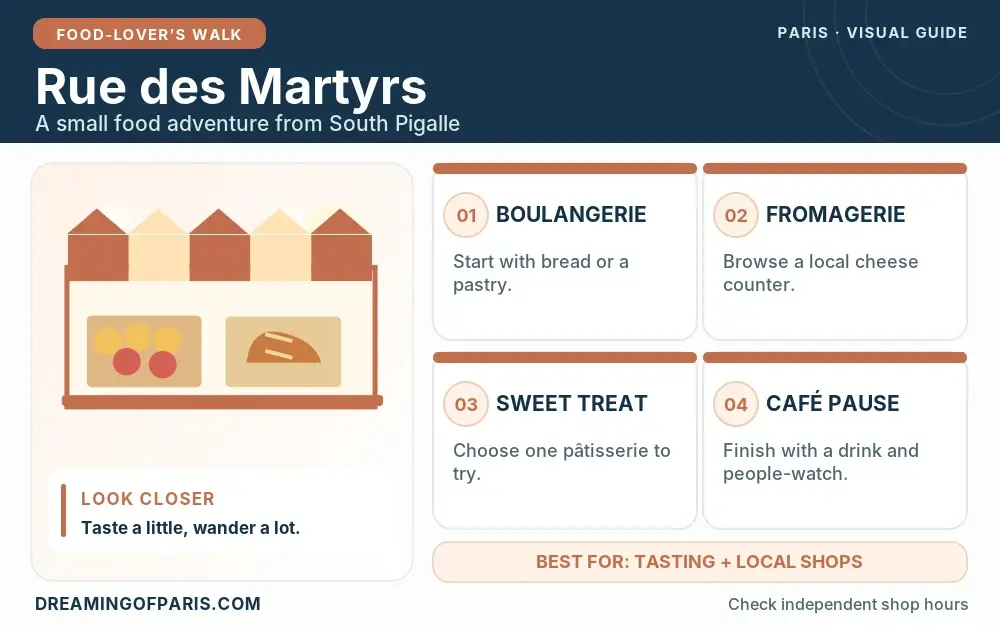
Rue des Martyrs is one of the easiest Paris streets to misunderstand. It appears on food lists because bakeries, cheesemongers, greengrocers, pastry shops and specialty stores sit close together, but its real value is the transition from the busier streets of the 9th arrondissement toward the foot of Montmartre. The street works best as a slow uphill walk with a few deliberate purchases, not as a checklist of famous addresses.
Why this street works as a route
Begin around Notre-Dame-de-Lorette and move north. The gradient gives the walk a natural direction and the storefronts change as you approach the 18th arrondissement. Rather than jumping between saved pins, pay attention to the sequence: daily food shopping, cafés, specialty retail and the increasingly visitor-heavy streets near Montmartre.
The best time to walk Rue des Martyrs
A weekday morning gives the clearest sense of an everyday shopping street; late morning into lunch is better if you want to buy food and eat nearby. Sunday can be lively but busier. Shop opening days and lunch breaks vary, so never build the entire route around a single small business without checking it directly.
What to buy without turning the walk into a tasting marathon
Choose two or three categories that travel well: bread or pastry for immediate eating, cheese or charcuterie only if you can store it properly, and a small specialty item such as chocolate, preserves or coffee. Buying less lets you compare quality and keeps the walk pleasant instead of becoming a bag-carrying exercise.
South Pigalle before the climb
The streets west and east of the lower section add another layer: 19th-century façades, cafés and the foothills below Montmartre. This is a useful place to stop for coffee before the steeper final section, especially if you are combining the walk with the covered passages or the grands boulevards earlier in the day.
How to connect the route to Montmartre
At the upper end, resist the temptation to head straight for the busiest Sacré-Cœur approach. Use the neighborhood streets to reach Montmartre more gradually, then follow our village-side route. This creates a logical half-day without repeating the same tourist corridor twice.
What makes the street worth revisiting
The strongest reason to return is not a specific shop but the rhythm. Seasonal fruit, bakery windows and restaurant menus change, and the street feels different before work, at lunch and in the early evening. Much of its appeal comes from functioning as a living commercial street rather than an attraction frozen in time.
Useful connections on Dreaming of Paris
Pair this walk with our Montmartre beyond Sacré-Cœur route. For a broader overview, see Paris markets and food streets.
Is Rue des Martyrs worth visiting if I am not a foodie?
Yes. The architecture, slope and link between the 9th arrondissement and Montmartre make it a useful neighborhood walk even if you buy nothing.
How long should I allow?
About 60–90 minutes works for a simple walk with one or two stops; add more time if you plan a meal or continue into Montmartre.
Is it better uphill or downhill?
Uphill creates the most natural progression toward Montmartre, while downhill is easier physically. Choose according to the rest of your day rather than a supposed mandatory direction.
A final planning note
Rue des Martyrs is useful precisely because it can remain ordinary. Buy thoughtfully, leave space for residents doing their daily shopping, and let the street connect two neighborhoods instead of treating it as a row of trophies.
For Rue des Martyrs Paris, one more practical point is worth keeping in mind. For a useful neighborhood comparison, notice who is shopping around you and what is being sold for everyday use. A place can be famous and still function locally, but the balance between residents, visitors and destination shoppers tells you when to linger and when to move on. Use this as a decision rule rather than a rigid instruction: the best version of the day is the one that keeps the route coherent and leaves enough energy for the place itself.
For Rue des Martyrs Paris, one more practical point is worth keeping in mind. Carry a reusable bag and a small amount of payment flexibility. Many places accept cards, but small purchases, market stalls and temporary technical problems are easier when you have a backup. Tastings vary by stall, and it is usually best to check before handling produce or photographing a stall at close range. Use this as a decision rule rather than a rigid instruction: the best version of the day is the one that keeps the route coherent and leaves enough energy for the place itself.
For Rue des Martyrs Paris, one more practical point is worth keeping in mind. Treat food stops as part of the route rather than a list to collect. Paris streets change character by the hour: produce markets are strongest earlier, lunch counters can become crowded quickly, and specialty shops may close between services. A flexible sequence usually works better than reserving every bite in advance. Use this as a decision rule rather than a rigid instruction: the best version of the day is the one that keeps the route coherent and leaves enough energy for the place itself.
A route that works block by block
For a first walk, start near Notre-Dame-de-Lorette and move uphill rather than dropping into the street halfway through. The lower part lets you see how South Pigalle changes from cafés and everyday shopping into a denser food street; by the time the slope becomes more noticeable, Montmartre is already the natural continuation. A useful rhythm is one bakery stop, one savory purchase and one sit-down break rather than trying to taste something at every address. That keeps the walk enjoyable and leaves room for whatever looks strongest on the day.
Rue des Martyrs is also a good place to compare specialist food shopping with a conventional market. A cheesemonger, fishmonger, pâtisserie and greengrocer each have a different service rhythm: you may queue, order by weight, or need to wait while something is wrapped. If you are building a picnic, buy fragile items last and carry a small tote that stays upright. For a fuller market morning on another day, compare the experience with Marché d’Aligre.
Three ways to use the street
- Breakfast route: arrive early, choose a boulangerie and coffee, then continue toward Montmartre before the hill is busy.
- Lunch route: walk late morning, buy one or two things to eat, then stop before climbing to Sacré-Cœur.
- Food-shopping route: visit with a real list—cheese, bread, fruit or pastry—rather than treating shops as photo stops.
If your priority is atmosphere rather than food, do not worry about “missing” a famous address. The value of Rue des Martyrs comes from the continuous street life: deliveries, regular customers, school-run traffic and small shops working side by side. That is also why weekday and weekend visits feel different. A Saturday can be lively but crowded; a weekday late morning makes it easier to look at façades, windows and side streets without blocking shoppers.
Finish by choosing one continuation. For classic sights, go uphill into Montmartre. For a quieter neighborhood contrast, turn west into South Pigalle and the streets around avenue Trudaine. Trying to combine Rue des Martyrs, all of Montmartre and several museums in the same half-day usually makes the food walk feel like transit rather than an experience.
A practical decision check for Rue des Martyrs
Use Rue des Martyrs when you want food shopping integrated into a Montmartre or South Pigalle day, not when you are looking for one destination restaurant. Before you give it a fixed slot, compare that reason with the strongest alternative already on your itinerary. If the alternative matters more, move this stop to an optional block instead of forcing both into the same half-day. That simple choice keeps the article useful for different travelers rather than implying that every reader needs the same Paris.
A realistic way to fit it into the day
A compact version is breakfast near the lower end, a slow uphill walk with one shopping stop, then Montmartre before lunch. A later version starts around 10:30, buys picnic components and finishes on the hill. Keep the previous and following stops close enough that a delay of twenty or thirty minutes does not create a cascade of missed reservations. Paris days become much easier when the route can absorb a longer lunch, a queue or a weather change without requiring a taxi across the city.
The trade-off worth making explicit
The street loses value if you cross Paris only for a pastry you saw online. Its strength is density: several useful food businesses, ordinary errands and a natural uphill route in one corridor. Making that trade-off deliberately is more useful than adding another item to a checklist. Ask what you would remove if this experience takes longer than expected; if the answer is “nothing,” the day is probably already too full.
Small details that prevent avoidable problems
If you buy cheese, cream pastries or prepared food, think about storage and temperature. Schedule those purchases near the time you will eat them instead of carrying them through museums. Save the exact address or entrance you intend to use, keep enough phone battery for the return route and recheck any time-sensitive information on the official site. These are small steps, but they protect the part of the experience that actually matters from being swallowed by logistics.
Where it belongs in the wider Paris cluster
Combine it with Montmartre, South Pigalle or an early-morning hill walk; do not combine it with Aligre or Montorgueil on the same day unless food shopping is the entire purpose of the trip. Treat that pairing as a geographic or thematic cluster, not an obligation to complete everything. One strong connection is enough to make the day coherent; two or three distant add-ons usually reduce the value of the place you came to see.
More food-focused Paris guides
After Rue des Martyrs, continue with the Paris chocolate guide, the Paris cheese guide and our pillar on what to eat in Paris.