Disclosure: This article contains affiliate links or booking widgets. If you book through them, Dreaming of Paris may earn a commission at no extra cost to you. How our affiliate links work.
The Musée Picasso Paris works best when you stop expecting a chronological “greatest hits” gallery. Housed in the Hôtel Salé in the Marais, the museum combines Picasso’s work with exhibitions, archival material and changing displays. The building, the curatorial approach and the temporary program are part of the experience, so a repeat visit can feel substantially different.
Check tickets and Paris experiences
Compare current tours, timed-entry tickets and experiences before fixing your itinerary.
GetYourGuideTiqetsCivitatisViatorAffiliate links: we may earn a commission at no extra cost to you.
For travelers already planning Le Marais, Picasso is one of the easiest major museums to integrate without sacrificing a full day. The institution itself recommends roughly 90 minutes to two hours for a complete visit, which is a useful planning range.
Opening hours, free Sunday and crowd patterns
The museum currently opens Tuesday to Sunday from 9:30 a.m. to 6 p.m., with last admission before closing. Monday is the regular closure day. The first Sunday of the month is currently free, and the museum publishes typical crowd patterns that show early morning as one of the calmer periods.
Free Sunday can be attractive for budget reasons but may not be the best choice if your priority is quiet viewing. If you are paying anyway, an early weekday slot can deliver a better experience than organizing the entire trip around a zero-euro ticket.
What the museum is — and is not
This is not simply a room-by-room biography of Picasso. Displays can emphasize themes, periods, relationships or dialogue with other artists. If there is one specific work you regard as essential, check the current collection/exhibition information before assuming it will be on the wall.
That changing presentation is a strength for repeat visitors. It is also why reading the current program before arrival matters more here than at a museum with a mostly fixed route.
The Hôtel Salé deserves attention too
The museum occupies a seventeenth-century mansion whose architecture gives the visit a very different character from the converted railway station of Orsay or the vast palace of the Louvre. Look at the staircase, proportions and movement between historic rooms rather than treating the building as a neutral container.
This is one reason the museum pairs so well with a Marais walk: the art and architecture continue the neighborhood’s broader story of hôtels particuliers, courtyards and aristocratic urban fabric.
Garden and rooftop café: seasonal details
The museum currently opens its garden seasonally, generally from spring into early autumn, and operates a rooftop café during museum hours with its own service schedule. These spaces can make a two-hour visit feel less intense, but do not build a trip around them without checking the day’s operations.
If weather is good, use the garden or café as a pause before returning to the streets of the Marais. If rain is heavy, the museum itself becomes a strong anchor for an indoor neighborhood day.
Picasso + Le Marais: the best combination
Place des Vosges, Hôtel de Sully, Rue des Rosiers and quieter Marais streets can all sit in the same half-day as the museum. The mistake is to add another large museum immediately afterward. Use the museum as the cultural anchor and the neighborhood as the breathing space.
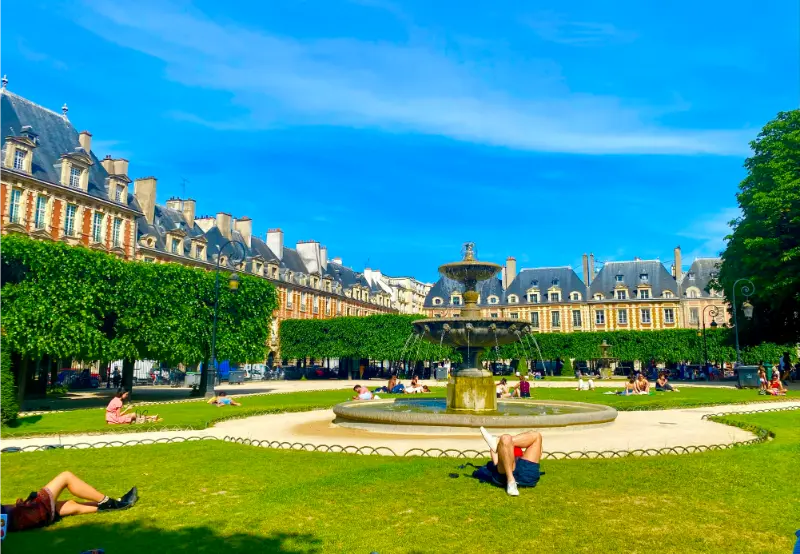
Follow our Le Marais walking guide for a route that avoids reducing the district to shopping streets and a few famous façades.
Picasso or Centre Pompidou / contemporary art?
The choice depends on what you want from the day. Picasso is artist-centered and intimate relative to Paris’s largest museums. The Bourse de Commerce is focused on contemporary art from the Pinault Collection, while Fondation Louis Vuitton combines architecture and changing modern/contemporary exhibitions.
If modern and contemporary art are a priority, compare our Bourse de Commerce guide and Fondation Louis Vuitton guide before booking.
Guided visit or independent?
Independent visiting works well if you already know Picasso’s broad career and enjoy interpreting thematic displays. A guide adds more value if you want biographical context, stylistic development or help understanding why particular works are grouped together.
The auto widget below can surface current bookable museum and Marais experiences. Compare inclusions carefully: some tours include museum admission, while others are neighborhood walks that only discuss Picasso from outside.
Official information
Check the official Musée Picasso practical-information page for the current exhibition program, late openings, garden operation and free-admission rules. The museum’s own crowd chart is unusually useful when choosing a time.
The simplest strategy remains: reserve an early slot, allow 90–120 minutes, and keep the rest of the half-day in the Marais.
Museum Pass and ticket decisions
Musée Picasso is not a reason by itself to buy a multi-attraction pass. Calculate the pass across your whole itinerary and verify current inclusion. Our Paris Museum Pass guide explains the break-even logic; the best ticket is the one that fits your route, not the one marketed as “unlimited.”
If you dislike Picasso
Do not visit merely because he is famous. The Marais has Carnavalet, small museums, architecture and food streets. A specialist artist museum rewards curiosity; without it, those two hours may be better spent elsewhere. This is an important principle for building a personalized Paris itinerary.
A final planning rule
A useful final test for Musée Picasso Paris is whether the visit improves the day around it. Paris itineraries become weaker when every famous name is treated as mandatory. Check opening hours, place the visit beside nearby sights, leave time for security and walking, and keep one flexible block in the half-day. That small amount of margin is what protects the plan when queues, weather or energy levels differ from expectations. If a ticket is timed, arrive early enough to find the correct entrance without turning the previous activity into a race. If admission is free or flexible, use that flexibility rather than creating an artificial deadline. The goal is not to maximize the number of doors you enter; it is to remember what you saw and still enjoy the streets between attractions.
How to look when the display is thematic rather than chronological
If the galleries do not follow a simple early-to-late biography, avoid fighting the curatorial structure. Read the room introduction, identify the question or theme, then compare two or three works before moving on. Picasso worked across painting, sculpture, drawing, printmaking and ceramics, so changes of medium can be as revealing as changes of date. A thematic display can show those cross-connections better than a strict timeline, but only if you slow down enough to notice why works have been placed together.
A Marais museum day without overload
If weather is poor and you want two museums, pair Picasso with Carnavalet rather than crossing Paris for another blockbuster. The first offers an artist-centered, ticketed visit; the second offers free Paris history and can be shortened easily. Put lunch or a café break between them and walk through Place des Vosges or quieter side streets. This creates variety: modern art, urban history and neighborhood atmosphere, rather than three consecutive hours of gallery fatigue.
Day-of-visit check
Before leaving the hotel, recheck the official website for the day rather than relying on a screenshot saved weeks earlier. Paris institutions can change rooms, access routes, security rules or opening times for events. Keep the reservation email accessible offline, arrive with only the bags you need, and know the nearest alternative activity in the same neighborhood. This small preparation is especially useful during strikes, exceptional closures or exhibition changeovers. It also protects your internal itinerary: if one venue changes, you can remain in the same district instead of losing an hour crossing the city.
What to do if the famous works you expected are not on view
Artist museums rotate works for conservation, loans and exhibition design. If a specific Picasso image is the reason you are visiting, check the current display information before buying. When something is absent, do not treat the visit as a failure. Use the temporary arrangement to notice media or periods you know less well, and remember that the collection is much broader than the handful of works reproduced in guidebooks. This is also a reason to avoid promising children or companions that they will definitely see one exact piece unless the museum confirms it. Good museum planning manages expectations. The strongest memory may end up being a ceramic, drawing, sculpture or view through the Hôtel Salé rather than the work you had in mind.
Keep the itinerary flexible
For Musée Picasso Paris, one more practical habit improves the visit: decide in advance what would make you leave early. That might be crowding, a tired child, a temporary gallery closure or simply discovering that another part of Paris interests you more. A travel plan should give permission to change course. Keep nearby alternatives saved, avoid non-refundable back-to-back bookings, and remember that walking the surrounding neighborhood is often part of the cultural experience. This approach is especially useful in Paris because major attractions sit inside districts that are worth exploring in their own right. A shorter, attentive visit followed by an unhurried walk is often more memorable than staying until every room has been covered.
Frequently asked questions
How long does Musée Picasso take?
The museum itself recommends roughly 90 minutes to two hours for a complete visit.
Is Musée Picasso free on the first Sunday?
Under the current rules, yes. Check the official site again before your visit.
Is the museum closed on Monday?
Yes, Monday is the regular weekly closing day.
What is the best nearby plan?
Combine it with a focused Marais walk rather than another large museum.