Disclosure: This article contains affiliate links or booking widgets. If you book through them, Dreaming of Paris may earn a commission at no extra cost to you. How our affiliate links work.
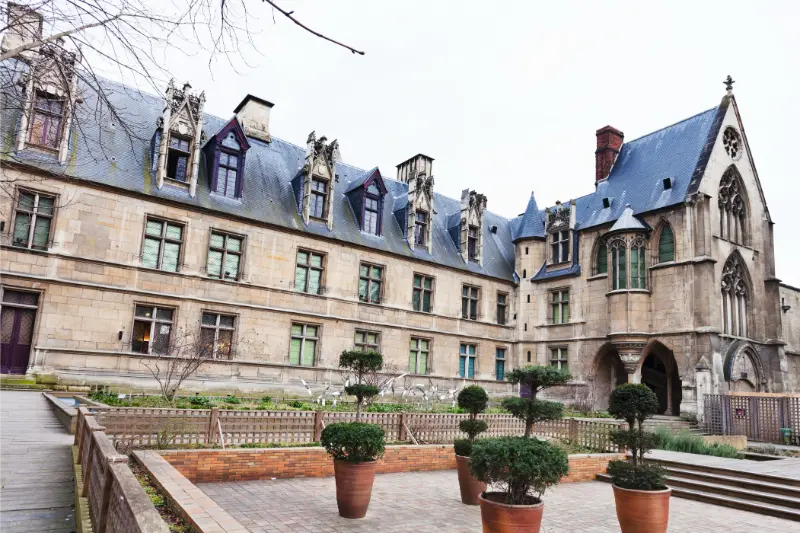
Musée de Cluny is where the Latin Quarter stops being only cafés, students and bookshops and becomes a place with visible layers of Roman and medieval Paris. The museum combines the late-fifteenth-century Hôtel de Cluny with the much older Gallo-Roman thermal baths of Lutetia, then fills those spaces with one of Europe’s major medieval-art collections.
Check tickets and Paris experiences
Compare current tours, timed-entry tickets and experiences before fixing your itinerary.
GetYourGuideTiqetsCivitatisViatorAffiliate links: we may earn a commission at no extra cost to you.
The star is the Lady and the Unicorn tapestry cycle, but reducing Cluny to one room misses the reason the museum is so valuable: it connects objects, architecture and the physical remains of ancient Paris in one manageable visit.
Opening hours and first-Sunday free entry
The museum currently opens Tuesday to Sunday from 9:30 a.m. to 6:15 p.m. and is closed Monday, January 1, May 1 and December 25. The official ticketing system currently offers free admission to everyone on the first Sunday of the month.
Online tickets do not eliminate the security check. If you want a quieter experience, the museum itself recommends weekday mornings as a lower-traffic period.
The Roman baths: why Cluny starts before the Middle Ages
Part of the museum incorporates the Thermes de Cluny, remains of a monumental Gallo-Roman bath complex from ancient Lutetia. The frigidarium is particularly striking because its scale survives inside the modern city in a way that street-level sightseeing rarely communicates.
This makes Cluny unusually useful for understanding Paris chronologically. Before medieval churches and university streets, there was a Roman city. The museum lets you stand inside that earlier layer rather than merely read about it.
The Lady and the Unicorn
The six tapestries known as The Lady and the Unicorn are the museum’s most famous works and deserve unhurried viewing. Five are commonly associated with the senses; the sixth, bearing the phrase “À mon seul désir,” has inspired more open interpretation.
The tapestries reward more than a quick photo stop. Looking at repeated animals, flowers, gestures and differences between scenes makes the cycle much richer. The cycle becomes much richer when you notice how motifs shift across the series.
A focused 90-minute route
Begin with the Roman baths so the timeline starts with Lutetia. Move into the medieval collections, prioritizing sculpture, stained glass and everyday objects that interest you. Finish with the Lady and the Unicorn rather than using it as the first photo stop.
This sequence gives the visit a narrative. If you have more time, slow down around fragments connected to medieval Parisian monuments and compare them with what you have seen at Notre-Dame and Sainte-Chapelle.
Cluny + Latin Quarter
The museum sits in the heart of the Latin Quarter, making it easy to combine with the Sorbonne surroundings, Panthéon, Rue Mouffetard or Luxembourg Gardens. Do not take the Metro to another district immediately after leaving; the context outside is part of the visit.
Use our Latin Quarter walking guide and Panthéon guide to build a coherent half-day.
Cluny + Notre-Dame / Sainte-Chapelle
If medieval Paris is your theme, a powerful day can connect Cluny with Notre-Dame and Sainte-Chapelle across the river. The key is to avoid overbooking. Sainte-Chapelle often works best with a timed ticket, while Notre-Dame entry rules and queues can shift with demand.
Our Sainte-Chapelle and Conciergerie guide helps turn these sites into one historical cluster instead of three disconnected attractions.
Families and medieval objects
Cluny can work surprisingly well with children who are interested in castles, animals, myths or knights because the collection includes visually readable objects rather than only paintings on white walls. Use the unicorn tapestries as a visual hunt and keep explanations concrete.
For younger children, combine the museum with Luxembourg Gardens afterward. A museum followed by playground or open space is usually more successful than adding another monument immediately.
Guided tours and workshops
The museum runs guided visits and workshops, including programs around medieval daily life and the collections. These can be valuable when the period feels unfamiliar. The widget below can also show current broader Paris medieval-history experiences, but check whether museum admission is included.
Independent visitors should still read a short introduction before arrival; knowing what the Roman baths and unicorn tapestries represent makes the collection much easier to navigate.
Official information
Use the official Musée de Cluny website and official ticketing site for the current calendar, prices, Thursday events and workshops. First-Sunday rules and temporary exhibitions should always be rechecked.
The museum is compact enough to be deliberate: choose the Roman baths, a few medieval themes and the tapestries, then return to the Latin Quarter with a much clearer sense of the district’s age.
Why the museum works after Notre-Dame
Notre-Dame gives you a living medieval monument that has evolved for centuries; Cluny gives you objects and fragments that help explain the artistic world around it. Visiting both creates connections between architecture, sculpture, stained glass and religious imagery that are hard to see from one site alone.
Do not overlook the building transition
The movement between Roman masonry, medieval mansion and modern museum intervention is itself a history lesson. Pause at thresholds and changes in material. Cluny is not just a collection stored in an old building; the building is one of the collection’s strongest interpretive tools.
A final planning rule
A useful final test for Musée de Cluny is whether the visit improves the day around it. Paris itineraries become weaker when every famous name is treated as mandatory. Check opening hours, place the visit beside nearby sights, leave time for security and walking, and keep one flexible block in the half-day. That small amount of margin is what protects the plan when queues, weather or energy levels differ from expectations. If a ticket is timed, arrive early enough to find the correct entrance without turning the previous activity into a race. If admission is free or flexible, use that flexibility rather than creating an artificial deadline. The goal is not to maximize the number of doors you enter; it is to remember what you saw and still enjoy the streets between attractions.
What children can look for in the unicorn tapestries
Turn the tapestry room into observation rather than a lecture. Ask children to find the lion, unicorn, rabbits, birds, flowers or repeated colors. Older children can compare which sense each scene may represent and guess why the sixth tapestry is interpreted differently. This approach gives them a task without requiring medieval-art vocabulary. Afterward, the Roman baths provide a complete change of scale and subject, which helps reset attention.
A medieval-theme day that still feels like Paris
Start at Cluny in the morning, walk through the Latin Quarter toward the Seine, cross to Île de la Cité, and visit Sainte-Chapelle or Notre-Dame depending on reservations and queues. Break for lunch before the second major interior. The route lets you move from Roman foundations to medieval art and surviving Gothic monuments while remaining in a compact area. It feels like a city day rather than a specialist history excursion because cafés, bookshops and river views sit naturally between the historic stops.
Day-of-visit check
Before leaving the hotel, recheck the official website for the day rather than relying on a screenshot saved weeks earlier. Paris institutions can change rooms, access routes, security rules or opening times for events. Keep the reservation email accessible offline, arrive with only the bags you need, and know the nearest alternative activity in the same neighborhood. This small preparation is especially useful during strikes, exceptional closures or exhibition changeovers. It also protects your internal itinerary: if one venue changes, you can remain in the same district instead of losing an hour crossing the city.
What makes Cluny unusually efficient for a short trip
Many specialist museums require a detour. Cluny does not. It sits where first-time visitors are already walking, close to the Seine, Notre-Dame, the Panthéon and Luxembourg Gardens. That means even a 75-minute visit can add substantial historical depth without consuming an extra transit block. If you are deciding between Cluny and another remote museum on a three-day trip, location can legitimately break the tie. This efficiency also makes the museum a strong rain backup: you can move indoors without abandoning the Left Bank route. The collection is compact enough that you can leave when attention drops, then continue through the Latin Quarter rather than feeling that you have committed the entire day to one institution.
Keep the itinerary flexible
For Musée de Cluny, one more practical habit improves the visit: decide in advance what would make you leave early. That might be crowding, a tired child, a temporary gallery closure or simply discovering that another part of Paris interests you more. A travel plan should give permission to change course. Keep nearby alternatives saved, avoid non-refundable back-to-back bookings, and remember that walking the surrounding neighborhood is often part of the cultural experience. This approach is especially useful in Paris because major attractions sit inside districts that are worth exploring in their own right. A shorter, attentive visit followed by an unhurried walk is often more memorable than staying until every room has been covered.
Frequently asked questions
Is Musée de Cluny open on Monday?
No. The regular weekly closure is Monday.
Is the first Sunday free?
Under the current ticketing rules, admission is free for everyone on the first Sunday of the month.
What is the most famous work?
The Lady and the Unicorn tapestry cycle is the museum’s best-known masterpiece.
How long do you need?
Around 90 minutes works for a focused visit; two hours allows more time for the Roman baths and medieval collections.