Disclosure: This article contains affiliate links or booking widgets. If you book through them, Dreaming of Paris may earn a commission at no extra cost to you. How our affiliate links work.
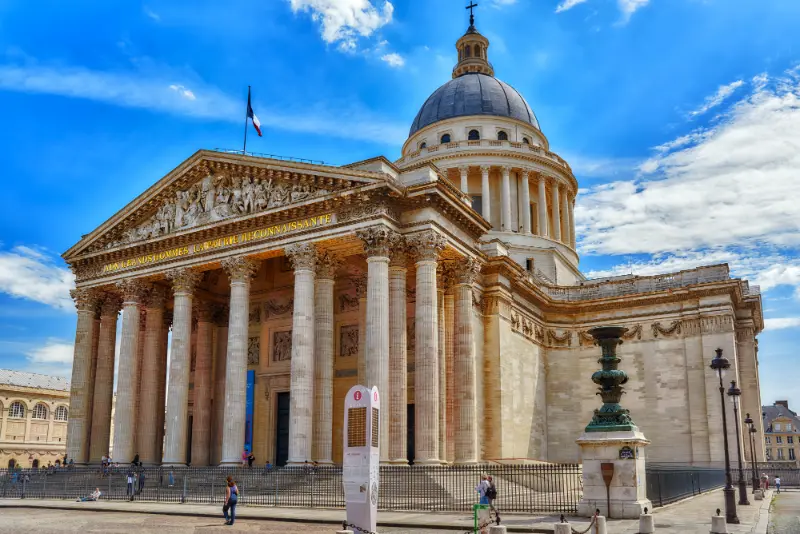
The Panthéon is one of the best places in Paris to connect architecture, science and national memory in a single visit. It began as a church dedicated to Sainte-Geneviève, became a monument honoring major French figures, contains Foucault’s famous pendulum experiment and has a crypt that turns abstract names from textbooks into a physical map of French history.
Check tickets and Paris experiences
Compare current tours, timed-entry tickets and experiences before fixing your itinerary.
GetYourGuideTiqetsCivitatisViatorAffiliate links: we may earn a commission at no extra cost to you.
For 2026, one detail is especially important: the official Panthéon practical-information page currently states that the panorama is not open to visitors. Older guides may still describe the upper panorama as a standard add-on. Plan the visit around the nave, Foucault pendulum, decoration and crypt unless the official site announces a reopening.
Current 2026 hours and pricing structure
The Panthéon is currently open daily from 10 a.m. to 6:30 p.m. from April through September and from 10 a.m. to 6 p.m. from October through March, with last entry 45 minutes before closing. On the first working Monday of each month it opens at noon. Annual closures include January 1, May 1 and December 25.
The 2026 individual rate is currently €16 in the high season and €13 in the low season, with a reduced Wednesday high-season price shown by the official ticketing system. Prices and special free-entry days can change, so verify your specific date rather than relying on an old screenshot.
Start with the building before going to the crypt
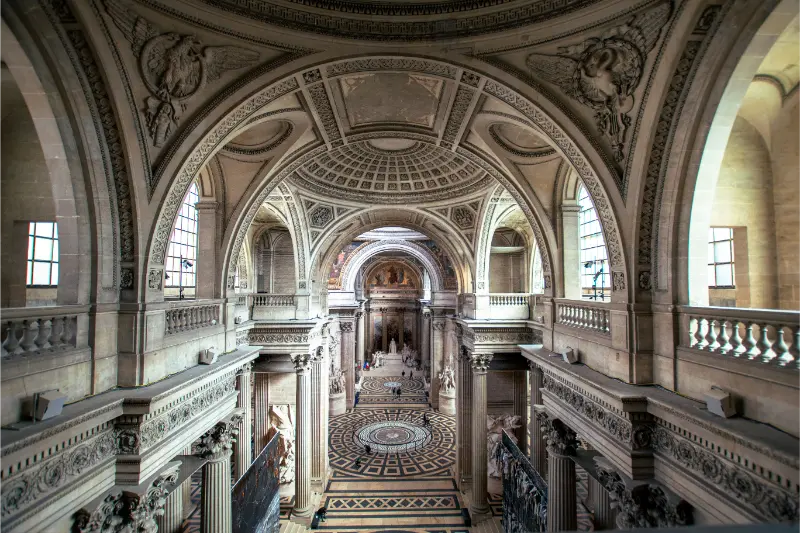
The scale of the nave is easiest to understand before you descend. Soufflot’s architecture sits at a turning point between religious monumentality and the later civic role of the building. Look at the dome structure, columns and vast central crossing before focusing on individual paintings and sculptures.
If you enter and immediately rush underground to famous tombs, the Panthéon becomes a list of names. Give the building ten quiet minutes first; it changes the emotional weight of the crypt.
Foucault’s pendulum: why it belongs here
In 1851 Léon Foucault used the Panthéon’s height to demonstrate Earth’s rotation with a long pendulum. The current installation makes physics visible in the middle of a national monument, which is one reason the building feels so different from a conventional church or museum.
Do not worry if you cannot immediately “see” the Earth turning in a few seconds. The experiment is about the gradual shift of the pendulum’s plane of oscillation relative to the rotating Earth. Read the interpretation on site and then return to it after exploring the nave.
The crypt: choose people and stories rather than reading every plaque
The crypt honors figures including Voltaire, Rousseau, Victor Hugo, Émile Zola, Marie and Pierre Curie, Alexandre Dumas, Simone Veil, Joséphine Baker and others. In 2026 Marc and Simonne Bloch were also honored at the Panthéon. The list continues to evolve because the site remains an active national memorial.
Before visiting, choose three or four people whose lives you want to understand. That simple decision prevents the crypt from becoming a corridor of famous surnames and turns it into a personal historical route.
The panorama is currently closed: why that matters for your itinerary
Many travel pages still sell the Panthéon as both monument and viewpoint. At the time of this update, the official site says the panorama is not open to visitors. That means you should not choose the Panthéon because you need a skyline view. Use our best views of Paris guide for currently usable alternatives.
This is also a reminder to verify attraction details close to travel dates. Paris has many historic buildings, but their upper levels, towers and terraces can close independently from the main monument.
A strong Latin Quarter route with the Panthéon
The Panthéon works best as part of a Left Bank half-day. Start with the market streets or Roman layers of the Latin Quarter, visit the monument, then continue toward Jardin du Luxembourg or Saint-Étienne-du-Mont. This keeps walking coherent and gives you a mix of indoor and outdoor space.
Use our Latin Quarter walk and Luxembourg Gardens guide to turn the monument into a neighborhood route.
Panthéon for literary Paris
Victor Hugo, Zola and Dumas make the crypt an obvious stop for readers, but the literary context is wider than the tombs. The surrounding Latin Quarter connects to publishing, universities, bookshops and writers’ addresses. A literature-focused visitor can use the Panthéon as the historical anchor before following our literary Paris guide.
This is one of the clearest examples of how cluster travel planning works: one monument becomes more meaningful because the streets around it continue the same theme.
Paris Museum Pass and reservations
The Panthéon is currently included in the Paris Museum Pass. If you are already planning Louvre, Orsay, Sainte-Chapelle, Arc de Triomphe and Invalides, it can help the pass mathematics. If the Panthéon is your only paid monument that day, the pass is not automatically useful.
Read our Paris Museum Pass 2026 guide and compare your actual itinerary.
Guided visits: when they add value
A guided visit is most valuable when you want the political transitions explained: church, revolutionary monument, changes of regime, and the modern national memorial. Otherwise, a self-guided visit with focused reading is entirely workable. Compare guided products carefully because some city tours include only exterior commentary.
Official information
Check the official Panthéon practical-information page shortly before visiting, especially if the panorama is important to you. The current closure is exactly the sort of detail that older travel guides may not reflect.
Frequently asked questions
Is the Panthéon panorama open in 2026?
At the time of this update, the official Panthéon site states that the panorama is not open to visitors. Check again close to your date because that status can change.
How long do you need?
About 60–90 minutes is a good first visit, longer if you read the crypt biographies or temporary exhibitions in depth.
Is the Panthéon included in the Paris Museum Pass?
Yes, currently. The pass covers the standard monument visit, subject to current access conditions.
What should I combine with it?
The Latin Quarter, Jardin du Luxembourg and a literary walk are the most coherent nearby combinations.
Temperature and comfort inside
The Panthéon can feel cool even when the weather outside is mild because of its monumental stone interior. In shoulder seasons, keeping a layer with you is useful. The crypt also changes the physical atmosphere of the visit: quieter, lower and more enclosed than the nave.
Free-entry days can be busier
The official monument participates in specific free-entry periods, including European Heritage Days and certain first Sundays in the low season under current rules. Free admission is valuable, but it can also increase queues. If calm matters more than saving the ticket price, a paid weekday can be the better experience.
Saint-Étienne-du-Mont next door
Immediately beside the Panthéon, Saint-Étienne-du-Mont offers a striking contrast: a functioning church, the shrine connected with Sainte-Geneviève and a very different interior scale. If it is open, a short visit can help you understand the religious history that predates the Panthéon’s civic role.
Who is in the crypt changes over time
Panthéonization is a political and cultural act, not a closed historical list. New figures can be honored by national decision, and ceremonies may affect access. That living function distinguishes the Panthéon from a museum where the collection is essentially fixed.
The monument for children and teenagers
The pendulum gives younger visitors an immediate scientific hook, while the crypt works better when they recognize at least one person. Before visiting with children, choose a story — Marie Curie, Victor Hugo, Joséphine Baker or another figure — and make that the thread. A targeted story is more effective than demanding interest in dozens of tombs.
Security and bags
The official site states that there is no luggage locker or cloakroom and that only standard backpacks are accepted; larger or prohibited items can disrupt your day. Do not arrive between hotel checkout and a train with substantial luggage expecting the monument to store it.
A better way to prepare for the crypt
Before the trip, read one short biography rather than a giant list of everyone buried there. Marie Curie, Victor Hugo, Simone Veil or Joséphine Baker can provide a personal entry point. Once inside, use that person as the anchor and let nearby names expand the story. This turns the crypt from a checklist into a connected historical space.
Panthéon at the start or end of the day
The monument works well early because the Latin Quarter is pleasant before midday crowds, but it can also anchor a late-afternoon Left Bank walk. Because closing hours change by season and the first working Monday opens later, check the exact schedule before building the garden and dinner around it.
Do not treat the Panthéon as a mausoleum only
The building is also a lesson in architecture, political symbolism and science. The pendulum, murals, sculpture and changing civic role are not background decoration around the crypt; they explain why the Panthéon became an appropriate place for national commemoration. Spend enough time upstairs that the descent to the crypt feels like the second chapter rather than the entire visit.