Disclosure: This article contains affiliate links or booking widgets. If you book through them, Dreaming of Paris may earn a commission at no extra cost to you. How our affiliate links work.
Canal Saint-Martin gets the postcards; Bassin de la Villette and Canal de l’Ourcq give you the longer local story. The Ourcq canal runs 97 km from Paris toward Mareuil-sur-Ourcq, and its first 11 km from Bassin de la Villette toward the suburbs form a broad, lock-free urban/recreational corridor. You do not need to follow it for 11 km to understand why this part of northeast Paris feels so different.
This guide concentrates on the useful visitor segment: Bassin de la Villette, the approach to Parc de la Villette and the first section of the canal. It is ideal for a second trip, warm weather, cycling, families who need space or anyone who enjoyed Canal Saint-Martin and wants to continue beyond the classic locks.
Start at Bassin de la Villette
The basin is the hinge between Canal Saint-Martin to the south and Canal de l’Ourcq to the northeast. Wide water, quays and bridges make it feel more open than the narrower Canal Saint-Martin. Before walking, decide which bank fits your next stop; frequent bridge crossings are possible, but zigzagging adds distance without necessarily adding value.
Walk toward Parc de la Villette
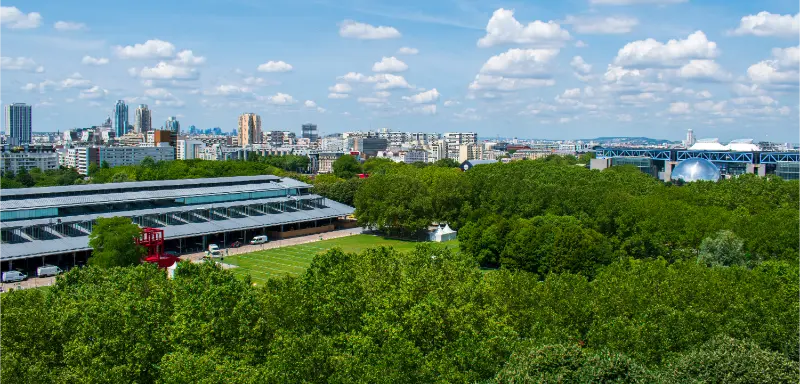
Heading northeast takes you toward the Cité des Sciences and Parc de la Villette. This is the strongest first-time route because it connects water, contemporary cultural architecture and large public spaces. The canal gradually stops feeling like an isolated scenic feature and becomes infrastructure threaded through recreation, freight history and new urban uses.
Summer 2026: the water is not only scenery
The Ville de Paris promoted free canoe, kayak and stand-up-paddle sessions at Bassin de la Villette from 4 July to 30 August 2026, 13:00–19:00, from age 14. Seasonal programs change every year, so use this as a model of what the basin can host, not a permanent promise. In summer, always check the current Paris Plages/water-sports calendar.
Licensed electric boats can also be rented on the Canal de l’Ourcq without a boating licence through private operators, allowing visitors to travel toward Parc de la Villette and farther. If you are considering one, compare the rental duration with how much canal you actually want to see; a five-hour booking can turn a relaxed novelty into the main event of the day.
Walking vs cycling
Walking is best for the Bassin-to-La-Villette segment because cafés, bridges and cultural stops are close together. Cycling becomes more useful if you want to continue farther northeast. Use our Paris by bike and Vélib’ guide for rules and bike-system basics rather than renting impulsively at the canal.
A 3-hour route
- Start at Stalingrad/Jaurès and look across Bassin de la Villette.
- Walk one bank northeast, stopping only when the water/urban view changes rather than at every barge.
- Reach Parc de la Villette and cross through the public spaces around the Cité des Sciences.
- If energy is high, continue a short distance along the Ourcq beyond the park for a more local industrial-residential feel.
- Return by Metro from Porte de Pantin or another convenient station rather than retracing every step.
Families: space is the advantage
Compared with narrow central sidewalks, this area gives families more room and easier breaks. Pairing the canal with Cité des Sciences is particularly strong because you can alternate structured indoor time with outdoor movement. For young children, avoid making the canal walk too linear: pick a destination and use Metro for the return.
How it differs from Canal Saint-Martin
Canal Saint-Martin is more intimate: locks, footbridges, trees, cafés and dense streets. Bassin de la Villette/Ourcq is broader, more recreational and increasingly metropolitan as it heads northeast. If you only have one canal walk and want classic Paris atmosphere, choose Saint-Martin. If you want space, cycling, families or contemporary northeast Paris, choose Villette/Ourcq.
Set the turnaround point before you start walking
Bassin de la Villette alone can fill 60–90 minutes with bridges, waterside activity and a café stop. Continuing through Parc de la Villette makes a strong three-hour route. Once you keep following Canal de l’Ourcq, however, the experience stops behaving like a compact sightseeing walk: the waterway continues far beyond the tourist core and becomes part of the wider metropolitan landscape.
Decide in advance whether your finish is Parc de la Villette, Pantin or simply a time limit. That one decision prevents the common problem of walking farther than your energy—or daylight—supports.
Do not assume every kilometre of canal is the same experience
The Bassin is broad and social, the La Villette section is cultural and park-oriented, and farther stretches mix housing, sport, industry and commuting. That change is valuable for repeat visitors, but it is not a continuous postcard. Continue because you are curious about that transition, not because a map line suggests you must keep going.
Choose one canal cluster, not three
Pair the Bassin with La Villette and, for families, the Cité des Sciences. If you prefer cafés and iron footbridges, use our Canal Saint-Martin route on a different day rather than trying to walk every Paris canal in one continuous outing.
Frequently asked questions
Is Canal de l’Ourcq the same as Canal Saint-Martin?
No. They connect through the Paris canal system, but the Ourcq begins at Bassin de la Villette and continues far beyond Paris; Canal Saint-Martin runs south from the basin toward the Seine.
How long is Canal de l’Ourcq?
The City of Paris describes the canal itself as 97 km long from Paris to Mareuil-sur-Ourcq.
Can you rent boats?
Yes, private operators offer licence-free electric boats on parts of the canal; availability and prices are seasonal.
Is it good with children?
Yes, especially when paired with La Villette/Cité des Sciences, because the area offers more open space than central Paris.
What is the best Metro access?
Stalingrad/Jaurès work well for the Bassin; Porte de Pantin/Porte de la Villette are useful around Parc de la Villette depending your route.
The canal as infrastructure, not decoration
The Ourcq was conceived under Bonaparte in the early 19th century to improve Paris’s water supply and navigation. The city notes that work began in 1802 and the canal opened in stages. Knowing that history changes the walk: locks, widths, bridges and industrial edges become evidence of an engineered system rather than picturesque background.
A food and evening version
In warm weather, arrive late afternoon, walk from the Bassin toward La Villette and stop for dinner around the canal or in the 19th. This creates a low-ticket evening alternative to central monuments. Keep valuables controlled on crowded quays and use normal city awareness, but do not treat the area as a “hidden dangerous Paris” trope; it is a lived recreational corridor with varying blocks and atmospheres.
A canal day by traveler type
Couples: late-afternoon walk, apéritif and dinner near the water. Families: Cité des Sciences first, then a short canal segment as decompression. Cyclists: use the Bassin as the start of a longer northeast ride. Repeat visitors: continue beyond Parc de la Villette to see where tourist Paris blends into the wider metropolis.
Do not confuse “local” with empty
Warm evenings can make the Bassin and quays busy. Local atmosphere does not mean solitude, and a crowded summer canal bank may be more social than a central museum district. If you want quiet, go morning. If you want the reason Parisians use the area, go late afternoon or evening in good weather.
A rain alternative
If rain arrives, shorten the open-air section and move into Cité des Sciences, Philharmonie-related programming or another La Villette venue. This is one reason the area is easy to plan: the canal is the connective landscape, but the day does not depend entirely on dry weather.
How far should you actually continue?
For most visitors, Parc de la Villette is the natural endpoint. Continuing a little farther gives you a useful sense of the canal’s metropolitan character, but walking kilometres beyond that only makes sense if the canal itself is your subject. A bike changes the calculation because distance becomes part of the pleasure rather than dead time.
Set a hard turnaround based on daylight and your return station. In summer the long evening can tempt you farther than planned; in winter the same industrial edges can feel empty after dark. A good canal day ends while the waterside still feels enjoyable, not when you are tired enough to resent the walk back.
Where the experience starts to feel less tourist-oriented
Beyond the immediate Bassin and La Villette cultural zone, the canal edges become more mixed: residential blocks, sports, industry and everyday commuting share the water. That transition is exactly the point for repeat visitors. You are watching Paris merge into the wider Grand Paris landscape rather than hunting for another isolated monument.
A canal-day checklist that is actually specific
- Choose walking, cycling or a boat activity before setting the distance; each changes the sensible turnaround point.
- In summer, verify the current Paris Plages/water-activity program rather than assuming swimming or rentals operate every day.
- After dark, use the livelier stretches and a clear Metro return instead of extending the route simply because the canal continues.
- For children, build the day around open space and one major indoor attraction, not several museums around La Villette.
- Carry a light layer: waterside evenings can feel cooler than dense central streets even after a warm afternoon.
The canal is most rewarding when you allow the scenery to become progressively less monumental. That change—from leisure basin to working metropolitan waterway—is part of the point.