
Disclosure: This article contains affiliate links or booking widgets. If you book through them, Dreaming of Paris may earn a commission at no extra cost to you. How our affiliate links work.
Getting from Charles de Gaulle Airport to Paris is simple only after you look at the final hotel leg. RER B is the public-transport backbone, while the regulated taxi flat fare becomes increasingly attractive for several travelers, large luggage or hotels far from a convenient RER connection. The wrong decision is usually made by comparing “train versus taxi” without mapping the last fifteen minutes.
RER B in 2026
RER B serves major central stations including Gare du Nord, Châtelet–Les Halles, Saint-Michel–Notre-Dame, Luxembourg and Denfert-Rochereau. The eligible airport journey uses the €14 Paris Region–Airports ticket in 2026; it is not the €2.55 ordinary Metro-Train-RER fare.
RER B is particularly logical if your accommodation is walkable from a central RER station. If you need an onward metro connection, check the station layout. A short line on the map can hide long underground corridors and stairs.
The terminal part people underestimate
CDG is a multi-terminal airport. After landing you may still have immigration, baggage reclaim and terminal movement before you even reach the rail or taxi decision. Follow airport signage once you know your actual arrival terminal rather than assuming the railway is a five-minute walk away.
This is why I avoid timed attractions on long-haul arrival afternoons. The airport-to-city leg is predictable enough for transport planning but not precise enough for a non-refundable 16:00 museum slot.
Taxi flat fares
For direct airport trips, current regulated maximum flat fares are €56 between CDG and the Right Bank and €65 between CDG and the Left Bank, before permitted supplements. For one person, RER B is much cheaper. For a family or group of four, the difference narrows quickly.
Use the official taxi rank. An unsolicited driver approaching you inside arrivals is not the same thing as joining the regulated taxi queue. The flat fare is valuable precisely because it removes the need to negotiate.
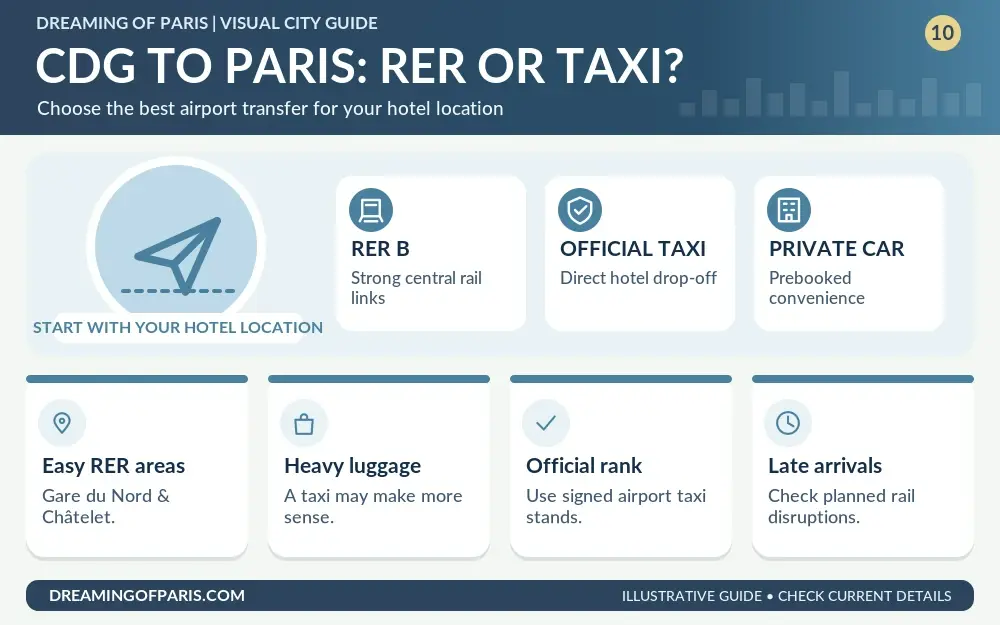
Where RER B is strongest
Gare du Nord and the central RER corridor are obvious winners. Latin Quarter hotels near Saint-Michel or Luxembourg can also be convenient. Le Marais may require an onward connection, while Eiffel Tower hotels have no direct RER B stop. For those areas, compare a taxi with the full rail-and-metro chain rather than only the first segment.
If your hotel is still undecided, use our Paris neighborhood guide and current hotel inventory on Booking.com.
Late arrivals and planned works
Evening engineering work and service changes can alter the best route. Check the official RATP or Île-de-France Mobilités planner close to travel. Know your taxi fallback before you land rather than troubleshooting after the last convenient train.
A good airport plan always has Plan B. For CDG that usually means understanding both RER B and the regulated taxi fare even if you expect to use only one.
A realistic arrival sequence
Think in stages: aircraft at gate, immigration if applicable, baggage reclaim, terminal movement, ticket/taxi queue, journey to Paris, final hotel leg. The uncertain part is mainly before you board the city transport.
For a first evening, choose dinner near your accommodation or an easy Seine/neighborhood walk. Our first-time Paris itinerary is designed around that lower-risk arrival strategy.
Frequently asked questions
How much is RER B from CDG in 2026?
The eligible airport journey uses the €14 Paris Region–Airports single ticket.
How much is a taxi from CDG to Paris?
Current flat-rate maxima are €56 to the Right Bank and €65 to the Left Bank, before allowed supplements.
Does RER B go to the Eiffel Tower?
No. You need an onward connection, which is why groups staying near the Tower should compare taxi door-to-door.
Is RER B safe with luggage?
Use normal big-city precautions: zipped bags, valuables inaccessible and extra attention in crowds and at doors.
Should I buy an unlimited pass at CDG?
Only after comparing your complete itinerary. The most expensive unlimited product is not automatically the best value.
How this fits into our Paris Arrivals cluster
This guide is designed to connect with the rest of the site rather than sit alone. Continue with airport comparison, transport guide and scams and mistakes. Internal links are placed where the next decision naturally appears, so you can move from transport to neighborhood, attraction, season or day trip without rebuilding the plan from scratch.
The decision that matters most
Pick the option that is easiest at the hotel end. RER B can be perfect until the final transfer becomes a luggage problem; a taxi can look expensive until four travelers split the regulated fare.
How to make the decision before you fly
For CDG Airport to Paris, save the exact hotel address offline and test two door-to-door routes before departure: the best public-transport route and the licensed-taxi fallback. Compare total group cost, number of changes, estimated walking with luggage and what happens if the flight is one hour late. This simple exercise is more useful than memorizing a single “best transfer.” Airport travel is unusually sensitive to luggage, children, mobility, time of day and the location of the hotel entrance relative to the station exit.
What to keep in your hand luggage
Keep the hotel address, reservation confirmation, a charged phone, payment card and any transport app you plan to use accessible before landing. Do not bury the information you need inside checked luggage or a suitcase that must be opened on the station floor. A small amount of preparation reduces the temptation to accept help from unofficial drivers or strangers at ticket machines. If your phone depends on roaming or an eSIM, make sure connectivity is working before you leave the terminal.
When public transport stops being the cheapest option in practice
Price per passenger is only one cost. Add the possibility of a second local ticket, a last-mile taxi, luggage fatigue and the time value of multiple transfers. A couple may still prefer rail because it is predictable in traffic; a family may find a flat-rate taxi close enough in price to justify the convenience. Travelers with limited mobility should also investigate lift availability and station layouts rather than assuming every rail interchange is equally easy.
Arrival day: the low-risk version
After checking in, keep the first activity close to the hotel. Walk a neighborhood, eat early, buy basic groceries or take a short river walk. This creates slack for a delayed flight and lets you learn the local metro entrance without pressure. Save timed icons for the next morning. If you arrive surprisingly early and energetic, you can always add something flexible; the reverse—trying to recover a missed nonrefundable ticket—is much harder.
Departure day: work backward from the flight
Start with the airline’s required airport arrival time, then subtract the verified transport duration and an additional disruption margin. Do not begin with the first train you hope will work. Early flights are the situation in which a prebooked taxi, airport hotel or different final-night plan can be rational even for travelers who used public transport during the rest of the trip.
Mobility, children and heavy luggage
A route that looks easy on a transit map may involve escalators, long passageways and platform changes. Families should count suitcases and strollers before choosing, while travelers with reduced mobility should verify step-free routing on official transport information. A direct taxi is not automatically “less authentic”; airport transfers are logistics, and the best option is the one that gets everyone to the hotel with enough energy left to enjoy Paris.
48-hour checklist
Recheck planned engineering works, the flight terminal, the hotel’s check-in instructions and the official transport planner. Screenshot the address and route. Confirm the current regulated taxi fare if that is your backup. Charge devices and avoid scheduling a critical connection immediately after landing. Paris airport systems are manageable, but the small details are what turn a smooth transfer into a stressful one.
If your flight is delayed
A delayed flight should change the evening, not the whole trip. Once the new arrival time is clear, recheck the official transport planner and decide whether your original route still makes sense. If public transport becomes awkward, switch to the licensed-taxi fallback you already priced. Message the hotel if check-in is affected. Do not try to “win back” lost time by rushing straight to a major attraction. Eat near the hotel, take a short walk if you still have energy, sleep, and restart the itinerary the next morning. This protects the expensive part of the trip—the days after arrival—from one unpredictable travel day.
If you arrive before hotel check-in
Ask the hotel about luggage storage before the trip rather than improvising with cases in the city. Once bags are stored, choose a low-commitment activity within the same part of Paris: coffee, lunch, a market street, a park or a river walk. Large luggage is inconvenient on the metro and can be prohibited at some attractions, so using the hotel as the first logistical anchor is usually smarter than sightseeing directly from the airport. If the property cannot store bags, research a reputable luggage solution near your arrival route in advance and verify its current hours.
The easiest way to compare options
For CDG Airport to Paris, write the real cost of each route for your group in one line: tickets or taxi fare, expected travel time, number of changes, walking distance with luggage and the latest time the route remains practical. A route with one direct train may beat a faster theoretical route with two transfers. A taxi may beat rail for a family even when it loses for a solo traveler. This five-factor comparison is more reliable than generic advice because it changes automatically with your hotel, group and arrival time.
Leaving CDG during a long connection
Travelers with a long connection should use our CDG layover guide before deciding whether 6, 8, 10 or 12 hours is enough for central Paris.
\n\nWhen an airport hotel is the smarter choice
\n\n\nFor very early flights or late arrivals, our CDG airport hotel guide compares Terminal 2, Roissypôle and Roissy-en-France.
\n