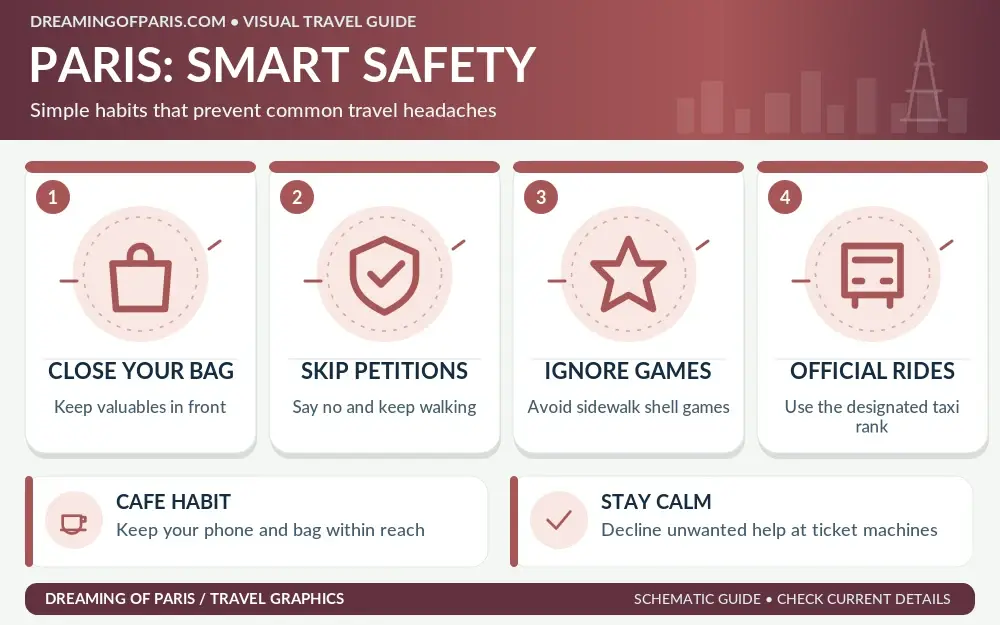
Paris is not a city where visitors need to travel in fear, but it is a city where distraction can be expensive. Most tourist problems are ordinary: open bags on crowded transport, phones left on café tables, fake taxi approaches, petition pressure, bracelet tactics, shell games and confusion at ticket machines. The best defense is recognizing the situation early without treating every stranger as a threat.
Pickpocketing is about opportunity
Crowded metro cars, station escalators and queues create opportunities. Use a zipped bag, keep valuables inaccessible and avoid carrying a phone half out of a back pocket while following a map. Think about access to your belongings rather than trying to memorize a list of “dangerous” arrondissements.
Petitions and clipboards
If someone pressures you to sign, donate or engage with a clipboard in a tourist area, you do not owe a conversation. Keep moving and keep belongings closed. The goal is to avoid distraction and crowding, not to debate the person.
Bracelets and unwanted gifts
Some visitors encounter people who try to place a bracelet or string on a wrist and then demand payment. Do not extend your hand, do not stop and say no early. Prevention is easier than negotiating after physical contact.
Shell games
Do not stake money on street cup, disk or card games where bystanders appear to be winning. Apparent winners can be part of the setup, and the crowd can also distract you from your belongings.
Fake airport taxi mistake
At CDG and Orly, use the official taxi rank or a clearly identified prebooked driver. Direct Paris airport taxi journeys have regulated flat fares, so an unsolicited “special deal” inside arrivals is unnecessary. Read our airport guide before landing.
Ticket-machine helpers
Paris ticketing changed significantly in 2025–2026. If an unsolicited stranger tries to control your purchase, step away and use official staff, official apps or another machine. Our 2026 transport guide explains the current fare structure before you arrive.
Phone and café habits
Do not leave a high-value phone at the edge of an outdoor table where someone can cover it with paper or distract you. Put it away when you are not using it and position bags so they cannot be lifted while you are focused on food or conversation.
Planning mistakes that cost time
The Louvre is closed Tuesday; Versailles Palace is closed Monday; viewpoint recommendations can become outdated; airport tickets differ from ordinary city tickets. Group sights by area and avoid nonrefundable reservations immediately after flights. These are not scams, but they ruin trips just as effectively.
Frequently asked questions
Is Paris safe for tourists?
Millions of visitors use Paris normally. The most useful precautions focus on pickpocketing, distraction and licensed transport rather than generalized fear.
Where are pickpockets common?
Risk is tied to crowded tourist and transport environments, especially busy metro cars, stations and queues.
How do I avoid fake taxis?
Use the official airport taxi rank or a clearly identified prebooked service.
What should I do if something is stolen?
Prioritize safety, block cards or devices as appropriate, contact police for a report when needed and contact your insurer or consulate for important documents.
Should I avoid the Metro at night?
Not as a blanket rule. Use normal awareness, choose comfortable routes and switch to a licensed taxi when a journey feels impractical or too late.
How this fits into our Practical Paris cluster
This guide is designed to connect with the rest of the site rather than sit alone. Continue with first-time itinerary, transport guide and airport guide. Internal links are placed where the next decision naturally appears, so you can move from transport to neighborhood, attraction, season or day trip without rebuilding the plan from scratch.
The decision that matters most
Make yourself a difficult target without letting precautions dominate the trip: close the bag, put the phone away, know the correct fare, use official taxi ranks and keep walking when an interaction feels engineered.
Use a decision rule instead of a long checklist
The easiest way to apply Paris scams advice is to define one rule before the day begins. For shopping, decide the purpose and budget. For safety, decide where phone, wallet and passport will live. For free sightseeing, decide which paid attraction is worth spending on and let free stops fill the surrounding geography. A clear rule prevents dozens of tiny choices from consuming the day.
Keep the city geographically coherent
A practical Paris day should rarely require repeated cross-city travel. Pair shopping with the neighborhood around it, free museums with nearby parks, and evening plans with where you already are. Every extra metro transfer introduces stairs, waiting and the temptation to buy something or eat somewhere simply because everyone is tired. Geography is one of the strongest budget and safety tools at the same time.
What to prepare offline
Save the hotel address, emergency contact details, copies of key reservations and the names of the official transport apps you intend to use. Do not keep every critical detail in one online document that becomes inaccessible when the phone battery dies or data fails. A small offline note with hotel, insurance and card-blocking information takes minutes to create and is far more useful than carrying a thick printed itinerary.
Cash, cards and payment habits
Cards are widely useful, but keep one backup payment method separate from the main wallet. Do not expose all cash, cards and identification every time you buy a coffee. For larger purchases, understand the refund or return conditions before paying. For small markets, having a modest amount of cash can be convenient, but there is no reason to carry a large emergency reserve on your person all day.
When “saving money” becomes false economy
Walking 40 minutes in bad weather to save one metro ticket, taking a complicated airport route with tired children or choosing accommodation far from every planned activity can cost more in time and energy than it saves in euros. Budget travel works best when you protect the expensive parts of the trip—your limited vacation days, sleep and major reservations—rather than optimizing every small transaction.
How to evaluate online advice
Check the publication date, whether the writer distinguishes official rules from personal preference, and whether prices or closures are sourced. Paris changes: transport fares, museum access, viewpoints and seasonal events can become outdated quickly. Advice that never mentions dates is useful for atmosphere but weaker for operations. Verify anything that can make you miss a train, ticket, refund or reservation.
End-of-day reset
Each evening, spend five minutes checking the next morning’s first reservation, transport disruptions and weather. Repack the day bag so valuables have fixed locations. This tiny routine reduces mistakes when you leave the hotel early and tired. It also lets you change tomorrow’s order before a weather or transport problem turns into a lost morning.
A simple daily money system
Separate the money you expect to spend today from backup funds and cards. Keep the main payment method accessible but protected, and store the backup separately. This reduces both overspending and the consequences of losing one wallet. For shopping-heavy days, note your intended budget before entering the first department store. For free-sightseeing days, decide in advance which paid experience is allowed to break the budget. Small rules are easier to follow than trying to evaluate every purchase from scratch.
How to avoid decision fatigue
When dealing with Paris scams, make the key choices before the busy part of the day. Know the correct transport ticket, identify the shopping district, choose the museum cluster or decide where valuables will be carried. Once outside, you should be looking at Paris rather than repeatedly researching logistics on the pavement. Good practical planning is almost invisible: it removes dozens of tiny problems so the city itself gets more of your attention.
What to verify with an official source
Use official sources for any rule that can cost money or make you miss something: transport fares, museum closures, tax-refund eligibility, airport taxi rates and event opening dates. Blogs are excellent for strategy and lived experience, but operational facts age quickly. If a rule has a number, deadline or exception attached to it, verify it close to the trip. This habit is one of the best ways to avoid the exact kind of outdated advice that makes otherwise useful travel articles unreliable.
What to do after an uncomfortable interaction
If someone pressures, follows or crowds you, move toward a staffed shop, hotel, station information point or other populated place. You do not need to diagnose whether the person intended a scam before leaving the situation. Keep your response short, protect belongings and prioritize distance. If money or property has been taken, avoid physically confronting a group. Document what happened as soon as practical, block cards or devices if necessary and contact police or transport staff for the appropriate next step.
Travel insurance and document resilience
Before departure, keep secure digital copies of the passport identification page, insurance policy and important booking references. Store them somewhere you can access if the phone is lost, but do not leave sensitive files publicly accessible. Know how to freeze your payment cards and locate your phone remotely. This preparation is not Paris-specific, yet it reduces the consequences of the most common travel problems. Good safety planning focuses as much on recovery as on prevention, because no traveler can eliminate every risk.
Traveling alone
Solo visitors can combine these safety habits with our solo travel in Paris guide for dining, nightlife and neighborhood planning.
Safety planning for solo travelers
Traveling alone changes some evening and dining decisions but does not require a fear-based itinerary. Our solo travel in Paris guide covers practical safety, eating alone and route planning in more detail.
Protect the practical side of the trip
Keep payment risk low with our money, cards and ATM guide, and save the official contacts in our Paris emergency numbers and pharmacies guide.