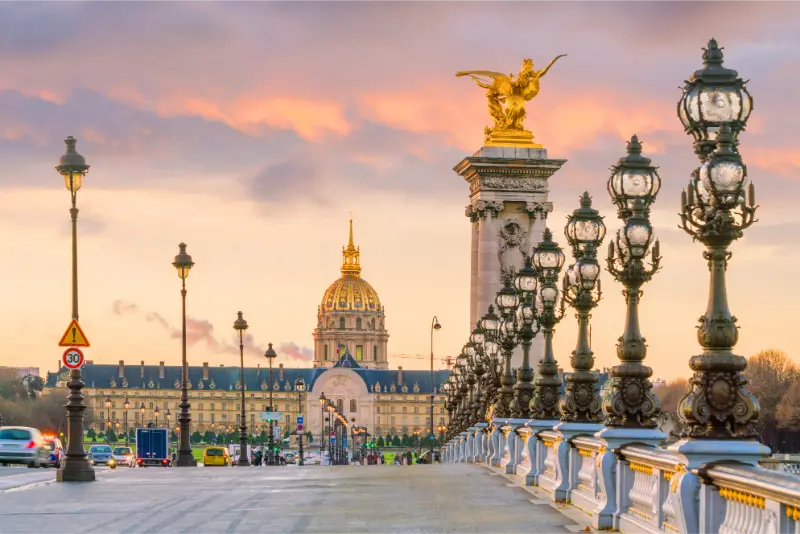
Waking up early in Paris is useful only if you choose places that are actually accessible early. Many museums and monuments will still be closed, so a 6:30 start should not be built around ticketed attractions. Early morning is strongest for public streets, bridges, riverbanks, squares, architecture and photography, followed by breakfast as the city begins to open.
Île de la Cité before the day builds
The exterior of Notre-Dame, bridges and Seine edges are calmer before tour groups accumulate. Use the quiet period for public-space views, then return later if you hold a timed ticket for another island monument. This separates atmosphere from queue management.
The easiest way to make a Paris itinerary feel relaxed is to group sights geographically. Crossing the city is simple, but repeated cross-city journeys create invisible fatigue. Keep each half-day in one broad zone and use a single transport jump when you deliberately change neighborhoods.
Montmartre before the portrait crowds
The hill can feel dramatically different early, especially around the lanes beyond the most direct Sacré-Cœur approach. Because many of these streets are residential, early-morning photography is usually more comfortable when doorways remain clear and the stop stays brief.
Build the day around opening patterns rather than around a rigid ranking of attractions. Early mornings, late openings and neighborhood meal times can change what works. Keep one indoor alternative and one free outdoor alternative available so weather or queues do not derail the whole plan.
The Seine and bridges
A river walk works at almost any hour, but early light and lighter pedestrian traffic make central bridges easier to appreciate. Pick a short section rather than attempting the entire river through Paris before breakfast.
Leave unassigned time. Paris rewards the small discoveries between the headline sights: a bakery queue full of locals, a courtyard glimpsed through an open gate, a river view at a different angle. A plan with breathing room gives those moments somewhere to happen.
Breakfast should be part of the plan
Do not assume every celebrated bakery opens at dawn or every café serves the same schedule daily. Choose a neighborhood with several options and let the first hour end with breakfast rather than turning the morning into a race for one viral pastry.
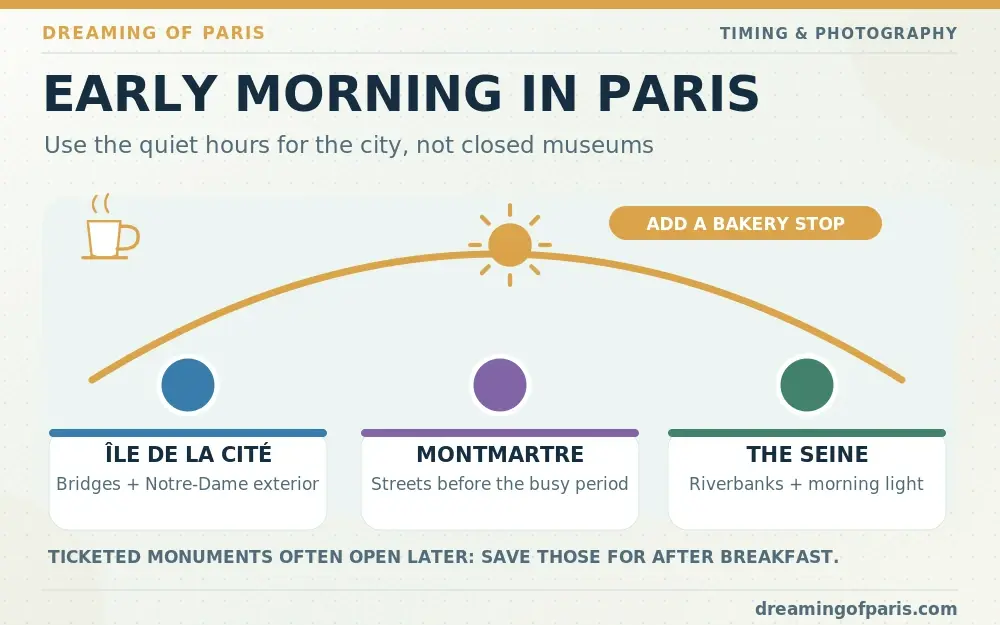
What is not better early
There is little advantage in standing outside a closed museum far before opening unless a specific queue pattern justifies it. Early time is valuable; spend it on spaces that are already available, then arrive at ticketed sites shortly before your official entry.
Photography without empty-city fantasies
You can find calmer compositions, but central Paris is never truly empty: cleaners, deliveries, commuters and residents are already at work. Include that reality rather than expecting a film set with no people.
Useful connections on Dreaming of Paris
Use our Notre-Dame and Île de la Cité guide or Montmartre walk for the next part of the morning.
What time is ‘early’ in Paris?
For public-space walking, roughly sunrise to 8:00 can feel substantially calmer, but useful timing changes by season and neighborhood.
Is the metro running very early?
Service begins early but not all night. Check the current RATP/Île-de-France Mobilités schedule for your exact line and day.
Is Paris safe to photograph alone at dawn?
Conditions vary by location and hour. Use normal city awareness, keep equipment discreet and avoid isolated spaces if they make you uncomfortable.
A final planning note
The best early-morning Paris plan uses the hours before opening for atmosphere, not for waiting. Walk one compact public area, eat breakfast, then transition into the first timed attraction of the day.
For early morning in Paris, one more practical point is worth keeping in mind. Build the day around opening patterns rather than around a rigid ranking of attractions. Early mornings, late openings and neighborhood meal times can change what works. Keep one indoor alternative and one free outdoor alternative available so weather or queues do not derail the whole plan. Use this as a decision rule rather than a rigid instruction: the best version of the day is the one that keeps the route coherent and leaves enough energy for the place itself.
For early morning in Paris, one more practical point is worth keeping in mind. Leave unassigned time. Paris rewards the small discoveries between the headline sights: a bakery queue full of locals, a courtyard glimpsed through an open gate, a river view at a different angle. A plan with breathing room gives those moments somewhere to happen. Use this as a decision rule rather than a rigid instruction: the best version of the day is the one that keeps the route coherent and leaves enough energy for the place itself.
For early morning in Paris, one more practical point is worth keeping in mind. The easiest way to make a Paris itinerary feel relaxed is to group sights geographically. Crossing the city is simple, but repeated cross-city journeys create invisible fatigue. Keep each half-day in one broad zone and use a single transport jump when you deliberately change neighborhoods. Use this as a decision rule rather than a rigid instruction: the best version of the day is the one that keeps the route coherent and leaves enough energy for the place itself.
Use the first two hours for places that benefit from emptiness
Early morning is valuable when a place is visually transformed by lower foot traffic. The Seine bridges, Place Dauphine, the exterior of Notre-Dame, Montmartre lanes and viewpoints are good examples. A museum that does not open until later gains nothing from a 6:30 a.m. wake-up, so do not sacrifice sleep for attractions whose bottleneck begins at the ticket desk.
A strong first morning can be very simple: reach Île de la Cité around sunrise or shortly after, cross two or three bridges, walk the river and stop for breakfast when bakeries and cafés begin serving. Save the first timed monument for late morning. Another day, use the same principle in Montmartre: photograph the streets before tour groups build, then eat breakfast and visit interiors when they open.
Photography without chasing an empty city
Paris is a working city even at dawn. Delivery vans, street-cleaning crews, commuters and runners are part of the scene. Treating them as obstacles to an “empty Paris” photo creates frustration and can lead to unsafe behavior in roads. Use the quieter hour to frame architecture more carefully, but stay on pavements and respect work crews.
If you are alone, choose well-lit, familiar routes and keep expensive equipment discreet between shots. Dawn in summer can be extremely early; in winter, the same light arrives at a much more comfortable hour. Check sunrise time for your actual travel date rather than following a generic “be there at 6 a.m.” rule.
Early starts work best when the hotel location supports them. A central base can save an hour of transit across two mornings, which may justify a higher room price for photographers or first-time visitors. Use our where to stay in Paris guide to compare that trade-off, and pair the morning with the evening guide rather than trying to do both late night and dawn every day.
A practical decision check for Early Morning in Paris
Early morning is worth the alarm only for places transformed by low foot traffic or soft light. It is wasted on attractions that remain closed until mid-morning. Before you give it a fixed slot, compare that reason with the strongest alternative already on your itinerary. If the alternative matters more, move this stop to an optional block instead of forcing both into the same half-day. That simple choice keeps the article useful for different travelers rather than implying that every reader needs the same Paris.
A realistic way to fit it into the day
Pick one zone—Île de la Cité, Montmartre or the Seine—walk for 60–90 minutes, then eat breakfast nearby and begin the first ticketed visit when it opens. Keep the previous and following stops close enough that a delay of twenty or thirty minutes does not create a cascade of missed reservations. Paris days become much easier when the route can absorb a longer lunch, a queue or a weather change without requiring a taxi across the city.
The trade-off worth making explicit
The trade-off is sleep versus atmosphere. One or two early mornings can improve a trip; doing it daily often reduces enjoyment more than crowds would. Making that trade-off deliberately is more useful than adding another item to a checklist. Ask what you would remove if this experience takes longer than expected; if the answer is “nothing,” the day is probably already too full.
Small details that prevent avoidable problems
Check sunrise for your travel date and the first practical transport option from your hotel. Winter dawn and summer dawn are radically different planning problems. Save the exact address or entrance you intend to use, keep enough phone battery for the return route and recheck any time-sensitive information on the official site. These are small steps, but they protect the part of the experience that actually matters from being swallowed by logistics.
Where it belongs in the wider Paris cluster
Use dawn with an early-closing day or a relaxed afternoon. Do not combine a late nightlife evening with a 5:30 a.m. photography start unless you intentionally schedule recovery time. Treat that pairing as a geographic or thematic cluster, not an obligation to complete everything. One strong connection is enough to make the day coherent; two or three distant add-ons usually reduce the value of the place you came to see.