
Disclosure: This article contains affiliate links or booking widgets. If you book through them, Dreaming of Paris may earn a commission at no extra cost to you. How our affiliate links work.
Île de la Cité is only a small island, but it can absorb half a day when you stop treating Notre-Dame as a single photo stop. This is the historic core of Paris: the cathedral, the former royal palace, Sainte-Chapelle, the Conciergerie, medieval street patterns, river views and small fragments of a city that existed long before the boulevards most visitors associate with Paris.
The useful way to visit is not to run from one monument entrance to another. Build the island around one timed attraction, usually Sainte-Chapelle, and let Notre-Dame, the quays and the western tip of the island provide the flexible parts of the day. That keeps queues from dictating your entire morning and gives you time to notice the geography of the Seine.
Notre-Dame in 2026: what changed for visitors
Notre-Dame reopened to the public after the post-fire restoration, and entry to the cathedral itself remains free. The cathedral recommends a free time-slot reservation because it can reduce waiting, but spontaneous entry is still possible. The most important detail is that legitimate cathedral entry is not sold as a paid skip-the-line ticket. Use the official Notre-Dame reservation information and be cautious with third-party pages that imply otherwise.
The current opening pattern is generous: Monday to Friday from 7:50 a.m. to 7 p.m., with Thursday extended to 10 p.m.; weekends generally open from 8:15 a.m. to 7:30 p.m. Last entry is 30 minutes before closing, and services or exceptional events can change access. Because Notre-Dame is an active cathedral rather than a museum, check the official calendar on your actual date.
The best time to see Notre-Dame
Early morning gives you the calmest exterior experience and lets you continue to Sainte-Chapelle before the island becomes busy. Thursday evening is another interesting option because the cathedral normally stays open later. Interior light varies by season and weather, so do not build the entire visit around an exact “perfect” minute. The building is rewarding in overcast light too because your attention shifts toward stone, vaulting and restored details.
If you have a reservation, arrive with reasonable margin but do not turn it into an airport check-in. Security is part of the process. Keep large luggage away from the visit and plan a normal city day bag instead.
What to look for inside instead of walking straight through
The temptation after years of restoration coverage is to look only for signs of what is “new.” A better visit compares the cathedral as a whole: the rebuilt roof and spire belong to the restoration story, while the nave, chapels, rose windows, choir and liturgical furnishings connect multiple periods of the building’s history. Slow down where the side aisles open into chapels and notice how the light changes as you move away from the center.
The Treasury is a separate paid visit with its own hours. If religious art and objects interest you, allow extra time; if your priority is architecture, do not feel obliged to add it simply because you are already inside.
Do not miss the exterior after the interior
Many visitors exit and immediately cross the square. Instead, walk around the east and south sides as access allows. The flying buttresses and chevet explain Gothic engineering more clearly than the west façade alone. The surroundings are still evolving after the restoration period, so paths and works can change. Treat the official signage on site as more current than any old walking map.
Sainte-Chapelle: the island’s other masterpiece
Sainte-Chapelle is physically close to Notre-Dame but emotionally very different. Built in the 13th century within the medieval royal palace, its upper chapel is dominated by stained glass. The visit is compact, often around 45 minutes, which makes it ideal as the timed anchor for your island route.
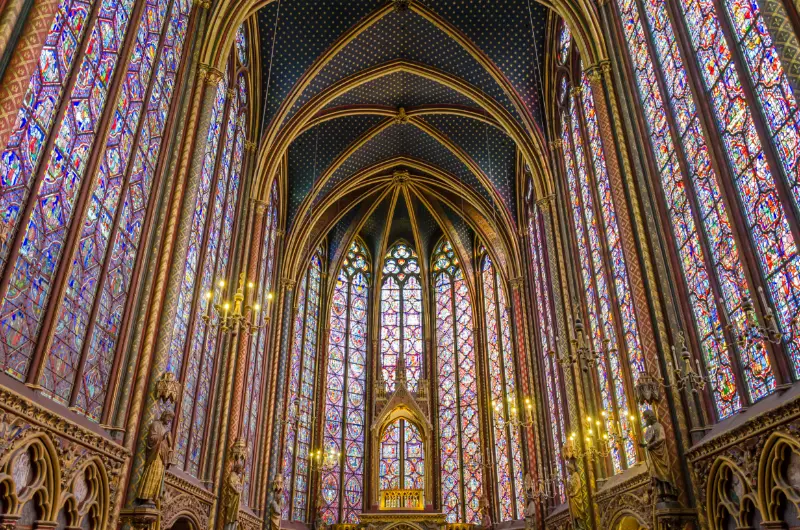
For 2026, the official Sainte-Chapelle site lists opening from 9 a.m. to 7 p.m. from April through September and 9 a.m. to 5 p.m. from October through March, with last access 30 minutes before closing. Individual ticket pricing changed in January 2026 and differs for EEA nationals/residents and other adult visitors, so check the current category before paying. A combined Sainte-Chapelle and Conciergerie ticket can make sense if you genuinely want both.
When is the stained glass best?
Bright sun can make the colors spectacular, but “sunny at noon” is not a universal rule. Orientation, season, cloud cover and crowd density all matter. If photography is your priority, give yourself enough time to wait for movement around the room rather than arriving with a ten-minute gap before another booking. On a grey day, the chapel is still extraordinary; the glass simply feels less explosive and more detailed.
The Conciergerie: worth it or skippable?
The Conciergerie occupies part of the former royal palace and later became a prison associated above all with the French Revolution and Marie Antoinette. It is worth adding if you like political history, medieval architecture or want context for the Palais de la Cité complex. If you have only two hours on the island, prioritize Notre-Dame plus either Sainte-Chapelle or a river walk rather than forcing all three interiors.
A useful rule is to avoid stacking three security lines in succession. Paris is more enjoyable when one substantial interior visit is followed by open air.
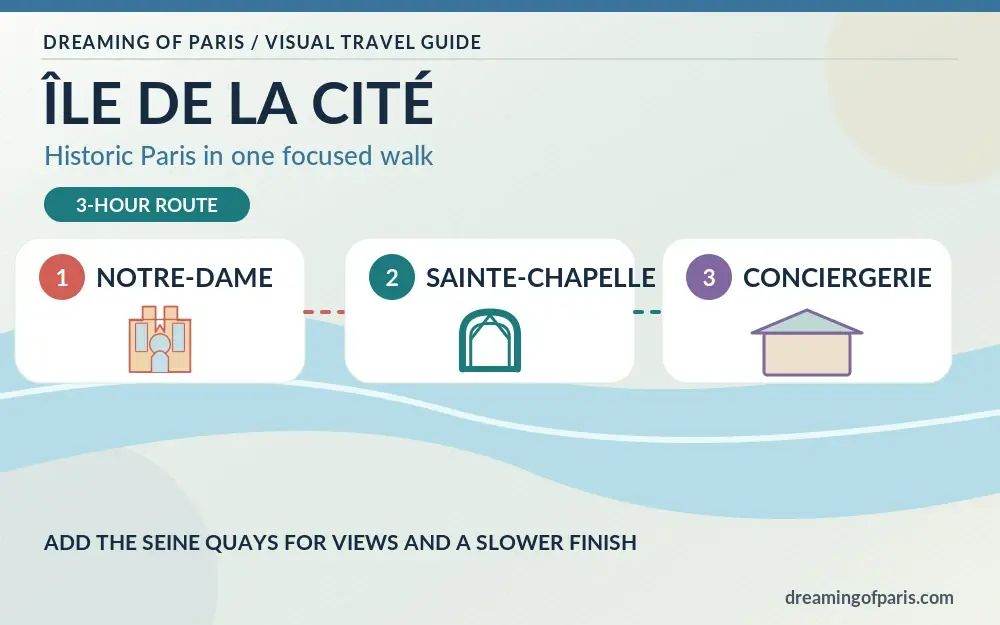
A smarter 3-hour Île de la Cité route
- 0:00–0:45: Notre-Dame interior and a slow look at the façade.
- 0:45–1:10: walk around the cathedral and along the eastern quays.
- 1:10–1:30: cross through the island toward the Palais de Justice area.
- 1:30–2:20: timed Sainte-Chapelle visit.
- 2:20–3:00: walk toward Pont Neuf and Square du Vert-Galant, then cross to the Right or Left Bank.
If you add the Conciergerie, make this a half-day. If you want lunch, do not rely only on the streets directly facing the cathedral; crossing to the Latin Quarter or Marais opens more options.
The quiet details most rushed visitors miss
Walk the quays rather than only the central streets. From the waterline you understand the island as a fortified and ceremonial place. At the western end, Square du Vert-Galant sits below Pont Neuf and gives you a low perspective along the Seine. It is not “secret,” but it feels surprisingly detached from the traffic above.
Look also at Place Dauphine, tucked behind the Palais de Justice. Its triangular plan dates to the early 17th century and creates a different mood from the monumental axis around Notre-Dame. It is particularly pleasant early or later in the day when through-tour traffic is thinner.
How to connect the island with the Latin Quarter
After Île de la Cité, the most natural continuation is south toward Saint-Michel and the Latin Quarter. This is better than jumping across Paris for Montmartre or the Eiffel Tower. You can continue toward the Sorbonne, Panthéon and Luxembourg Garden using our Latin Quarter walking guide and keep the day geographically coherent.
For a first visit, this pairing also works well on Day 1 of our 4-day Paris itinerary because both areas can be shortened if jet lag catches up with you.
How to connect the island with Le Marais
Cross north from the cathedral toward Hôtel de Ville and you can move directly into the Marais. This works especially well if your Notre-Dame visit is in the morning and you want lunch, small museums and neighborhood walking in the afternoon. Our Le Marais guide starts close enough that you do not need a metro transfer.
Notre-Dame with children
Keep the cathedral visit focused. Children often respond more strongly to a simple visual mission—find a rose window, gargoyle, carved portal figure or view across the river—than to a long architectural explanation. Sainte-Chapelle can be impressive because the visual impact is immediate, but its small spaces may feel crowded. Use the riverbanks as the reset between interiors. More pacing ideas are in our Paris with kids guide.
Accessibility and practical comfort
The cathedral interior and Treasury are listed as accessible, but the historic island includes uneven surfaces, security barriers and busy crossings. Sainte-Chapelle has accessibility provisions, yet its medieval structure means you should check the monument’s current access page if step-free movement is essential. Public toilets exist around the cathedral area; Notre-Dame itself states that there are no public toilets inside the cathedral.
Common mistakes on Île de la Cité
- Paying for a supposed Notre-Dame cathedral entrance ticket when cathedral admission is free.
- Booking Sainte-Chapelle immediately after another timed attraction across the city.
- Visiting only the west façade and missing the riverside views.
- Trying to do Notre-Dame, Sainte-Chapelle and Conciergerie in 90 minutes.
- Leaving the island for a distant neighborhood instead of continuing naturally into the Latin Quarter or Marais.
FAQ
Do I need a reservation for Notre-Dame?
No. Individual visitors can enter without a reservation, but a free official time slot is recommended when available because it can reduce waiting.
Is Notre-Dame free?
Entry to the cathedral is free. Separate experiences such as the Treasury have their own charges.
How long should I spend on Île de la Cité?
Allow three hours for Notre-Dame, Sainte-Chapelle and a good island walk. Allow half a day if you add the Conciergerie, lunch and time to photograph the river.
Can I combine Notre-Dame and the Louvre?
You can, but avoid making both heavy visits. A better combination is Notre-Dame and Sainte-Chapelle in the morning, then a relaxed walk west; save the Louvre for a separate focused session using our Louvre strategy guide.
The island is at its best when you let history and geography work together. Reserve only what truly needs a time slot, keep Notre-Dame flexible and leave enough open air between monuments. That is how a compact square kilometer becomes one of the richest half-days in Paris.
More of Île de la Cité
Pair Notre-Dame with our Sainte-Chapelle and Conciergerie guide for a focused historic-island route.
Continue onto Île Saint-Louis
After the monument-heavy Île de la Cité, use our Île Saint-Louis guide for quieter quays and seventeenth-century architecture.
Climb the reopened towers
The cathedral and towers now require separate planning. See our 2026 Notre-Dame Towers guide for the compulsory e-ticket, 424 steps and late summer opening.
Compare Île de la Cité and Notre-Dame guided visits
The live options below are useful if you want a guided visit, reserved experience or packaged activity for this specific part of the trip. Compare the exact inclusions, meeting point, language and cancellation terms before booking.