Disclosure: This article contains affiliate links or booking widgets. If you book through them, Dreaming of Paris may earn a commission at no extra cost to you. How our affiliate links work.
Les Invalides is not one attraction. It is a monumental complex containing the Musée de l’Armée, the Dôme des Invalides and Napoleon I’s tomb, plus additional collections and temporary exhibitions. Visitors often make one of two mistakes: they assume the tomb is a quick standalone photo stop, or they try to read every military gallery and end the day exhausted.
Check tickets and Paris experiences
Compare current tours, timed-entry tickets and experiences before fixing your itinerary.
GetYourGuideTiqetsCivitatisViatorAffiliate links: we may earn a commission at no extra cost to you.
In 2026 the Musée de l’Armée is generally open every day from 10 a.m. to 6 p.m., with annual closures on January 1, May 1 and December 25. The first Friday of each month has a late opening until 10 p.m. under the current schedule. Standard admission covers the Dome Church and Napoleon’s tomb, the permanent collections, the current temporary exhibition and associated museums listed by the institution.
Decide what kind of Invalides visit you want
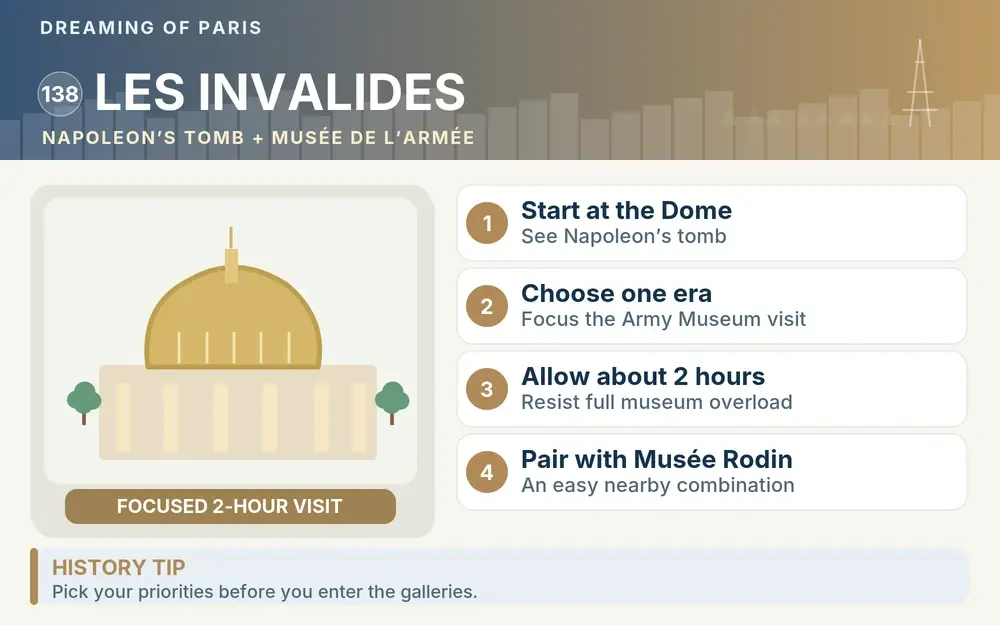
A 60–90 minute visit can focus on the Dome, Napoleon’s tomb and a small amount of context. A two-to-three-hour visit allows one substantial Musée de l’Armée section as well. A half-day makes sense for visitors with a strong interest in military history. Choose before entering; the collection is too large for casual completionism.
This is the same principle we use for the Louvre and Orsay: a museum becomes more memorable when you choose a route rather than measuring success by rooms covered.
The Dome and Napoleon’s tomb
The gilded dome is visible across large parts of central Paris and creates the visual climax of the site. Inside, Napoleon’s tomb occupies a circular crypt beneath the dome, surrounded by a deliberately monumental architectural setting. Give yourself time to view the tomb from the upper level and then descend; the spatial sequence is part of the design.
Remember that Les Invalides began as a royal institution for wounded and retired soldiers under Louis XIV. Napoleon’s tomb is a later layer, not the complete story of the complex.
Musée de l’Armée: choose a period rather than “the museum”
The permanent collection spans centuries of warfare, armor, weapons, uniforms and modern conflict. If medieval arms and armor interest you, spend your museum time there. If the World Wars are your focus, choose the modern galleries. If Napoleon is the reason you came, use the relevant rooms to give the tomb historical context rather than wandering every floor.
Parents with children should be realistic about attention span. Armor can be visually engaging; long chronological galleries may not be. Our Paris with kids guide offers broader pacing strategies that apply here too.
A strong 2-hour route
Begin with the cour d’honneur to understand the scale of the complex. Continue to one selected museum section while your attention is fresh, then finish with the Dome and tomb. Reversing that sequence is also valid if Napoleon is your absolute priority, but the final dome reveal can make a satisfying conclusion.
Do not add Musée Rodin “because it is next door” unless you still have energy. It is a beautiful combination geographically, but two museums in one block can become visual overload. Our dedicated Rodin guide below explains when the pairing works.
Invalides + Musée Rodin: one of Paris’s easiest museum pairings
Musée Rodin sits only a short walk away, and the institutions currently sell a combined ticket option. The pairing works best if you keep each visit focused: military history and monumental architecture at Invalides, sculpture and garden time at Rodin. In good weather, Rodin’s garden provides a useful psychological reset after the dense museum galleries.
Continue with our Musée Rodin guide before deciding whether to do both in the same half-day.
Invalides and the Eiffel Tower in one day
The two landmarks are geographically compatible but not adjacent enough to treat as one attraction. A pleasant route can connect Invalides, the Champ de Mars and Eiffel Tower area, but timed Eiffel tickets should determine the direction. Do not leave a fixed summit slot dependent on an open-ended museum visit.
Use our Eiffel Tower visit strategy to decide whether the tower belongs before or after Invalides.
Paris Museum Pass and ticket strategy
Les Invalides is included in the Paris Museum Pass network. That can make the site a strong part of a culture-heavy pass itinerary, especially when combined with nearby Rodin or other included monuments. Pass holders are still subject to the site’s current security checks and access rules.
See our Paris Museum Pass 2026 guide for a realistic break-even calculation rather than assuming every museum-heavy traveler automatically saves money.
Late opening: when the first Friday is useful
The current first-Friday late opening until 10 p.m. can solve a scheduling problem: it lets you use daylight for neighborhoods or gardens and move a museum into the evening. Always verify the specific date because special events and exceptional closures can modify standard hours.
Late openings are also a good crowd-management tool. They are not guaranteed to be empty, but they spread demand beyond the classic 11 a.m.–3 p.m. window.
Guided tours and bookable experiences
A guided visit is most useful if the historical context is more important to you than object-by-object browsing. It can also help families or first-time visitors focus on a coherent story. Compare whether an offer includes museum admission, Napoleon’s tomb, a neighborhood walk or only exterior commentary.
Official information before you go
Check the official Musée de l’Armée opening and ticket page before visiting. Special ceremonies, exhibitions and events can affect access in a complex that still has institutional and military functions.
Frequently asked questions
Is Napoleon’s tomb included with the Musée de l’Armée ticket?
Yes, under the current standard admission structure the Dome Church and Napoleon I’s tomb are included.
How long do you need at Les Invalides?
About 60–90 minutes for a tomb-and-dome-focused visit, two to three hours for a meaningful museum visit, and longer for serious military-history interests.
Can I combine Invalides and Rodin?
Yes. They are close and currently have a combined-ticket option. Keep both visits focused to avoid museum fatigue.
Is Les Invalides in the Paris Museum Pass?
Yes, it is currently included. Check the official pass list again before purchase because pass inclusions can change.
Accessibility and physical demands
The main complex is large and involves significant walking even when you use a focused route. Visitors with mobility needs should check the museum’s current accessibility information before arrival, especially for historic spaces around the Dome. A shorter, clearly prioritized visit can be much more satisfying than discovering halfway through that the route is longer than expected.
Why military museums can be emotionally heavy
Modern-war galleries contain weapons, uniforms, propaganda, photographs and stories tied to mass violence. Build in a pause if you are visiting with teenagers or anyone sensitive to the material. The courtyard or nearby garden spaces can provide a useful transition before moving to the next attraction.
The cour d’honneur deserves a pause
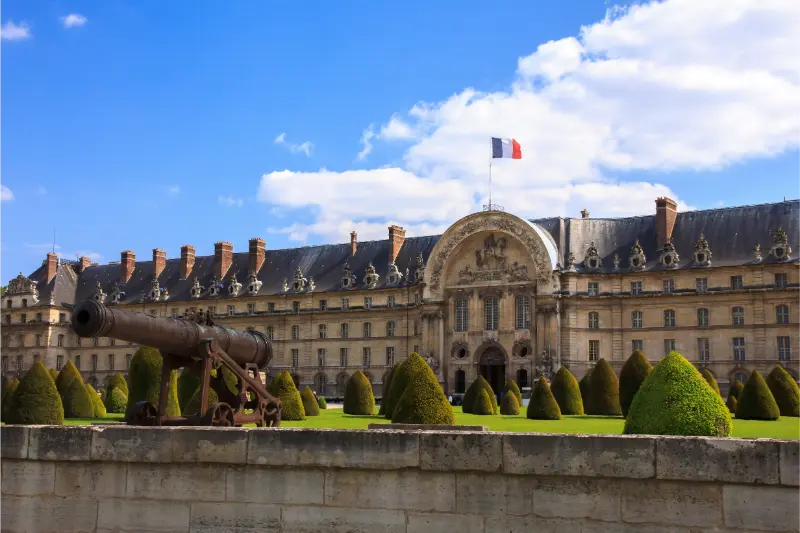
The main courtyard is easy to treat as a passageway, but it helps explain the original military purpose of the complex. Look at the arcades, cannon displays and long façades before entering galleries. This short exterior pause makes the transition from royal veterans’ institution to modern museum much easier to understand.
Napoleon without hero worship or caricature
The tomb is deliberately monumental, but a useful visit separates architectural commemoration from historical judgment. Use the surrounding galleries to understand the political and military context, then decide what the monument is trying to communicate. That is more interesting than treating the site as either a shrine or a simple photo opportunity.
Families and teenagers
For teenagers who already study European history, Invalides can be more engaging than a general art museum because objects connect directly to wars, uniforms and political change. For younger children, choose visually strong sections and keep the visit shorter. A two-hour adult route can easily become too much for a child who has already walked all morning.
When to choose Invalides over another museum
Choose Invalides if military history, Napoleon, state architecture or the World Wars genuinely interest you. Choose Rodin if you need a smaller art experience with outdoor space, Orsay if 19th-century painting is the priority, and the Louvre if this is your only chance to see an encyclopedic collection. There is no obligation to visit all four.
Tickets, security and arrival buffer
Even with an advance ticket or museum pass, allow time for security. Les Invalides is a large institutional site rather than a small gallery with one front door. Check the entrance named on your ticket, because approaching from the wrong side of the complex can add a surprisingly long walk.
A good final hour in the neighborhood
After the museum, use the lawns and broad perspectives around Invalides to decompress before moving on. If the weather is good, the walk toward Pont Alexandre III and the Seine is more rewarding than immediately disappearing underground. From there you can continue toward the Grand Palais area or cross to the Right Bank without adding another formal attraction.
Do not let the tomb erase the rest of the site
Napoleon is the obvious headline, but Les Invalides is also about Louis XIV, veterans, military technology, state ceremony and the long way France has remembered war. Even a short visit becomes richer if you notice one object or room unrelated to Napoleon before leaving. That small detour prevents the entire complex from collapsing into a single famous tomb.