Disclosure: This article contains affiliate links or booking widgets. If you book through them, Dreaming of Paris may earn a commission at no extra cost to you. How our affiliate links work.
The Musée de l’Homme has an unusually difficult subject: all of us. Human evolution, biological diversity, culture, language and the future of societies can easily turn into a museum of “everything.” The best visit is therefore not the longest one; it is the one built around three questions: Who are we? Where do we come from? Where are we going?
Check tickets and Paris experiences
Compare current tours, timed-entry tickets and experiences before fixing your itinerary.
GetYourGuideTiqetsCivitatisViatorAffiliate links: we may earn a commission at no extra cost to you.
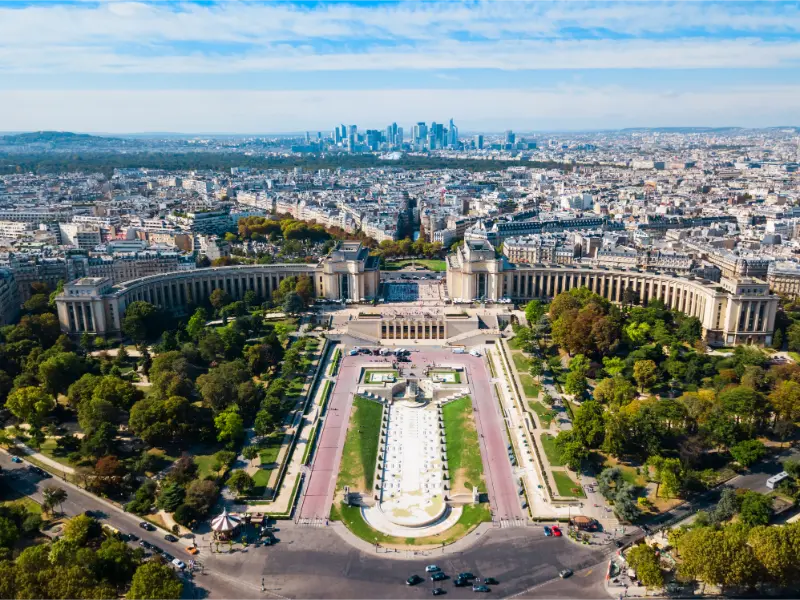
The museum is inside the Palais de Chaillot at Trocadéro, directly facing the Eiffel Tower across the Seine. It opens every day except Tuesday, currently 11:00–19:00, and its standard pricing is listed in the €12–15 range depending on ticket/exhibition. The location makes it one of the easiest museums to pair with an iconic outdoor Paris experience.
Use the permanent gallery as a story, not a cabinet collection
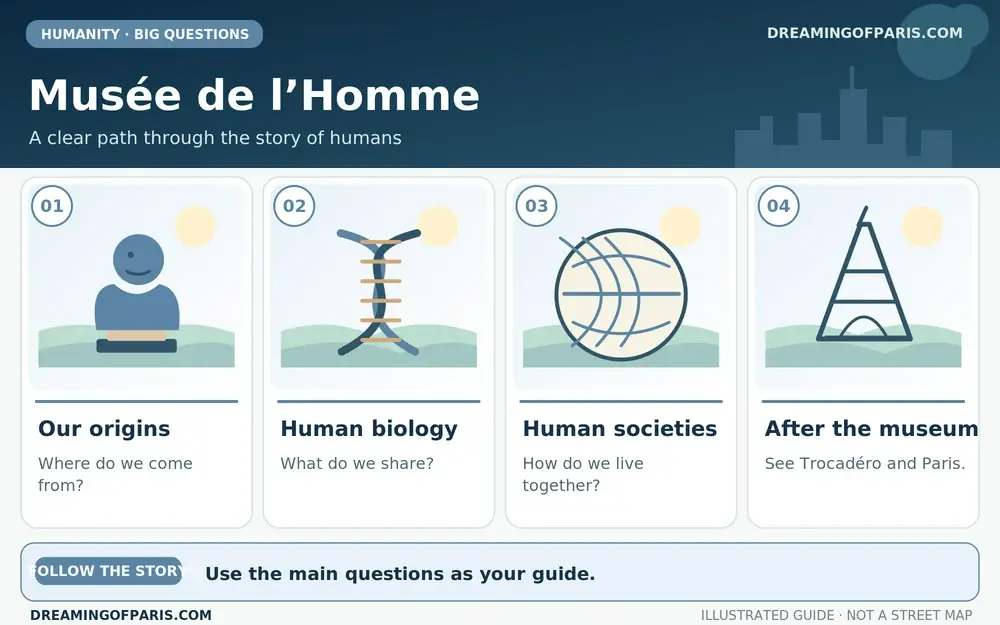
The permanent Galerie de l’Homme is designed around major questions rather than one historical chronology. Keep that structure. In the first part, concentrate on what defines Homo sapiens biologically and socially. In the origins section, look for the relationship between fossils, tools and reconstructed environments rather than memorizing species names. In the final section, pay attention to how demographic, environmental and technological choices reshape the future.
The 90-minute route
- 0–25 minutes — identity and human diversity: choose a few displays that challenge assumptions about biological difference.
- 25–55 minutes — origins: follow the big evolutionary transitions and spend time with only a handful of specimens/objects.
- 55–80 minutes — societies and adaptation: connect tools, culture and environment.
- 80–90 minutes — future questions and the building/view: leave time to reorient yourself to Trocadéro rather than exiting exhausted.
Why it works well for families from about age six
The museum itself recommends visits from around age six. That is a useful signal: the experience relies on questions, comparison and some reading rather than toddler-scale play. With children, avoid turning the route into a lecture on evolution. Ask concrete questions: Which feature makes humans good walkers? What can teeth tell us? Why do different societies solve the same problem differently?
For younger children or a highly interactive science day, compare it with Cité des Sciences. For a natural-history spectacle focused on biodiversity, Grande Galerie de l’Évolution may be a better visual hit.
The current 2026 temporary-exhibition context
In 2026 the museum is presenting Les grands âges from 8 April 2026 to 3 January 2027, connecting aging research with photography by Nikos Aliagas. Temporary exhibitions change the value equation: if the topic interests you, add time and buy the relevant ticket; if not, do not let a temporary show distract from the permanent gallery simply because it is heavily promoted at the entrance.
Trocadéro pairing: do the museum before the viewpoint
A strong sequence is museum first, outdoor Trocadéro second. The reason is practical: your timed cognitive work is done while energy is high, then the esplanade/gardens become decompression. From there, either cross to the Eiffel Tower or walk west into Passy. Our Trocadéro guide gives the full outdoor route.
Accessibility and logistics
The museum provides access information for visitors with motor, sensory and cognitive disabilities and grants free admission to a visitor with a disability and a companion/carer on presentation of proof. The building is substantially easier than historic tower attractions with spiral stairs, which makes it a useful alternative when members of a group have different mobility needs.
Who should prioritize it
Prioritize it if you are interested in anthropology, archaeology, evolution, identity or museums that encourage discussion rather than simply admiration. Skip or shorten it if your trip already includes several natural-history/science museums and you mainly came to Trocadéro for the Eiffel Tower. It is a very good second-trip museum because its subject is broader than “French art” and therefore changes the rhythm of a Paris itinerary.
Use the 11am opening to your advantage
Because the museum opens later than many central attractions, it fits naturally after an early Trocadéro photo walk. A 90-minute permanent-gallery visit is enough for a first encounter if you follow the museum’s big questions rather than every case. Add another hour only if the current temporary exhibition genuinely interests you; otherwise move outside while your attention is still fresh.
Do not turn anthropology into a race through answers
The Musée de l’Homme deals with origins, biological diversity, culture and the future of humanity. Those subjects are too large for a checklist. Pick two or three exhibits that make you stop, discuss what they change about your assumptions, and accept that leaving some sections for another visit is better than skimming everything.
Three sensible continuations from Chaillot
Stay local with the Trocadéro route; walk into Passy and Auteuil for a quieter neighborhood; or cross the Seine and finish with an Eiffel Tower-area cruise. Which one works depends on whether your museum visit was mentally energizing or tiring.
Frequently asked questions
When is the Musée de l’Homme open?
It currently opens every day except Tuesday from 11:00 to 19:00, with last admission before closing; it also closes on selected public holidays.
How much are tickets?
The museum currently lists tickets in the €12–15 range depending on the offer/exhibition. Check the official ticket page for your date.
Is it suitable for children?
The museum recommends the visit from around age six.
How long do I need?
About 90 minutes is enough for a focused permanent-gallery visit; allow two to three hours if adding a temporary exhibition.
Can I combine it with the Eiffel Tower?
Yes. It is one of the most geographically efficient museum-and-monument combinations in Paris because both sit on opposite sides of the Trocadéro/Seine axis.
What not to expect
This is not a cabinet of “exotic cultures” organized as curiosities, and it is not only a prehistoric-human museum. The institution has a complicated history of anthropology and representation; the contemporary route deliberately frames humanity as one species with biological diversity and enormous cultural variation. That makes language and interpretation central to the visit.
A discussion prompt that improves the visit
At the end, ask each person in your group to choose one display that changed an assumption rather than one object they thought was beautiful. That small exercise suits this museum better than a “top ten masterpieces” list and helps children or teenagers turn information into a conversation.
How to connect the museum to Paris outside
After the museum, look at the Trocadéro crowd as an anthropologist for five minutes: languages, group behavior, photography rituals, clothing and how people negotiate a famous public space. This is not part of the official exhibition, but it is a useful mental bridge between museum questions about human societies and the city outside.
For visitors already doing Jardin des Plantes
The Musée de l’Homme and Grande Galerie de l’Évolution overlap in broad questions about life and humanity but not in visitor experience. If you love natural history, doing both on different days is reasonable. If your schedule is tight, choose Grande Galerie for visual biodiversity and family spectacle; choose Musée de l’Homme for human origins, culture and debate.
Do not schedule the Musée de l’Homme immediately after three hours at another anthropology/history museum. Its value depends on attention. A Trocadéro walk, lunch in Passy and then the museum—or museum first followed by the Eiffel Tower—creates more contrast.
A note on sensitive subjects
Human origins, race, migration, identity and colonial histories can be emotionally or politically charged. The museum’s value is that it provides scientific and historical framing rather than reducing those subjects to slogans. Read the labels carefully where terminology matters, especially if you are visiting with older children who may ask why older classifications of human difference changed.
For English-speaking visitors, allow extra time if a particular temporary section has less translation than the core route. Rather than rushing past, use the museum’s digital or printed resources where available and prioritize exhibits with clear bilingual interpretation.
Best time of day
Because the museum opens at 11:00, it works naturally after an early Trocadéro walk rather than as your first dawn activity. Photograph the Eiffel Tower when the esplanade is calmer, have coffee, then enter at opening. Alternatively, use the museum after lunch and stay through late afternoon before crossing the Seine toward an evening Eiffel Tower slot.
A better Musée de l’Homme visit in five decisions
- Arrive knowing whether the permanent gallery or the temporary exhibition is your priority.
- Use the recommended age guidance when planning with children; this is a discussion-rich museum, not a playground.
- Leave time to look outside from the Trocadéro setting—the geography of the building is part of the experience.
- If a section raises a sensitive subject, slow down rather than pushing a family or school-age child through it just to complete the route.
- Do not add a second major museum unless your group actively enjoys long indoor days.
The visit succeeds when you leave with a few questions you can still discuss over lunch, not when you can say you read every panel.