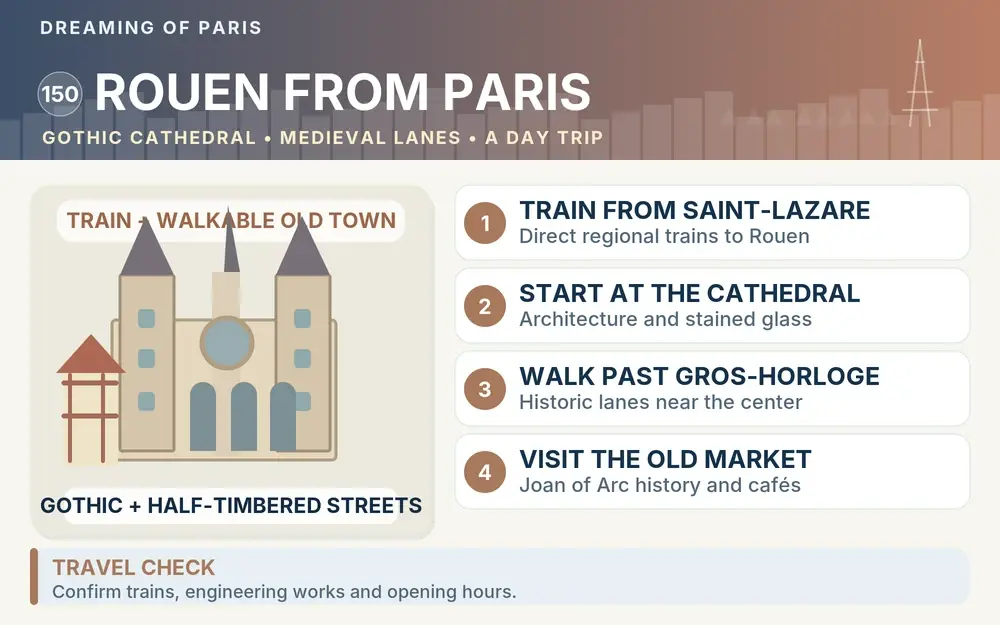
Rouen is one of the strongest city day trips from Paris when you want a place that feels genuinely different without spending half the day in transit. The historic centre is dense, walkable and architecturally rich: a major Gothic cathedral, half-timbered streets, the Gros-Horloge, the market square associated with Joan of Arc and several good museums all sit within a manageable radius. Direct regional trains connect Paris Saint-Lazare with Rouen Rive Droite. Current SNCF schedules show the fastest journeys at roughly 1 hour 12 minutes, with many direct departures; exact times and fares change by date. For exact departures, engineering works and fares, check SNCF Connect shortly before travel.
Is this day trip worth leaving Paris for?
Rouen is one of the strongest city day trips from Paris when you want a place that feels genuinely different without spending half the day in transit. The historic centre is dense, walkable and architecturally rich: a major Gothic cathedral, half-timbered streets, the Gros-Horloge, the market square associated with Joan of Arc and several good museums all sit within a manageable radius. The best reason to go is not that it is ‘close to Paris’; it is that the destination offers a coherent experience that Paris itself cannot reproduce. If you only have two or three days in Paris, stay in the capital. If you have four or more days, or you have visited Paris before, this is where the calculation changes.
Check tickets and Paris experiences
Compare current tours, timed-entry tickets and experiences before fixing your itinerary.
GetYourGuideTiqetsCivitatisViatorAffiliate links: we may earn a commission at no extra cost to you.
How to get there by train
Direct regional trains connect Paris Saint-Lazare with Rouen Rive Droite. Current SNCF schedules show the fastest journeys at roughly 1 hour 12 minutes, with many direct departures; exact times and fares change by date. Leave from Paris Saint-Lazare and aim to arrive at Rouen Rive Droite early enough to have the morning in front of you. Train timetables are not a static fact, so use the journey times here as planning guidance rather than a promise for every date.
Buy the ticket that matches the train type. Regional TER or Transilien services can have different flexibility rules from reserved TGV or OUIGO trains. If your return is tied to a specific train, build a comfortable buffer at the end of the day. Our Paris train stations guide explains the major Paris terminals, while the Paris public transport guide helps with the journey to the departure station.
Morning: use your best energy on the essential sights
From Rouen Rive Droite, walk downhill toward the historic centre rather than taking local transport. Start with the area around the Palais de Justice and Rue du Gros-Horloge, then continue to Notre-Dame Cathedral before the streets become busier. The cathedral is not just a landmark; its changing west façade was repeatedly painted by Claude Monet, so it connects medieval architecture with the Impressionist story that many visitors already associate with Normandy.
Start on foot whenever possible. A day trip feels much more satisfying when the route unfolds naturally from the station instead of beginning with another local bus or taxi. If you have limited mobility, reverse this principle: use local transport strategically and save your walking energy for the places you actually came to see.
Lunch and the middle of the day
After the cathedral, cross the Gros-Horloge axis slowly. The monument combines a Renaissance arch with a historic astronomical clock and belfry. If you want to enter, check the day’s opening hours first: in 2026 the site has seasonal hours and occasional works. Otherwise the street view itself is one of Rouen’s essential experiences. Continue toward Place du Vieux-Marché, where the modern Sainte-Jeanne-d’Arc church and the memorial context recall Joan of Arc’s execution in 1431.
Normandy is part of the appeal. Rather than losing time on a destination restaurant far from your route, choose a central lunch and look for regional references such as Normandy cheeses, apples, cider-based dishes or a simple market-style menu. If you want a pastry or snack later, the historic centre has enough bakeries that you do not need to cross the city for a famous address.
If budget matters, compare this with our Paris on a budget guide: the cheapest day trip is not automatically the one with the cheapest train. A rushed schedule often creates extra taxi rides, convenience food and wasted reservations. One good lunch plus a compact route usually costs less than chasing every attraction.
Afternoon: choose depth over a checklist
Use the afternoon for one substantial indoor visit rather than trying to collect every museum. The Historial Jeanne d’Arc is the obvious choice if medieval history is your priority; the Musée des Beaux-Arts works better for painting and sculpture. Rouen’s museum network has also been known for generous free-access policies to permanent collections, but verify the current rule before travel. Finish with Saint-Ouen or a slower walk through the antique-shop streets before returning uphill to the station.
One major afternoon interior is usually enough. A cathedral, museum, palace room or historic house requires more concentration than its opening-hours line suggests. Leave room for the streets, river, parks or cafés that make the destination distinct. If the weather is excellent, it is often worth shortening an indoor visit rather than sacrificing the only outdoor part of the day.
Best season and weather strategy
Rouen works year-round. Spring and early autumn usually offer the best balance of daylight and walking weather. Winter can be atmospheric and quieter, but rain and short daylight make a museum-heavy plan more useful. Summer weekends bring more visitors and events. Check the local calendar because festivals, cathedral projections and special exhibitions can materially change the best order of the day.
Before departure, check official Rouen tourism website for temporary closures, events and seasonal programs. Then compare the forecast with our Paris packing guide. A day trip exposes you to more walking and fewer easy hotel breaks than a normal Paris day, so shoes, rain protection and a small water bottle matter more.
Who will enjoy this trip most?
This trip suits travelers who prefer a strong sense of place over attraction-counting. Architecture and history fans can build the day around monuments; photographers benefit from arriving early and staying through late-afternoon light; couples can keep the schedule loose; families should reduce the number of interiors and protect meal breaks. Travelers with reduced mobility should research station lifts, cobbles, slopes and monument access individually rather than assuming the historic centre is step-free.
If you are still comparing destinations, start with our best day trips from Paris overview. It is more useful to choose the trip that matches your interests than to rank destinations by fame.
How it compares with other Paris day trips
Choose Rouen over Giverny when you want a full historic city rather than a garden-and-art pilgrimage. Choose it over Reims when Gothic streets and Normandy atmosphere matter more than Champagne. It is a particularly good alternative to Versailles for repeat visitors who want fewer palace crowds and more freedom to wander.
For a palace-focused day, see Versailles from Paris. For art and gardens, Giverny is the classic choice. For a medieval small-city atmosphere, compare Provins. For Champagne cellars and a cathedral, use our Reims guide.
A realistic sample timetable
- 07:30–08:30: reach Paris Saint-Lazare and take a morning train.
- 09:00–10:00: arrive at Rouen Rive Droite and walk into the centre.
- 10:00–12:30: essential historic sights while energy and attention are high.
- 12:30–14:00: lunch without crossing town for a famous address.
- 14:00–17:00: one major museum/interior plus a slower outdoor route.
- 17:00–18:30: café, river/old-town walk and return toward the station.
- Evening: return to Paris with enough margin for the booked or preferred train.
Treat this as a framework, not a minute-by-minute contract. If one place is better than expected, stay longer and drop the final item. The advantage of a day trip is freedom; reproducing a package-tour timetable defeats that advantage.
Mistakes to avoid
The biggest mistake is treating Rouen as a two-hour stop. Train time is short enough to tempt a rushed visit, but the city rewards a full day. A second mistake is scheduling several ticketed interiors back-to-back; the half-timbered streets are not filler between monuments, they are a major reason to come. Finally, leave a buffer before your return train because the station is uphill from much of the historic centre.
Do not carry large luggage unless necessary. If this is a transfer day, read our Paris luggage storage guide and consider leaving bags in Paris. Also avoid buying non-refundable attraction tickets before confirming train works or strikes; our Paris strikes and disruption guide explains where to check transport status.
Practical checklist before you leave Paris
- Check outbound and return train times on the same day of the week you plan to travel.
- Open the official destination site for closures, seasonal boat/tower schedules and major events.
- Reserve only the attraction that genuinely requires it; keep the rest flexible.
- Download an offline map and save the station name so you can navigate back without data.
- Carry water, a compact layer and comfortable shoes even if the Paris forecast looks mild.
- Set an alarm about 60–90 minutes before the return train so the day does not end in a sprint.
Frequently asked questions
Is Rouen easy without a car?
Yes. For a Paris day trip, a car is usually unnecessary. The direct train reaches a station within walking distance of the historic centre, and the main sights are compact enough to connect on foot.
How long should I spend in Rouen?
A full day is ideal. Aim for roughly seven to nine hours on the ground if you want the cathedral, historic streets, one museum and a relaxed lunch without turning the visit into a sprint.
Is Rouen good in the rain?
Yes. The architecture is still impressive in wet weather and there are several strong indoor attractions. Bring proper rain protection because the best experience still includes substantial walking.
Bottom line
Rouen from Paris works best as a full, unhurried day rather than a race to prove how much you can fit outside Paris. The transport is simple enough for independent travelers, but the quality of the trip comes from choosing one or two priorities and leaving room for the destination itself. Check trains and opening hours, start early, and come back to Paris with one place properly experienced instead of six boxes ticked.