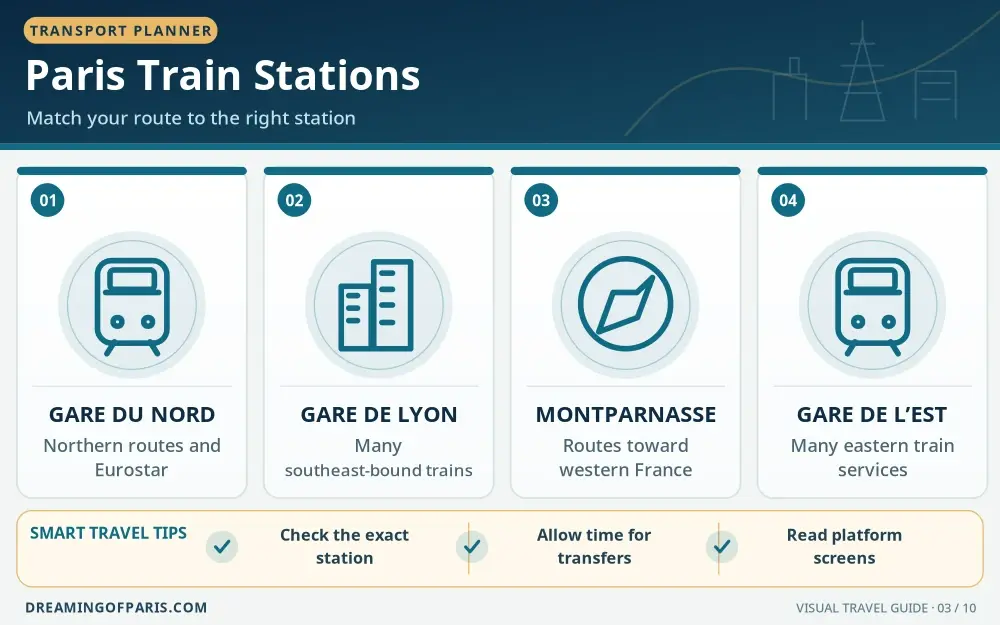
Paris does not have one central railway station. Different terminals serve different directions, so knowing your arrival station changes the best hotel area, airport connection and time you need for an onward train.
Quick planning summary
Gare du Nord
Gare du Nord serves northern France and major international routes including Eurostar. It connects to RER B and D plus several Metro lines, making it useful for CDG airport and cross-city travel. The station is extremely busy, so keep bags controlled and know which level you need before stopping in the middle of pedestrian flow.
Gare de l’Est
About a ten-minute walk from Gare du Nord, Gare de l’Est serves eastern France and international routes toward Germany and Luxembourg. Walking between the two stations can be easier than taking the Metro with luggage, but check weather and mobility needs.
Gare de Lyon
This station handles many trains to southeastern France and beyond, including routes toward Lyon, Marseille, Switzerland and Italy depending on the current timetable. Metro 1 and 14 plus RER A and D make it well connected. The historic Le Train Bleu restaurant is also inside the station complex.

Gare Montparnasse
Montparnasse serves western and southwestern France. The station is large and the connection between some Metro platforms and train halls involves long corridors. Arrive earlier than the map distance suggests, especially with luggage or children.
Gare Saint-Lazare
Saint-Lazare is important for Normandy and western suburban services. It sits near major shopping and Opéra districts. Line 14 provides a particularly useful connection toward Gare de Lyon, while other Metro lines connect across central Paris.
Gare d’Austerlitz
Austerlitz serves several central and southwestern routes and night trains. It is close to Gare de Lyon across the Seine but not the same complex. Allow enough time to walk or use local transport rather than assuming a five-minute platform transfer.
Changing stations
Paris train tickets often require a self-managed transfer between terminals. Build margin. Paris je t’aime notes that Gare du Nord to Gare de Lyon can be direct on RER D, while Saint-Lazare to Gare de Lyon is convenient on line 14. Engineering work can change the best route.
Luggage storage
Major stations have left-luggage services or private alternatives nearby, but hours and operators can change. Check the official station information for your date. Do not leave a train connection dependent on a locker that closes before you return.
Hotel strategy
If Paris is only a one-night stop between trains, staying near your departure station can be smarter than choosing the prettiest central district. If you have several sightseeing days, prioritize the city experience and accept one final transfer to the station.
Compare hotels for your stay in Paris
Check current availability, location and prices before choosing the exact neighborhood.
Check Paris hotels on Booking.comAffiliate link: we may earn a commission at no extra cost to you.
Day trips
Your station determines which day trips feel easiest. Reims uses Gare de l’Est; many Normandy routes leave Saint-Lazare; Versailles relies on regional transport rather than one main intercity terminal. Build day-trip articles around the correct departure rather than a generic ‘Paris station’.
How this article fits into the Dreaming of Paris cluster
For a deeper plan, continue with Paris public transport, CDG to Paris, Reims and Champagne, Montparnasse. These guides are linked because they share geography or a real planning decision, not simply because they mention Paris.
Official information
For the details most likely to change, use the Paris je t’aime train stations guide. Recheck it shortly before the visit rather than relying on a screenshot saved weeks earlier.
Practical checklist before you leave the hotel
- Recheck opening hours, closures or transport work.
- Save the exact entrance or meeting point, not only the attraction name.
- Carry water and keep enough phone battery for navigation.
- Know one nearby alternative in case the main plan changes.
- Allow more time if you have luggage, children or reduced mobility.
- Avoid scheduling another major timed attraction immediately afterward.
How many main train stations does Paris have?
Paris has several major terminal stations rather than one central station; the correct one depends on your route.
How much time should I allow to change stations?
Build generous margin—often at least 45–90 minutes depending on stations, luggage and service conditions.
Can I walk from Gare du Nord to Gare de l’Est?
Yes, they are close enough to walk for many travelers, though luggage, weather and mobility needs matter.
Which station does Eurostar use in Paris?
Eurostar uses Gare du Nord.
Final planning advice
The best way to use this guide to Paris train stations is to place it inside a coherent day rather than treat it as an isolated checklist item. Paris becomes easier when every reservation has a reason, every journey has a nearby second purpose and at least one part of the day remains flexible. That approach protects you from queues, weather changes and simple fatigue while leaving space for the unplanned café, street or view that often becomes the strongest memory.
Think of Paris stations as separate terminals, not one central rail hub
Paris has several major mainline stations, each serving different national and international directions. A ticket that arrives at Gare du Nord and departs from Gare de Lyon creates a city transfer, not a platform change. Build that transfer into the itinerary before buying tightly timed connections, especially with luggage, children or reduced mobility.
Gare du Nord and Gare de l’Est are close enough to walk for many travelers, but other station pairs generally require Metro, RER, bus or taxi. The fastest theoretical route is not always the easiest with suitcases. Avoid routes with multiple stair-heavy interchanges when a direct bus or taxi produces a more reliable transfer.
Arrival strategy by trip type
If Paris is your destination, identify the hotel route from the station before arrival and ignore people offering unsolicited taxi or ticket help. If Paris is only a connection, confirm the departure station printed on the second ticket and store luggage only with a legitimate operator if you have enough time to leave the station area.
Eurostar uses Gare du Nord, while different domestic TGV/Intercités routes use stations such as Gare de Lyon, Montparnasse, Saint-Lazare, Austerlitz or Gare de l’Est. Rail operators can alter platforms and service patterns, so the ticket and operator app on your travel date are the final authority. For airport connections, continue with the Paris airports guide.
A practical decision check for Paris Train Stations Explained
Train-station planning is about transfers: Paris has multiple terminals serving different corridors. Before you give it a fixed slot, compare that reason with the strongest alternative already on your itinerary. If the alternative matters more, move this stop to an optional block instead of forcing both into the same half-day. That simple choice keeps the article useful for different travelers rather than implying that every reader needs the same Paris.
A realistic way to fit it into the day
Read the station name on both tickets, map the transfer before travel and add a luggage-friendly buffer. For arrival stays, save the hotel route from the correct exit. Keep the previous and following stops close enough that a delay of twenty or thirty minutes does not create a cascade of missed reservations. Paris days become much easier when the route can absorb a longer lunch, a queue or a weather change without requiring a taxi across the city.
The trade-off worth making explicit
The trade-off is fastest route versus easiest route. One extra bus stop can be preferable to a Metro interchange with several flights of stairs. Making that trade-off deliberately is more useful than adding another item to a checklist. Ask what you would remove if this experience takes longer than expected; if the answer is “nothing,” the day is probably already too full.
Small details that prevent avoidable problems
Platform numbers can appear late and service can change. Stay near the concourse screen instead of entering a random platform area too early. Save the exact address or entrance you intend to use, keep enough phone battery for the return route and recheck any time-sensitive information on the official site. These are small steps, but they protect the part of the experience that actually matters from being swallowed by logistics.
Where it belongs in the wider Paris cluster
Gare du Nord is key for Eurostar and some northern routes; other national routes use Gare de Lyon, Montparnasse, Saint-Lazare, Austerlitz or Gare de l’Est. Treat that pairing as a geographic or thematic cluster, not an obligation to complete everything. One strong connection is enough to make the day coherent; two or three distant add-ons usually reduce the value of the place you came to see.
Give yourself a transfer floor, not a perfect minimum
Journey planners may show a station-to-station connection that works when lifts, escalators, platforms and traffic all cooperate. Treat that as the theoretical travel time, then add a real buffer for finding exits, moving luggage and boarding. Missing a reserved train to save twenty minutes between Paris terminals is a poor trade, especially when separate tickets are involved.
Store luggage before exploring
If a connection leaves several hours in Paris, compare station lockers, staffed storage and hotel options in our Paris luggage storage guide.
Eurostar from London
If you are arriving at Gare du Nord from the UK, continue with our London to Paris Eurostar guide for check-in timing, passports, luggage and onward transport.
\n\nChoosing a hotel beside your station
\n\n\nFor accommodation strategy, see our new guides to Gare de Lyon and Gare Montparnasse.
\n