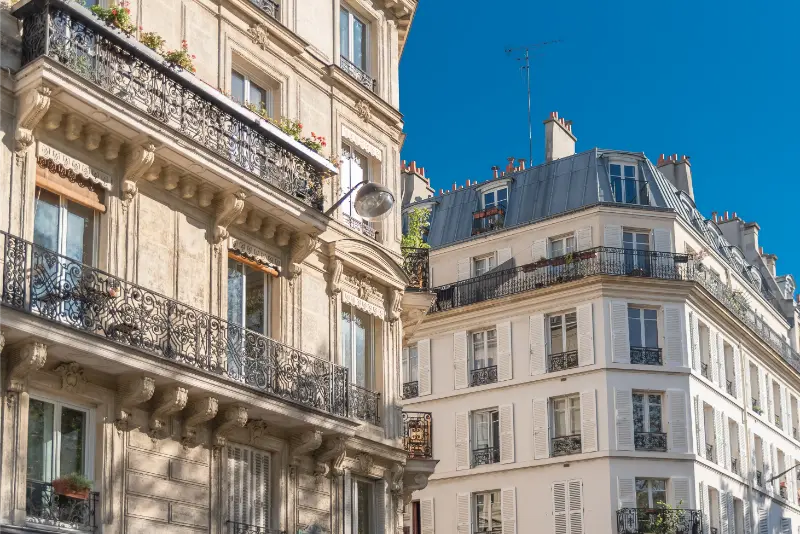
The cheapest Paris hotel is not always the cheapest Paris trip. A room far from useful transport can add airport transfer costs, late-night taxis and an hour of commuting every day. Budget accommodation works best when you accept a less prestigious postcode but keep a direct line, food nearby and an area that still feels worth returning to in the evening.
Compare hotels for your stay in Paris
Check current availability, location and prices before choosing the exact neighborhood.
Check Paris hotels on Booking.comAffiliate link: we may earn a commission at no extra cost to you.
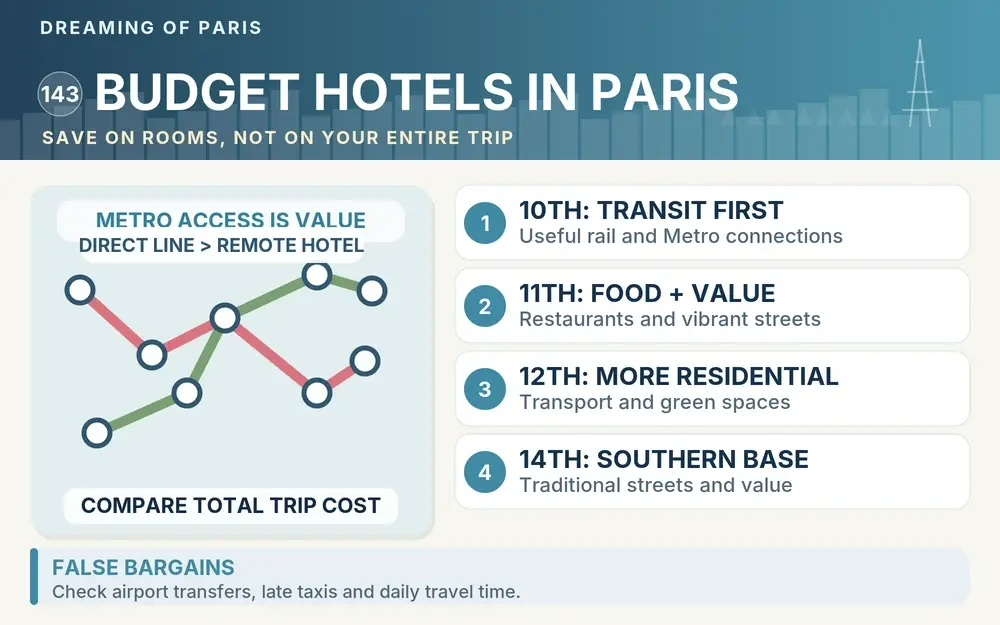
This guide is about value by location, not a list of hotels with prices that will be obsolete next week. Pair it with our Paris on a budget guide for food, tickets and daily spending. For accommodation, I would start with the 10th, 11th, 12th, 14th, 19th and 20th, then compare the exact street and station.
This guide contains affiliate links. If you book through them, Dreaming of Paris may earn a commission at no extra cost to you.
The 10th: strong value when transport matters
The 10th around Gare du Nord, Gare de l’Est and Canal Saint-Martin can offer lower rates than the historic center while keeping excellent connections. It is particularly logical if you arrive by Eurostar or use RER B for CDG. The 10th arrondissement guide explains why the station zone and canal zone should not be treated as the same neighborhood.
The immediate station environment is busy day and night. Budget travelers should not interpret that automatically as a reason to avoid it, but should look closely at the exact street, entrance lighting, reviews mentioning noise and the route from the station after dark. A room ten minutes toward the canal can feel very different from one directly on a traffic-heavy frontage.
The 11th: excellent for restaurants and nightlife without central prices
The 11th is one of the best budget compromises for travelers who want evenings to be part of the experience. Bastille, Charonne and Oberkampf offer enough restaurants and bars that you do not need to travel across the city every night. Our 11th arrondissement guide helps you choose between lively and quieter sectors.
Hotel rates can still rise on weekends, and rooms above nightlife streets may be noisy. If you can stay one or two blocks off the busiest axes, the 11th often gives better value than the Marais while remaining close enough to walk into central districts. This is especially strong for younger travelers and repeat visitors.
The 12th: residential value with Line 1, Line 14 and green space
The 12th can be a very efficient budget base near Gare de Lyon, Reuilly or the eastern residential areas. It is less “Paris postcard” than Saint-Germain, but direct lines make that much less important in practice. The 12th arrondissement guide shows how the district combines Aligre, Bercy, Coulée Verte and the Bois de Vincennes.
Families and travelers staying five nights or more often gain from the neighborhood infrastructure: supermarkets, bakeries, parks and larger accommodation inventory. The farther east you go, the more important station proximity becomes. A low rate should not tempt you into a fifteen-minute walk to a weak connection if you will repeat it four times a day.
The 14th: traditional Paris and useful prices south of the center
The 14th around Montparnasse, Pernety and Rue Daguerre is a strong option for travelers who prefer the Left Bank but cannot justify Saint-Germain prices. Our 14th arrondissement guide covers the different micro-neighborhoods, from the station area to quieter residential streets.
Montparnasse is particularly practical for rail travelers using western France. Even if you are not taking a train, the area has restaurants, food shops and transport without the monument premium. The weakness is distance from east-Paris nightlife and some northern attractions, so it suits travelers whose plans are balanced rather than concentrated in Montmartre and Belleville.
The 19th and 20th: the lowest-price strategy that still feels like Paris
The 19th and 20th often provide the strongest room value inside Paris. Around Buttes-Chaumont, Jourdain, Belleville or Ménilmontant, you get parks, local food and a more residential rhythm. See the 19th arrondissement guide and 20th arrondissement guide before booking because hills and Metro geography matter.

These districts are not ideal for every first-time traveler. If you have only forty-eight hours and every priority is around the Louvre, Seine and Eiffel Tower, the savings may not justify the commuting. On a five- to seven-night trip, however, a well-connected room here can save enough to fund experiences and meals while adding a neighborhood you might otherwise never see.
Do not ignore the 15th for longer stays
The 15th is not always the cheapest by nightly rate, but it can offer larger rooms, aparthotels and better long-stay value. A kitchenette, laundry access or family-size room can reduce other trip costs. Our 15th arrondissement guide is useful because the district is huge; the best-value hotel is only useful if its transport works for you.
For couples or families staying a week, I would compare total trip cost rather than nightly price alone. A slightly more expensive aparthotel that lets you prepare breakfast and store groceries can be cheaper than a tiny central room that pushes every meal into cafés and restaurants.
The false bargains to watch for
- Airport-area hotels for a city trip: convenient for one flight night, inefficient for daily sightseeing.
- Properties outside Paris with no direct rail: a low room rate can hide long transfers and early last connections.
- Non-refundable rates too early: the cheapest rate can become expensive if plans change.
- Hostels without privacy when you need sleep: saving money is not useful if fatigue ruins paid sightseeing days.
- Rooms without air-conditioning in a heatwave: sometimes acceptable, but it should be a conscious compromise.
- Very cheap rooms beside major nightlife: read noise reviews carefully and check room orientation.
Budget travel is about controlling the expensive mistakes. Location, cancellation policy and basic comfort often matter more than shaving the last €10 from the nightly rate.
A practical booking method
First choose three acceptable areas, not one. Set your maximum total accommodation budget, then compare flexible rates for the same dates. Sort candidates by walking time to a useful station, not by distance to the Eiffel Tower. Read the most recent negative reviews for recurring issues such as lifts, noise, cleanliness or construction. Only then compare the cheapest room category.
Use the Paris transport guide to calculate recurring journeys. If the cheaper hotel adds a connection every morning and evening, give that inconvenience a real value. Time is part of a travel budget too.
Compare accommodation before you commit
Hotel prices in Paris move sharply with exhibitions, school holidays, fashion events and major weekends. Use Booking.com to compare current room inventory, but compare the exact street, nearest station, cancellation terms, room size and air-conditioning rather than ranking properties only by headline price. A cheaper room that adds two awkward changes to every journey is not always the cheaper trip.
Official information to check before your trip
The official Paris je t’aime accommodation guide currently identifies Bastille and Belleville among lower-cost areas and stresses checking Metro access. Use it for current registered accommodation, then verify the exact rate and room conditions for your dates.
For short first trips, the 10th, 11th and 14th are often the easiest budget compromises. For longer stays, the 12th, 15th, 19th and 20th can give better space and a more local rhythm. The right choice is the cheapest area that still supports your itinerary—not the cheapest room anywhere on the map.
Paris does not require a luxury hotel to feel special. Spend money where it changes the experience: a good location, a room you can actually sleep in, and enough flexibility that you do not feel trapped by the booking.
One final planning check before you book
Open the map and trace the three journeys you are most likely to repeat: the first morning, the longest sightseeing day and the return after dinner. Then check the route from the station or bus stop to the hotel door, not only the station name. Paris blocks, hills, large intersections and station exits can make a short map distance feel very different with luggage or after a long day.
Compare the flexible rate with the cheapest non-refundable rate. If the saving is small, flexibility is often worth more than the discount because train times, flights, family plans and event dates can move. A good accommodation decision should still look good after the itinerary changes once or twice; that resilience is part of value, not an optional luxury.
Also check the most recent reviews for issues that are difficult to judge from official photographs: street noise after midnight, lift reliability, room temperature, construction nearby and how staff handle luggage before check-in. Look for repeated patterns rather than one angry review. When three or four recent guests mention the same practical problem, treat it as useful evidence and decide whether that compromise matters to your trip.
Finally, remember that Paris hotel pricing is highly date-sensitive. A neighborhood that looks expensive for one weekend may be competitive a week later, and the opposite can happen during trade fairs, fashion events, concerts or school holidays. Compare the same dates across several districts before deciding that one area is categorically outside your budget.