
A romantic Paris base should improve the hours you actually spend together, not simply supply a balcony photo. The right neighborhood lets you walk to dinner, take an unplanned evening route home and start the morning somewhere you both want to be. Couples often overpay for a landmark view while underestimating noise, tiny rooms or the inconvenience of crossing Paris every night after dinner.
Compare hotels for your stay in Paris
Check current availability, location and prices before choosing the exact neighborhood.
Check Paris hotels on Booking.comAffiliate link: we may earn a commission at no extra cost to you.
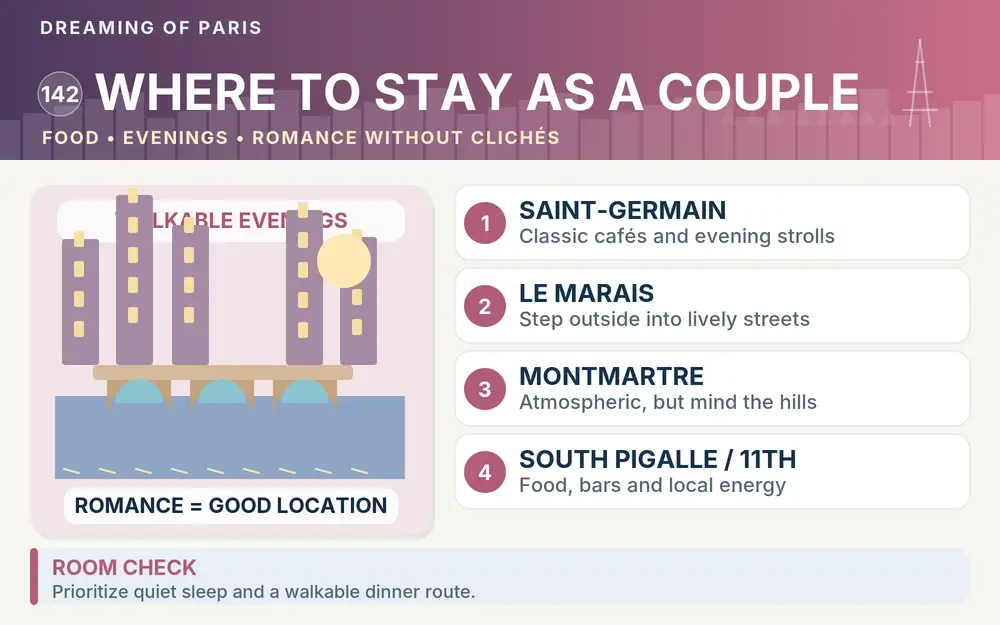
This article pairs with our romantic Paris guide, but focuses on accommodation. The strongest choices are Saint-Germain for classic Left Bank evenings, the Marais for energy and central walking, Montmartre for atmosphere, South Pigalle for restaurants and nightlife, and the 11th for a more contemporary local base.
This guide contains affiliate links. If you book through them, Dreaming of Paris may earn a commission at no extra cost to you.
Saint-Germain-des-Prés: classic Paris with the fewest compromises
Saint-Germain remains one of the easiest couple bases because the district gives you both daytime and evening value. You can walk to the Seine, Luxembourg Garden, cafés, galleries and the historic center, then return after dinner without depending on the last convenient connection. The Saint-Germain walking guide shows how much of the neighborhood is interesting beyond its two famous cafés.
The cost is the obvious drawback. Rooms can be small and boutique hotels in older buildings may trade modern facilities for character. If you are planning a short anniversary trip and expect to spend evenings on foot, that premium can be rational. If you want a large room, spa facilities or a longer stay, the same budget may buy more comfort elsewhere.
The Marais: best for couples who want to step outside into the city
The Marais suits couples who prefer a lively street over a quiet luxury bubble. Place des Vosges, small museums, shops, cafés and the Seine are woven into the neighborhood, so you can build a day without commuting. The Marais guide is useful for understanding which streets are atmospheric and which can become crowded.
For romance, I would prioritize a calm room rather than a famous address. Courtyard-facing rooms can be valuable. The Marais can be noisy on weekends, and some older properties have narrow stairs or compact lifts. If you want late dinners and spontaneous walks, those compromises may be acceptable; if sleep is the priority, stay on the quieter edges toward the 3rd rather than directly above the busiest bars.
Montmartre: atmospheric, but choose the slope carefully
Montmartre earns its reputation in the early morning and late evening, when day-trip crowds thin and the hill becomes more residential. A couple staying there can experience that quieter rhythm without scheduling a special trip. Our Montmartre beyond Sacré-Cœur route helps identify streets worth exploring away from Place du Tertre.
The hill is the trade-off. Carrying luggage up steep streets is not romantic, and transport connections vary significantly by side of the neighborhood. Lower Montmartre and the 9th around Rue des Martyrs can give you much of the atmosphere with easier transport. I would also check late-night street noise around Pigalle before choosing a room purely because the listing says “Montmartre.”
South Pigalle and the 9th: a strong choice for food and evenings
Couples who care more about restaurants, cocktail bars and easy evening energy than postcard quiet should look seriously at the 9th. South Pigalle, Rue des Martyrs and the streets below Montmartre have enough going on that you rarely need a taxi home after dinner. Our 9th arrondissement guide explains the difference between Opéra, Grands Boulevards and the northern part of the district.
This can also be better value than Saint-Germain at the same comfort level. The weakness is that some streets are busy and nightlife can create noise. Ask about room orientation and double glazing, especially for a weekend stay.
The 11th: contemporary Paris for couples who prefer bars and food to monuments
The 11th is one of the best bases for couples who have already seen Paris or who want evenings to be a major part of the trip. Bastille, Charonne and Oberkampf provide restaurants, wine bars and late energy, while side streets can feel surprisingly residential. The 11th arrondissement guide and Oberkampf walk show why the district is more varied than its nightlife reputation.
You give up immediate walking access to the Louvre and Saint-Germain, but direct Metro lines make the compromise manageable. In return, rooms can be better value and the evening feels less dependent on tourist districts. For a couple that likes to eat late and walk home, this is often a stronger romantic choice than an isolated luxury room.
Near the Eiffel Tower: worth it only when the view is part of the trip
A genuine Eiffel Tower view can be memorable, but it is one of the most expensive room attributes in Paris. Before paying the premium, decide whether you want a view from the room, proximity to the monument or simply an easy first-night walk. Those are three different needs. Our 7th arrondissement guide shows how the district stretches beyond the tower.
If the room view is the reason for the trip, confirm the exact category in writing and look for recent guest photos. “Eiffel Tower view” can mean a narrow partial angle. Couples who care more about restaurants and evening atmosphere may prefer Saint-Germain, Passy or the 9th and visit the tower at the best time rather than sleep beside it.
What makes a hotel romantic in practice?
- A room quiet enough to sleep: a balcony over a nightlife street can lose its charm at 2 a.m.
- Walkable dinner choices: spontaneity matters more than a lobby bar you never use.
- Good light and a comfortable bathroom: simple details often matter more than themed décor.
- Late check-in: useful after evening flights or dinner reservations.
- A real view, if you are paying for one: verify the room category rather than trusting a generic hotel photo.
- Location for your shared interests: art, food, architecture and nightlife should shape the base.
Couples sometimes choose the hotel as if it were the destination and then spend little time there. Decide first whether you want the room to be a major experience—spa, terrace, view, breakfast—or simply a comfortable base in a romantic neighborhood. That distinction prevents overspending on facilities you will not use.
A simple decision by couple style
Choose Saint-Germain for classic elegance and walkability; the Marais for central energy and historic streets; Montmartre for atmosphere and hilltop evenings; the 9th for food and nightlife with strong transport; the 11th for local bars and better value. If this is a first visit of only two nights, centrality deserves more weight. If you have five or six nights, a neighborhood with stronger evening life can become the better experience.
Whatever you choose, check how it fits your daytime plans using the transport guide. A romantic evening loses some of its appeal when the route home requires three changes and a twenty-minute uphill walk.
Compare accommodation before you commit
Hotel prices in Paris move sharply with exhibitions, school holidays, fashion events and major weekends. Use Booking.com to compare current room inventory, but compare the exact street, nearest station, cancellation terms, room size and air-conditioning rather than ranking properties only by headline price. A cheaper room that adds two awkward changes to every journey is not always the cheaper trip.
Official information to check before your trip
Use the official Paris je t’aime accommodation guide to compare current neighborhood descriptions and registered accommodation. Hotel offers, room categories and prices change constantly, so confirm the exact conditions directly with the property.
Paris is romantic because it gives couples many kinds of evening: a quiet Seine walk, a crowded wine bar, a late museum, a neighborhood dinner or an early morning before the city is busy. Choose the base that makes your preferred version easy rather than trying to buy romance through a postcode.
For most couples, Saint-Germain, the Marais, the 9th and the 11th are the strongest all-round choices. Montmartre is wonderful when the hill itself is part of the trip; the Eiffel Tower area is best when proximity or a verified view genuinely matters.
One final planning check before you book
Open the map and trace the three journeys you are most likely to repeat: the first morning, the longest sightseeing day and the return after dinner. Then check the route from the station or bus stop to the hotel door, not only the station name. Paris blocks, hills, large intersections and station exits can make a short map distance feel very different with luggage or after a long day.
Compare the flexible rate with the cheapest non-refundable rate. If the saving is small, flexibility is often worth more than the discount because train times, flights, family plans and event dates can move. A good accommodation decision should still look good after the itinerary changes once or twice; that resilience is part of value, not an optional luxury.
Also check the most recent reviews for issues that are difficult to judge from official photographs: street noise after midnight, lift reliability, room temperature, construction nearby and how staff handle luggage before check-in. Look for repeated patterns rather than one angry review. When three or four recent guests mention the same practical problem, treat it as useful evidence and decide whether that compromise matters to your trip.
Finally, remember that Paris hotel pricing is highly date-sensitive. A neighborhood that looks expensive for one weekend may be competitive a week later, and the opposite can happen during trade fairs, fashion events, concerts or school holidays. Compare the same dates across several districts before deciding that one area is categorically outside your budget.