
Disclosure: This article contains affiliate links or booking widgets. If you book through them, Dreaming of Paris may earn a commission at no extra cost to you. How our affiliate links work.
Montmartre is one of the most visited parts of Paris and still one of the easiest to misunderstand. If you arrive at Anvers, climb straight to Sacré-Cœur, photograph Place du Tertre and leave, you will see the postcard version of the hill—but miss the side that explains why artists, workers, cabarets, vineyards and village memories became so closely associated with this part of the 18th arrondissement.
This walk is designed to be taken slowly, ideally in the morning. It does not try to avoid every famous place; that would be artificial. Instead, it connects the major sights with quieter streets and historically meaningful details so that the neighborhood feels like a place rather than a stage set.
When to walk Montmartre
Early morning is the best time if you want calmer streets around Sacré-Cœur and Place du Tertre. The basilica itself opens every day from 6:30 a.m. to 10:30 p.m. and admission to the basilica is free, according to the official Sacré-Cœur website. The dome has separate access and opening hours. Because the basilica is a functioning sanctuary with services and prayer, visit respectfully even when you are there mainly for architecture or views.
Late afternoon and evening have a different appeal: the hill becomes lively, restaurants fill, and the city lights appear below. The trade-off is crowding. If this is your first time, a morning walk followed by a later return for dinner gives you two very different versions of Montmartre.
Start at Abbesses, not automatically at Anvers
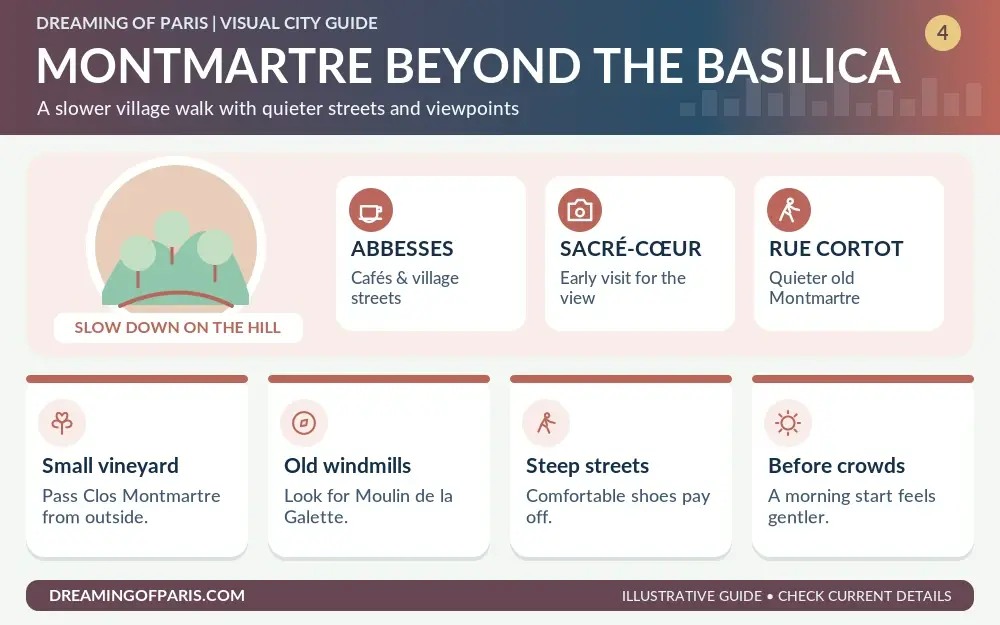
Anvers is the classic southern approach, but Abbesses is a more interesting starting point for this route. The square puts you immediately into the neighborhood rather than at the bottom of the main tourist staircase. From here, walk through the streets around rue des Abbesses before climbing. You will still reach Sacré-Cœur, but the approach feels less like an arrival corridor.
If steep streets or stairs are difficult, remember that Montmartre is genuinely hilly. The funicular connects the lower area near Square Louise Michel with the basilica level and uses the public transport fare system. Our Paris transport guide explains the 2026 ticket structure. The hill is not the place to prove that you can walk every meter if mobility or energy is limited.
Stop 1: Rue des Abbesses and the lower village streets
Before climbing to the famous summit, spend a little time on the streets where residents shop and eat. Rue des Abbesses mixes neighborhood businesses with places aimed at visitors, but it still gives you a better sense of everyday Montmartre than the souvenir axis around Sacré-Cœur. The point here is not to collect specific bakeries from a viral list; it is to notice how quickly the atmosphere changes when you move one block away from a photo hotspot.
Look upward as well as into shop windows. Montmartre’s slopes create unusual street perspectives, with buildings stepping around curves and intersections opening suddenly toward the city below.
Stop 2: Sacré-Cœur early, then keep moving
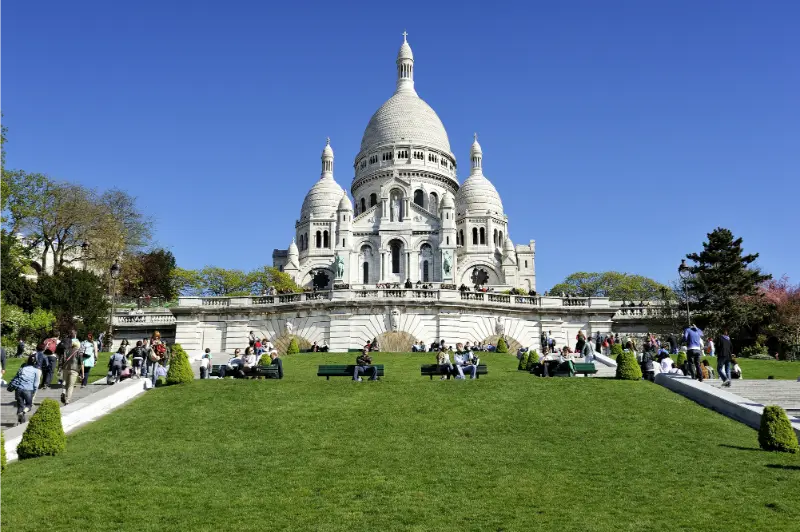
Sacré-Cœur is worth visiting, even if your goal is “hidden Paris.” The basilica’s white exterior, Romano-Byzantine design and position on the Butte make it one of the city’s defining landmarks. Inside is a vast apse mosaic. Outside, the forecourt gives a broad panorama over Paris.
Do not end the visit at the forecourt. Walk around the basilica toward the quieter northern side of the hill. This is where Montmartre begins to feel different. The tourist density drops, walls replace open panorama, and the route turns into a sequence of small discoveries.
Stop 3: Rue du Chevalier de la Barre and rue Cortot
Rue Cortot is one of the most important streets for understanding artistic Montmartre. The Musée de Montmartre occupies historic buildings where artists lived and worked. Its collection explores the history of the neighborhood, while the Renoir Gardens are named for Auguste Renoir, who lived on the site in the 1870s and painted works including Bal du moulin de la Galette during his Montmartre period.
The museum is open daily and is more than an indoor rainy-day alternative. The gardens provide a rare pause from the crowded streets, and views toward the vineyard help connect the area’s rural past with the dense city around it.
Stop 4: Clos Montmartre, the vineyard most visitors photograph but few understand
Montmartre’s vineyard, the Clos Montmartre, was planted in 1930 on the north side of the hill. It preserves the memory of a time when the slopes around Montmartre included vines, orchards and rural land. The vineyard is small and not a commercial wine estate in the usual tourism sense; you generally view it from the surrounding streets rather than wandering through it independently.
The annual grape-harvest festival celebrates this part of the neighborhood’s identity. The useful takeaway is not “Paris has a vineyard” as a novelty fact. It is that Montmartre’s village image is rooted in a real historical geography that existed before the city expanded around it.
Stop 5: Lapin Agile and the quieter north slope
Near the vineyard sits Au Lapin Agile, one of the historic cabaret names associated with Montmartre. Even if you do not attend a performance, the modest exterior is a reminder that the neighborhood’s artistic history did not unfold only in grand theaters. Small rooms, cafés, studios and cabarets shaped the social world of artists and writers here.
From this point, continue toward Lamarck-Caulaincourt rather than turning immediately back to Place du Tertre. The northern slope receives fewer first-time tour groups and gives you a more residential rhythm. It is also a useful area to consider for accommodation if you want Montmartre atmosphere without sleeping directly beside the busiest sights; see our where to stay in Paris guide.
Stop 6: Moulin de la Galette and the surviving windmills
Two historic windmills, Moulin Radet and Moulin de la Galette, survive on the hill. Their presence matters because Montmartre once had numerous windmills used for practical work. The famous name later became associated with entertainment, dance and artistic representations of the neighborhood.
Renoir’s Bal du moulin de la Galette made the social life around the site internationally famous, but seeing the windmills in the street reminds you that the painting came from a real local setting rather than an abstract “Parisian” scene.
Stop 7: Place du Tertre—yes, but with the right expectations
Place du Tertre is touristy, commercial and still part of Montmartre’s story. The mistake is pretending either that it is an untouched artists’ village or that it should be skipped completely because it is popular. Walk through, watch the artists at work, look at the square’s scale and then continue. You do not need to spend an hour there to understand it.
If you arrive before the busiest part of the day, the square is easier to appreciate. Later, it becomes one of the densest pedestrian points on the hill.
Stop 8: Rue de l’Abreuvoir and Maison Rose—beautiful, but be considerate
Rue de l’Abreuvoir has become one of the most photographed streets in Paris, in part because of its curve, slope and the pink façade of La Maison Rose. It is worth seeing, and it is also a residential street. The easiest way to photograph it is from public space without lingering in doorways or private entrances.
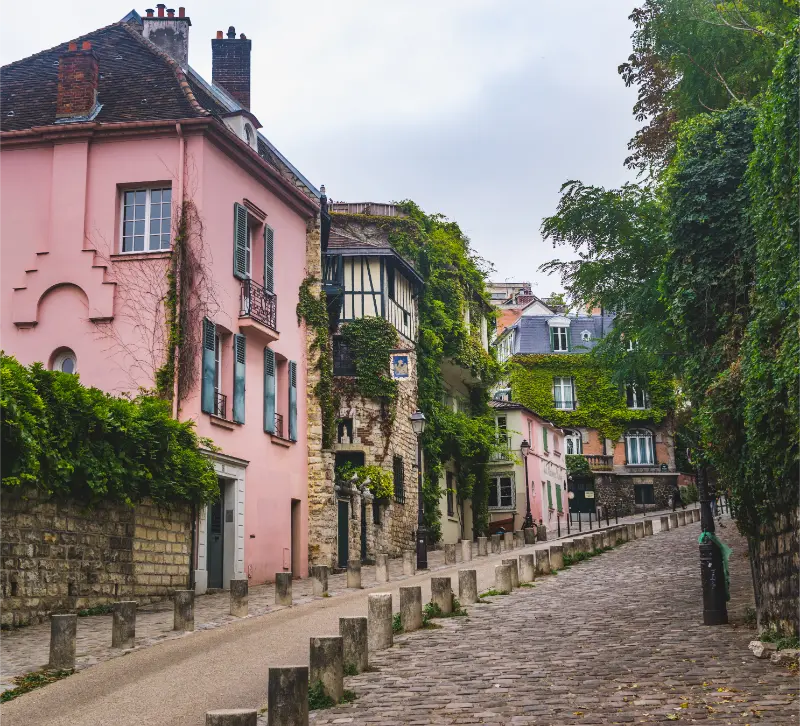
The street is a useful example of the new Montmartre problem: social media can turn a quiet corner into a micro-attraction. The best response is not to avoid it, but to visit lightly and keep moving.
Stop 9: A different panorama from the dome of Sacré-Cœur
If you want a higher view than the forecourt, the dome is reached separately from the basilica interior. The climb involves many steps and is not suitable for everyone, but the panorama is one of the strongest in northern Paris. Unlike the Eiffel Tower, the Eiffel Tower itself appears in your view, which can make the skyline feel more recognizably Parisian.
Check current dome hours at the official basilica site because access times can differ from the basilica’s long opening day.
A 3-hour Montmartre route
- 0:00–0:20: Abbesses and lower streets.
- 0:20–0:50: climb to Sacré-Cœur and visit the basilica.
- 0:50–1:30: rue Cortot, Musée de Montmartre exterior/gardens if not entering, vineyard and Lapin Agile.
- 1:30–2:10: north slope and windmills.
- 2:10–2:40: Place du Tertre and rue de l’Abreuvoir.
- 2:40–3:00: coffee, viewpoint or descent.
If you enter the Musée de Montmartre or climb the dome, add at least another hour. There is no reason to rush the hill simply because the walking distance looks short.
Where to eat without building the walk around one famous restaurant
Montmartre has excellent food and many tourist-oriented menus. Look for places with a focused menu, recent local reviews and pricing that makes sense for the area. The northern and western sides of the hill often feel less pressured than the immediate Sacré-Cœur/Place du Tertre circuit. If a place is full, having a second street in mind is better than crossing Paris for a restaurant you saw online.
Montmartre with children
The funicular can save energy, and the open views are engaging, but cobbles and slopes can make a heavy stroller frustrating. A foldable stroller or carrier may be more practical for small children. Break the walk with a garden or snack rather than expecting children to appreciate every historical stop. Our family guide to Paris includes more age-specific ideas.
Montmartre at night: safe planning, not fear
The tourist core remains busy well into the evening, but as in any large city, keep normal awareness around crowded transport stops and nightlife areas. The area around Pigalle feels very different from quiet northern Montmartre. If your hotel is on the hill, check the exact walking route from the metro before booking; a romantic address may involve a steep late-night climb.
A few practical points for Montmartre
- Do not assume the square below Sacré-Cœur represents the whole neighborhood.
- Residential doors are best kept clear when stopping for photographs.
- Do not accept unsolicited bracelets or street “games” that pressure you into paying.
- Do not schedule Montmartre between two distant timed attractions; the hill deserves time.
- Do not skip the north side if you came looking for the village atmosphere.
Montmartre FAQ
Is Sacré-Cœur free?
Entry to the basilica is free. The dome is a separate paid visit.
How long do you need in Montmartre?
Three hours is enough for a satisfying walk. Half a day is better if you want the museum, dome, lunch or time to explore side streets.
Is the vineyard open to walk through?
Do not plan on casual independent access. Visitors normally see Clos Montmartre from the surrounding streets; special events and organized access can occur.
Is Montmartre worth visiting if it is touristy?
Yes. Its history, topography and surviving village elements are real. The key is to move beyond the busiest 500 meters and visit at a time when you can still observe the neighborhood.
For a first Paris trip, pair this walk with our 4-day itinerary. Montmartre works best as a half-day neighborhood, not a one-hour photo stop.
Visit Sacré-Cœur itself
For free basilica entry, the dome climb, current access and crowd strategy, continue with our Sacré-Cœur visit guide.
Compare Montmartre walking tours and experiences
The live options below are useful if you want a guided visit, reserved experience or packaged activity for this specific part of the trip. Compare the exact inclusions, meeting point, language and cancellation terms before booking.