Disclosure: This article contains affiliate links or booking widgets. If you book through them, Dreaming of Paris may earn a commission at no extra cost to you. How our affiliate links work.
Paris’s covered passages are one of the best ways to see how the city changed before the department store and the modern shopping mall. Most were built in the late eighteenth and nineteenth centuries, when glass roofs, gas lighting, boutiques and sheltered promenades created a new kind of urban experience. Today they survive as an uneven but fascinating network of arcades filled with restaurants, bookshops, antiques, specialist stores and architectural details.
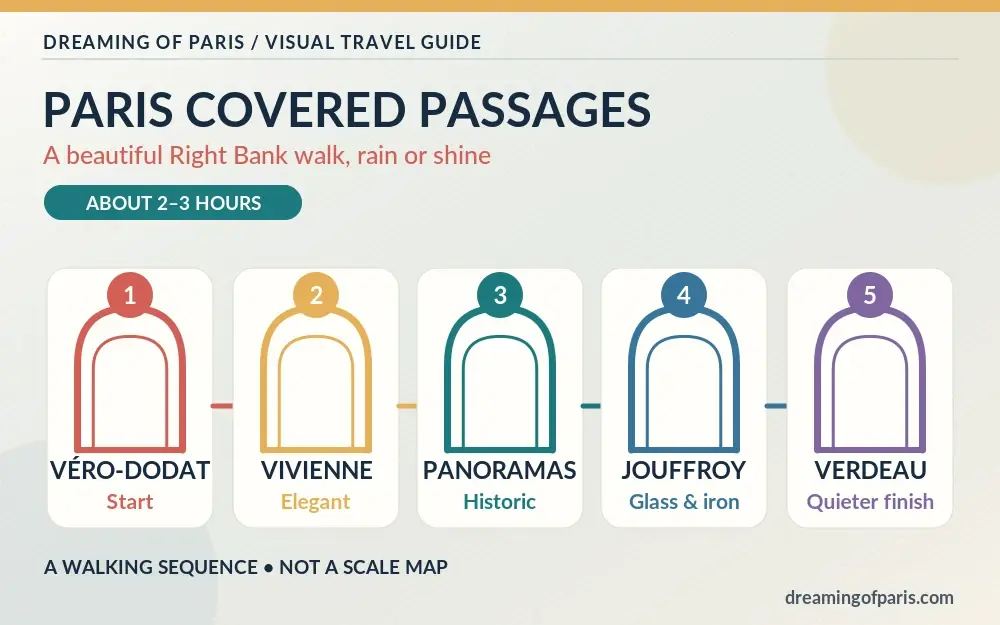
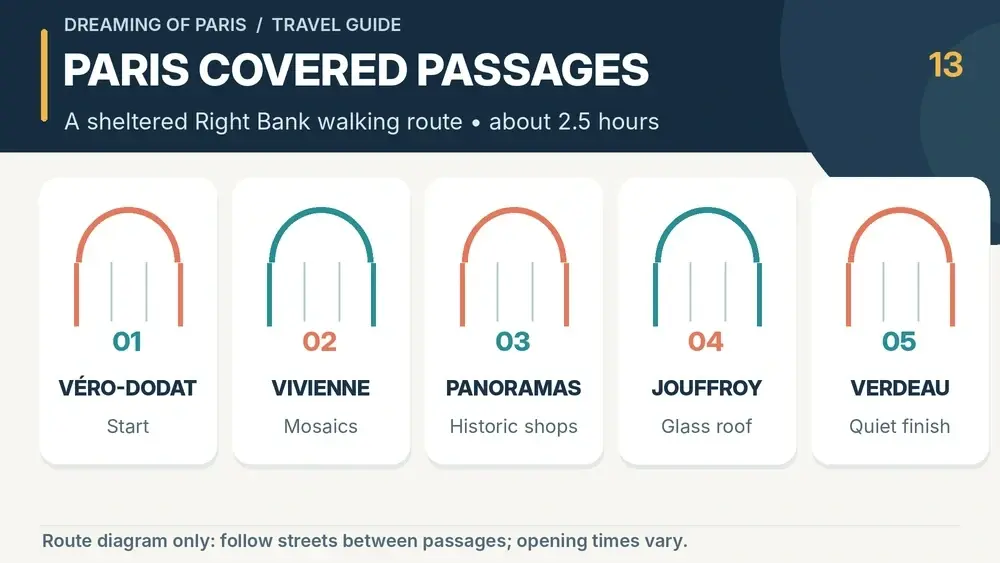
The best way to explore them is not to make a giant citywide checklist. The most rewarding cluster runs across the Right Bank between Palais-Royal and the Grands Boulevards. You can walk it in two to three hours, longer if you stop for lunch or browse shops.
Why this is more than a rainy-day route
The glass roofs make the passages useful in bad weather, but rain is not required. They reveal a transitional Paris: older, narrower and more intimate than the Haussmannian boulevards that later reshaped the city. Moving from a grand avenue into a passage only a few meters wide changes sound, light and scale almost instantly.
Paris je t’aime notes that most of the surviving passages are concentrated on the Right Bank and highlights Panoramas, Jouffroy, Verdeau, Grand-Cerf, Vivienne and Véro-Dodat among the most remarkable. Opening hours vary and some arcades close on Sundays or in the evening, so check individual listings if one specific passage is essential.
Start: Palais-Royal and Galerie Véro-Dodat
Begin around Palais-Royal. Before entering an arcade, spend a few minutes in the garden and arcades of the palace complex. It establishes the world from which the later commercial passages emerged: sheltered promenades, shops, social life and elegant urban space.
From here, Galerie Véro-Dodat is a worthwhile first detour. It is shorter and more polished than some of the busier passages farther east. The dark-and-light floor, shopfront rhythm and controlled perspective make it easy to see how designers used architecture to create a sense of luxury within a narrow corridor.
Galerie Vivienne: the most elegant introduction
Galerie Vivienne is one of the passages most likely to make first-time visitors understand the appeal immediately. Its mosaics, glass roof, rotunda and historic storefronts create a composed, almost theatrical interior. It opened in the nineteenth century near the Bourse and Palais-Royal, placing it at the heart of a wealthy commercial district.
Do not rush to photograph only the central perspective. Look at the floor patterns, signs, upper-level façades and the way natural light changes from one section to another. The passage is still a functioning commercial space, not an open-air museum, so opening businesses and customer traffic change the atmosphere throughout the day.
Optional detour: Galerie Colbert
Nearby Galerie Colbert is architecturally interesting precisely because it does not function like the retail passages around it. Paris je t’aime notes that it has no shops. Its rotunda and institutional use create a quieter experience. Access conditions can vary, so treat it as a bonus rather than a guaranteed shopping arcade.
Walk toward Passage des Panoramas
Continue toward the Grands Boulevards. The change in urban scale matters: you leave the refined Palais-Royal/Bourse environment and enter a historically entertainment-oriented district of theaters, restaurants and boulevards. Passage des Panoramas sits in this context.
Built in 1799, Passage des Panoramas is considered the oldest covered passage in Paris. It remains lively and less pristine than Galerie Vivienne, which is part of its appeal. Restaurants, stamp and postcard dealers, collectors and specialist shops coexist under the glass roof. The Théâtre des Variétés, opened in 1807, still operates nearby, reinforcing the link between the passage and the entertainment culture of the Grands Boulevards.
Passage Jouffroy: iron, glass and a different kind of spectacle
Cross boulevard Montmartre to Passage Jouffroy. Built in the nineteenth century, it is known for its iron-and-glass structure and marble paving. The Musée Grévin is located here, along with unusual specialist shops and the historic Hôtel Chopin.
Jouffroy is a good place to notice how the passages became destinations in themselves. The attraction was never only getting from one street to another; it was the controlled environment, shop windows, novelty and protection from weather. In that sense, these arcades are ancestors of later retail architecture.
Passage Verdeau: the route becomes quieter
Continue directly into Passage Verdeau, the extension north of Jouffroy. Built in 1847, it has a high glass roof and a strong concentration of antiques, old books, prints, postcards and collectible objects. The official tourism listing describes it as a continuation of Panoramas and Jouffroy, which makes these three passages the easiest continuous mini-route in Paris.
Verdeau is especially rewarding if you slow down. Instead of another iconic façade, the interest is in shop windows and the survival of specialist trades. It can feel less polished and more personal than Galerie Vivienne.
Optional extension: Passage Brady or Passage du Grand-Cerf?
If you still have energy, choose one extension rather than racing to both. Passage du Grand-Cerf, farther east near rue Saint-Denis, is striking for its tall glass structure and design shops. Passage Brady, farther north, is associated with South Asian restaurants and gives a completely different cultural atmosphere. The choice depends on what you want from the walk: architecture and design, or a passage that reflects the city’s later layers of migration and food culture.
A practical 2.5-hour route
- 0:00–0:20: Palais-Royal garden and arcades.
- 0:20–0:40: Galerie Véro-Dodat.
- 0:40–1:05: Galerie Vivienne and optional Colbert.
- 1:05–1:25: walk through the Bourse district to Grands Boulevards.
- 1:25–1:55: Passage des Panoramas.
- 1:55–2:15: Passage Jouffroy.
- 2:15–2:35: Passage Verdeau.
- 2:35 onward: coffee, lunch or optional extension.
The actual distance is modest. Browsing is what makes the route long.
Best day and time
Weekday late morning to afternoon is ideal if you want shops open and enough life to make the passages feel active. Sunday can be less reliable because individual businesses and some passages may close or reduce hours. Even when an arcade itself is accessible, the experience changes dramatically if shutters are down.
On a rainy day, expect more visitors to have the same idea. The passages are narrow, so they can feel crowded even with relatively small numbers.
How to combine the passages with the Louvre
This is one of the best pairings in central Paris. Visit the Louvre in the morning for two or three focused hours using our Louvre strategy, then leave the giant museum environment behind and walk through Palais-Royal into Galerie Vivienne. The architecture gets progressively smaller and more intimate, which is exactly the contrast you want after museum fatigue.
It also keeps the day geographically coherent. You avoid the common error of crossing Paris for Montmartre immediately after a Louvre session.
What to look for besides the “famous” passages
- Flooring: mosaics and patterned stone often do as much visual work as the roofs.
- Old signage: lettering and shopfront proportions reveal layers of commercial history.
- Roof structure: compare elegant rotundas with utilitarian iron frameworks.
- Transitions: the door from a loud boulevard into a quiet arcade is part of the experience.
- Specialist shops: stamps, books, cameras, prints and antiques preserve a form of retail increasingly rare elsewhere.
Photography in the covered passages
The passages are public or publicly accessible commercial spaces, while the shops remain private businesses. Architectural photography is generally possible where permitted, but policies for interiors, staff and merchandise vary by shop. Tripods can also be awkward in the narrowest walkways. Early morning may give emptier architecture, but many shops will still be closed; decide whether you want photographs or atmosphere.
Are the covered passages good with children?
Yes, especially as a shorter bad-weather walk. The constantly changing shop windows and compact scale are easier than a long museum. Passage Jouffroy can be combined with Musée Grévin if that interests your family. For more realistic family combinations, see our Paris with kids guide.
Accessibility
Many passage floors are relatively level, but entrances, thresholds and individual buildings vary. Historic infrastructure can be inconsistent. If wheelchair access is essential, verify each passage or venue in advance rather than assuming all arcades share the same conditions.
Covered passages FAQ
What is the oldest covered passage in Paris?
Passage des Panoramas, built in 1799, is generally identified by the official tourism office as the oldest surviving covered passage in Paris.
Do you have to pay to enter the passages?
Most are free to walk through. Museums, restaurants and shops inside have their own prices.
How long should I allow?
Two to three hours is enough for the central cluster from Palais-Royal to Verdeau. Add more time if you browse antiques, eat or extend toward Grand-Cerf or Brady.
Are they open at night?
Hours differ. Some close in the evening and individual shops keep their own schedules. Check specific listings if you are planning a late visit.
If you want a first-trip day that mixes a major icon with less obvious Paris, this route is ideal after the Louvre. It is central, weather-resistant and full of details that reward slow looking rather than queueing.
If the weather changes
For a wet-weather alternative around central Paris, use our Paris in the rain guide; for more no-cost stops, see free things to do in Paris.
Add Palais Garnier
The covered passages pair naturally with the 19th-century spectacle of the Palais Garnier.
Palais-Royal before the passages
Start the architectural cluster with our Palais-Royal guide, then continue into Galerie Vivienne and the covered passages.
Compare covered-passages and central Paris walking tours
The live options below are useful if you want a guided visit, reserved experience or packaged activity for this specific part of the trip. Compare the exact inclusions, meeting point, language and cancellation terms before booking.