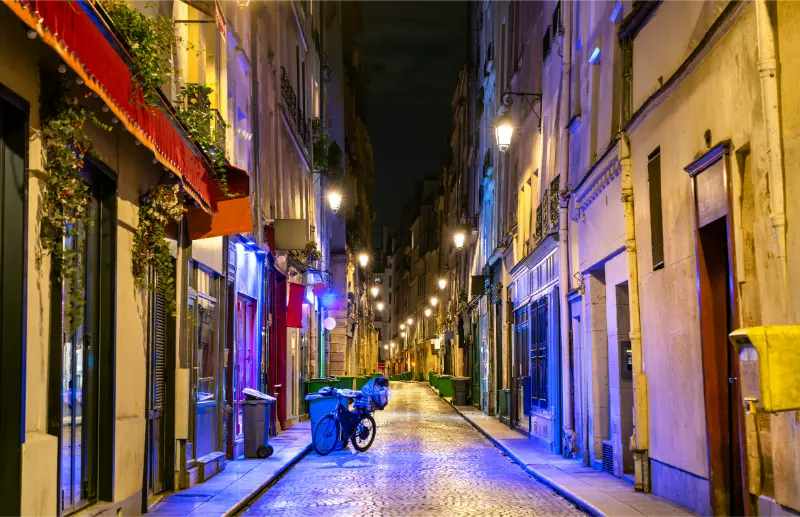
Rue Montorgueil works best when you treat it as a living food street connected to the history of Les Halles, not as a list of famous shops to photograph. The area has been tied to the provisioning of Paris for centuries, and the modern pedestrian environment still makes food, deliveries, terraces and local errands visible in a way that disappears on more monumental avenues.
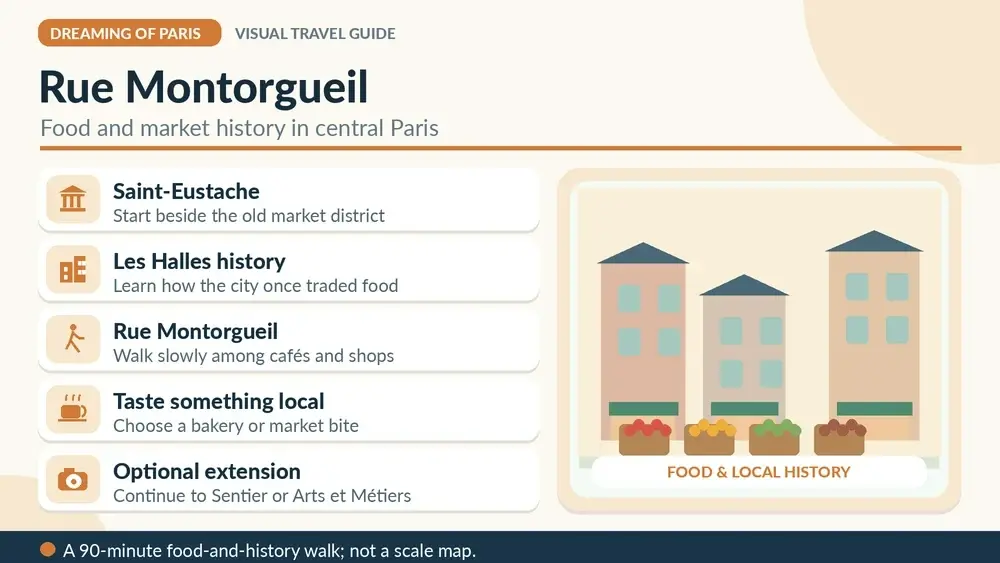
The strongest route starts at Saint-Eustache, moves through the edges of Les Halles, then follows Rue Montorgueil north toward Sentier. You can finish at the Musée des Arts et Métiers, continue to the covered passages, or turn west toward Palais-Royal.
Start at Saint-Eustache, because the market story makes more sense there
The great church of Saint-Eustache stands beside the historic Les Halles district. Paris archives trace the central market’s move to this area back to the 12th century, when the city’s provisioning center expanded around the crossroads of routes that included Rue Montmartre and Rue Montorgueil. The famous Baltard pavilions came much later, but the food identity is far older than the 19th century.
Saint-Eustache is free to enter. Opening hours can vary with religious services and school holidays, so check the parish website on the day. If a Mass is taking place, visit respectfully and do not treat the nave as a sightseeing shortcut.
Les Halles today: do not judge it only by the shopping center
The old wholesale market left central Paris in the 20th century, and the modern Forum des Halles is a major transport and commercial complex. Many travelers see the contemporary canopy and conclude that the historical district has disappeared. A better approach is to use modern Les Halles as the starting layer, then look for older traces around Saint-Eustache, Rue Montorgueil, Rue Tiquetonne and surrounding streets.
The area is heavily pedestrianized, which makes it practical for families and walkers, although bicycle and delivery traffic still requires attention. The official Paris tourism office describes central Les Halles as a year-round pedestrian area.
Walk Rue Montorgueil slowly enough to notice what changes block by block
The lower part near Les Halles carries heavy visitor traffic and restaurant activity. Farther north, the street still mixes food shops, produce, bakeries, fishmongers, cafés and everyday businesses. Do not expect a traditional open-air market with rows of temporary stalls; this is a permanent commercial street with a market identity.
Morning is the most revealing time. Deliveries, shop preparation and food shopping give context that disappears when every terrace is full at dinner. If you want photographs without emptying the street of life, arrive around 8:30–9:30 rather than sunrise.
Stohrer: visit for a specific reason
Stohrer at 51 Rue Montorgueil dates to 1730 and identifies itself as the oldest pâtisserie in Paris. Founder Nicolas Stohrer had worked for Stanislas Leszczynski before becoming pastry chef in the circle of Louis XV; the house is particularly associated with the baba au rhum tradition.
Do not enter just to say you entered. Choose one classic, look at the historic décor, then move on. If the line is long and you do not care about pastry history, there are many other good bakeries in Paris. The value here is continuity of place and craft, not a claim that one shop makes the objectively “best” pastry in the city.
What to buy on a Montorgueil food walk
A practical tasting walk should include contrast: one pastry or viennoiserie, a small savory item, seasonal fruit or cheese, and coffee later. Buying four pastries in fifteen minutes tells you less about Paris food than noticing how different shops specialize.
If you are staying in an apartment, this is a useful area for assembling a simple dinner: bread, cheese, fruit, charcuterie and dessert. If you are in a hotel without refrigeration, eat what you buy rather than carrying dairy around for hours.
Lunch strategy: avoid choosing by terrace alone
Rue Montorgueil has many terraces, but location does not guarantee quality. Read the menu, look for a coherent kitchen, and avoid assuming the busiest terrace is the best restaurant. For practical dining rules—water, tipping, service pace and reservations—use our Eating in Paris guide.
A better option on busy days is to use the street for food shopping and eat elsewhere, or book a specific restaurant after research. The neighborhood is useful even if you never sit on Rue Montorgueil itself.
A 90-minute walking route
- Saint-Eustache: 15–20 minutes if open and no service is taking place.
- Les Halles edge: 10 minutes to understand the modern market/transport layer.
- Rue Montorgueil lower section: walk slowly and note food shops rather than entering everything.
- Stohrer: 10–15 minutes if the queue is reasonable.
- Rue Tiquetonne / Rue Dussoubs side streets: leave the main axis for a quieter comparison.
- Sentier: finish around Metro Sentier or continue east to Arts et Métiers.
Extend the walk to Arts et Métiers
The Musée des Arts et Métiers is one of the best follow-ups because it changes the theme completely: scientific instruments, transport, engineering and Foucault’s pendulum rather than food. The walk from upper Montorgueil is short enough that you do not need another metro ride.
Extend west to Palais-Royal and the covered passages
If architecture is your focus, reverse the route: begin at Palais-Royal, walk Galerie Vivienne, then cross into the Montorgueil district for lunch. Our Palais-Royal guide and covered passages route create a strong half-day with very little transport.
Best time to go
Weekday morning: best balance of working food street and manageable crowds. Saturday late morning: lively but busy. Sunday: many food businesses operate, but hours vary and the atmosphere is more leisure-oriented. Evening: good for restaurants and terraces, less useful if your goal is understanding the market function.
Montorgueil with children
The pedestrian environment helps, but the district is still busy. Give children a mission: choose one pastry, identify three types of cheese, or compare shop signs. Saint-Eustache provides a quiet reset. Les Halles also offers toilets and transport connections, which matters more to families than romantic street descriptions suggest.
A few practical points
Saturday lunchtime is naturally one of the busiest moments, so the street can feel very different from an early weekday visit. Perishable purchases are easier near the end of a walking day, and narrow shop entrances can become congested when people stop for photos. Stohrer is worth seeing, but the broader appeal is the network of food commerce around it.
The side streets matter as much as Rue Montorgueil
Rue Tiquetonne, Rue Dussoubs, Rue Saint-Sauveur and parts of Rue du Nil change the mood quickly. The main street can feel like a continuous terrace; the side streets reveal smaller restaurants, old building fabric and the transition toward Sentier. A useful technique is to walk north on Montorgueil and return south one block east or west rather than retracing the same route.
Les Halles for architecture-minded visitors
Do not expect the old Baltard market pavilions: most were demolished after the wholesale market moved to Rungis. Instead, use the district as a lesson in how Paris repeatedly rebuilds its center. The medieval provisioning site, 19th-century iron-and-glass market, 20th-century redevelopment and current Canopée belong to different eras of the same question: how does a metropolis move food, people and commerce through its center?
A breakfast route that is more useful than a food checklist
Start with coffee and one pastry rather than a full brunch. Walk the street while shops open, then buy something savory for later. If you want to try Stohrer, do it before the busiest mid-morning period. Continue toward Sentier and save lunch for a restaurant you have chosen deliberately. This spreads eating across the route and prevents the common “four desserts before 11:00” food-tour problem.
How Montorgueil fits into a first trip
It is not a replacement for the Louvre, Marais or Saint-Germain. It is a connector. Use it between Palais-Royal and Arts et Métiers, after a Louvre morning, or as the food section of a covered-passages day. The district earns its place because it requires almost no additional transport when you are already in central Paris.
How it fits a repeat trip
Return visitors can use Montorgueil as a base for exploring Sentier, Rue du Nil, the garment-trade streets and the edges of the 3rd arrondissement. At that point the famous patisserie becomes a minor stop and the urban texture becomes the main event. This is exactly the shift from “what should I see?” to “how does this part of Paris work?” that makes a second trip richer.
Frequently asked questions
Is Rue Montorgueil a market?
It is best understood as a permanent food and commercial street with strong market traditions, not as a conventional open-air market made only of temporary stalls.
How long do I need?
About 60–90 minutes for a focused walk, two to three hours if you add Saint-Eustache, food stops and lunch.
Is it worth visiting if I already went to Marché d’Aligre?
Yes. Aligre is a market experience; Montorgueil is a pedestrian commercial street tied to the history of Les Halles. They show different forms of Paris food life.
Official Paris tourism information for Montorgueil.
Build a wider central-Paris food day
Use Montorgueil as the shopping-and-walking section of the day, then continue with the Paris bistro guide or Paris chocolate guide instead of crossing the city for unrelated food stops.