Disclosure: This article contains affiliate links or booking widgets. If you book through them, Dreaming of Paris may earn a commission at no extra cost to you. How our affiliate links work.
Palais-Royal is often reduced to one photograph of black-and-white columns, which is exactly how visitors miss the point. The site is a rare central-Paris combination of contemporary art, royal and political history, literary addresses, arcaded galleries and a formal garden where you can sit for free minutes from the Louvre.
Check tickets and Paris experiences
Compare current tours, timed-entry tickets and experiences before fixing your itinerary.
GetYourGuideTiqetsCivitatisViatorAffiliate links: we may earn a commission at no extra cost to you.
The national domain is free to enter. In 2026, the official opening hours are 8:00–22:30 from 1 April to 30 September and 8:00–20:30 from 1 October to 31 March. Those generous hours make it one of the easiest high-value additions to a Louvre, Tuileries or covered-passages day.
Start in the Cour d’Honneur, but do not stop there
Enter from Place Colette or Rue Saint-Honoré and you reach the Cour d’Honneur. Daniel Buren’s Les Deux Plateaux—the striped columns installed in the courtyard—creates the famous visual contrast with the classical architecture. The columns are not a random photo prop; the work plays with the hidden structural grid and different levels of the courtyard.
Spend five or ten minutes, not half an hour trying to reproduce the same pose as everyone else. Walk around the installation, look back toward the colonnades, then continue toward the kinetic fountains by Pol Bury. The transition from Buren’s strict stripes to moving metal spheres introduces the site’s modern-art layer before you enter the older garden.
The garden is the reason Palais-Royal deserves more than a photo stop
The garden traces its origins to Cardinal Richelieu’s 17th-century palace. The official history records major changes under André Le Nôtre and later transformations as galleries enclosed the space. Today the long central axis, rows of trees, flower beds, basin and chairs create a protected interior world that feels surprisingly calm for the 1st arrondissement.
The garden measures roughly 226 meters long and just under 100 meters wide. That scale is important: large enough to feel like a destination, small enough to understand in one slow circuit. Take the central path once, then return under an arcade rather than retracing the same line.
Walk the galleries like streets, not museum corridors
The Galerie de Montpensier, Galerie de Beaujolais and Galerie de Valois frame the garden. In the late 18th century, the Palais-Royal became an extraordinary commercial and social center, with shops, cafés, theaters and a reputation for entertainment that extended far beyond respectable retail. The official Ministry of Culture history notes that 180 ground-floor arcades were dedicated to commerce under the Duke of Orléans.
Today the galleries are quieter and more refined, with specialist shops, restaurants and institutional entrances. Look at the repeated arches, shopfront proportions and apartment facades above. This is the architectural idea that later covered passages and shopping arcades developed elsewhere in Paris.
A literary garden, not just a royal one
Diderot wrote about walking here; Colette lived at No. 9 Rue de Beaujolais; Jean Cocteau and Jean Marais lived on Rue de Montpensier. The official domain still emphasizes the garden’s literary identity. If you enjoy our Literary Paris guide, Palais-Royal is one of the easiest places to connect writing history with a real urban landscape rather than a plaque hunt.
The noon cannon: an odd detail worth knowing
A small meridian cannon recalls a system used to help Parisians set their watches. The original 18th-century device used sunlight to trigger the mechanism at solar noon. A replica remains in the garden. It does not fire every day today; the official domain schedules occasional ceremonial firings, so do not build a visit around hearing it unless a current event is listed.
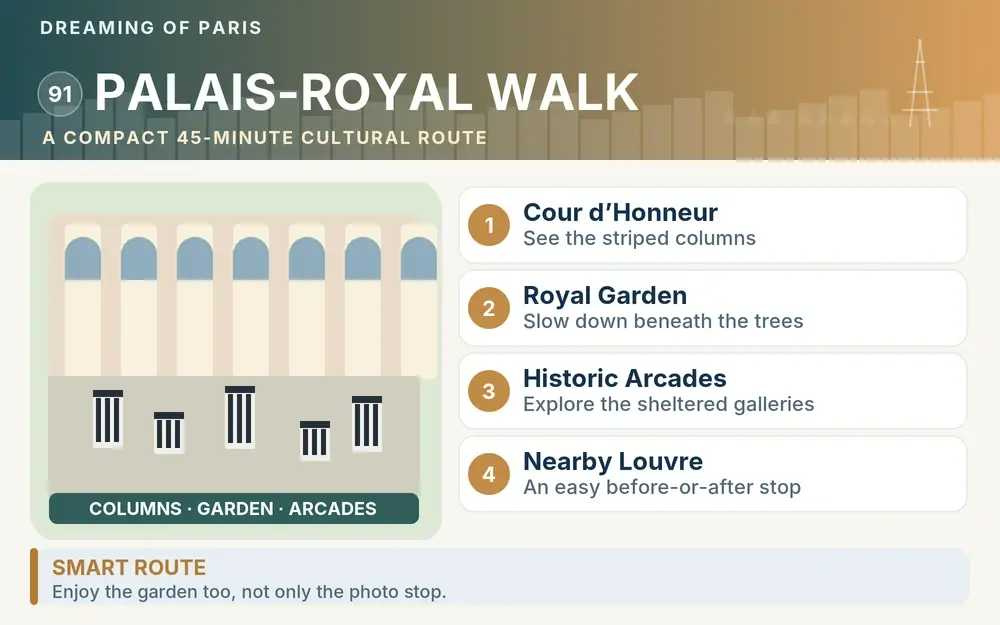
A 45-minute route
- Cour d’Honneur: 10 minutes with Buren’s columns and the architecture.
- Pol Bury fountains: 5 minutes.
- Central garden axis: 10 minutes walking and sitting.
- Galerie de Beaujolais: 5–10 minutes for literary addresses and the northern edge.
- Galerie de Montpensier or Valois: return under the arcades for 10 minutes.
If you have more time, add Galerie Vivienne nearby and turn the visit into a covered-arcade and urban-history walk using our covered passages guide.
Best time of day
Early morning is best for architecture photography and quiet. Late morning has more life without peak lunch crowds. Late afternoon gives better atmosphere in the garden and arcades. After dinner in summer can be excellent because the domain remains open late, but shopfronts may be closed and the experience becomes more about architecture and garden space.
Palais-Royal after the Louvre
This is one of the best Louvre decompression routes. Leave the museum, get outside, cross toward Palais-Royal and spend 30–45 minutes in the garden before dinner. It is much better than immediately entering another museum because your eyes shift from dense collections to architecture, plants and open space.
Our Louvre route and Tuileries guide can be combined with Palais-Royal without extra transport.
Palais-Royal before Montorgueil
A second strong combination is Palais-Royal → Galerie Vivienne → Rue Montorgueil → Saint-Eustache. This moves naturally north and east through the 1st and 2nd arrondissements. Use our Montorgueil and Les Halles guide for the continuation.
Accessibility and practical limitations
The official site provides ramps and adapted access in several parts of the domain, with seating throughout the garden. One practical limitation is easy to miss: there are no public toilets inside the national domain. Plan a café, museum or other facility nearby rather than arriving with children expecting park-style services.
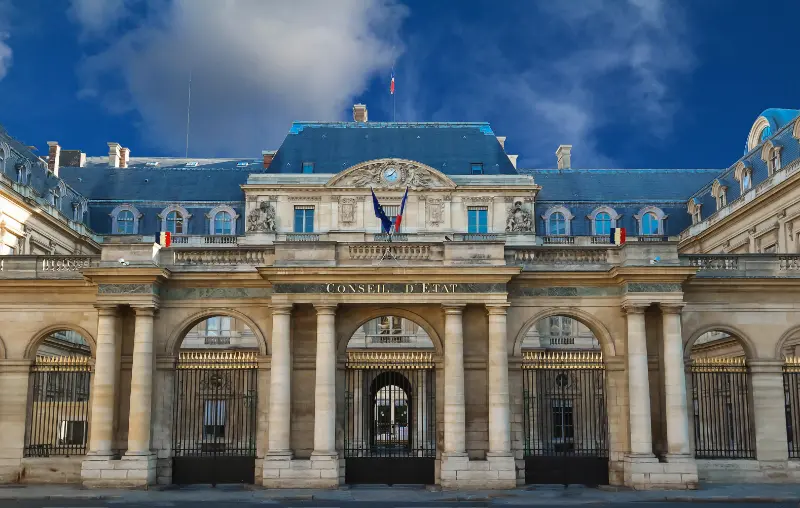
Because government institutions occupy parts of the complex—including the Conseil d’État, Constitutional Council and Ministry of Culture—you are visiting a living institutional site, not an entirely open palace interior. The free experience is primarily courtyards, galleries and garden.
Photography without blocking the site
The Cour d’Honneur is a working circulation space. Take your photo, then move. In the garden, use the long perspective rather than photographing every rose bed. Under the arcades, repeating columns and reflected shop windows create stronger compositions than the central lawn alone.
What not to expect
Do not come expecting furnished royal apartments on a standard self-guided ticket. Do not expect a large museum. Do not expect Buren’s columns to require an hour. Palais-Royal works because several layers fit into a compact free visit.
Palais-Royal and the French Revolution
The Palais-Royal was not only a refined garden. In the years before and during the Revolution, its arcades were a dense world of cafés, shops, political discussion and entertainment. Because the domain had a distinctive legal and social status under the Orléans family, it became a place where public debate could be unusually intense. Camille Desmoulins famously addressed a crowd here in July 1789 before events accelerated toward the storming of the Bastille.
You do not need to recreate the exact spot to understand the point. Stand under an arcade and imagine the same covered commercial environment filled with newspapers, cafés and political conversation. The architecture becomes easier to read when you remember that the galleries were built to generate urban life and revenue, not simply frame a garden.
The theaters are part of the district’s identity
Palais-Royal has a long theatrical history. The Comédie-Française stands at Place Colette on the southern side of the domain, while the Théâtre du Palais-Royal occupies the western edge. Even if you do not attend a performance, noticing the theater entrances explains why the area remains active after offices and shops close.
Where to sit and what to notice
The central chairs and benches are useful, but walk to the north end before choosing a seat. Look back toward the palace axis, watch pétanque when games are taking place, and notice how residents use the space differently from visitors. The garden’s value is precisely that it still functions as a neighborhood pause inside one of the most touristed parts of Paris.
Food and coffee around Palais-Royal
The arcades contain prestigious restaurants and specialist addresses, but you do not need to spend heavily to enjoy the site. For a cheaper plan, walk toward Rue Montorgueil after the garden. For a traditional café break, choose based on the actual menu and atmosphere rather than a famous address alone. If you have a timed Louvre visit, eat after rather than risking a slow lunch before your slot.
Palais-Royal with children
Children often respond better to Palais-Royal than adults expect because the columns, fountains, open garden and arcades provide variety without a long museum narrative. Give them ten minutes around the Buren installation, then move to the garden. Where signs or barriers restrict climbing, those limits are part of how the installation is managed; the columns are a public artwork rather than a general play structure.
One final detail: look up as well as across
The upper façades, shutters, roofline and rhythm of residential windows are easy to ignore when everyone photographs the courtyard floor. Give the architecture five minutes without a camera; it makes the contemporary artworks easier to understand as interventions inside a much older frame.
Frequently asked questions
Is Palais-Royal free?
Yes, access to the national domain and garden is free during opening hours.
How long do I need?
Forty-five minutes is ideal for a first visit; 20 minutes works for the courtyard and garden; 90 minutes allows the arcades, shops and nearby Galerie Vivienne.
Is it worth visiting if I am not interested in Instagram photos?
Absolutely. The garden, commercial history, literary addresses and political institutions make it one of the most layered free sites in central Paris.