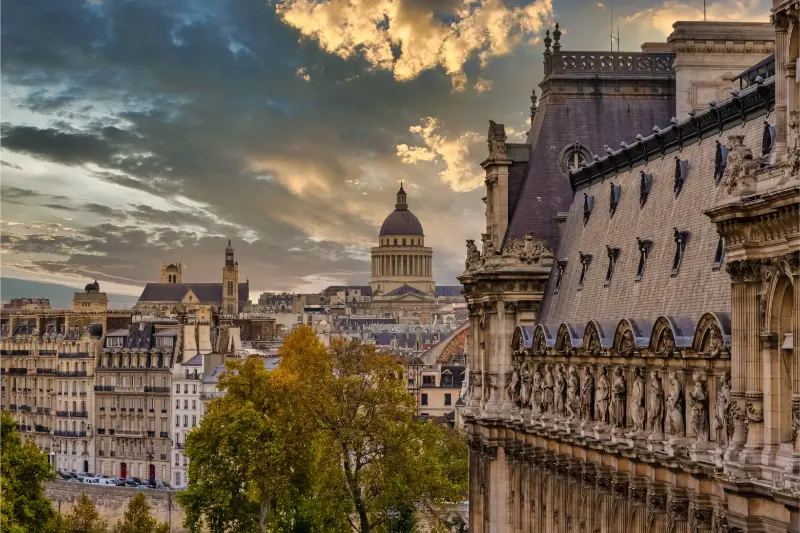
Paris 5th Arrondissement Guide: Latin Quarter, Panthéon, Rue Mouffetard and Roman Paris is for travelers who want to understand the district as more than a number on the Paris map. The 5th arrondissement is one of the best places to understand how many versions of Paris occupy the same hill. Roman remains, medieval learning, the Panthéon, botanical gardens, student streets and food-market rhythms all sit within a walkable Left Bank district.
This guide contains affiliate links. If you book through them, Dreaming of Paris may earn a commission at no extra cost to you.
Book the practical parts of your Paris trip
Compare accommodation first, then check tickets and experiences for the fixed parts of your itinerary.
Check Paris hotelsGetYourGuideTiqetsCivitatisAffiliate links: we may earn a commission at no extra cost to you.
Why explore the 5th arrondissement?
The 5th is especially rewarding for history lovers, families, first-time visitors who want a lively Left Bank base, bookish travelers and anyone who enjoys mixing monuments with market streets and gardens. It is less convincing for travelers seeking nightlife-first accommodation or a purely luxury experience; the district is lively and central, but its character is academic, historic and residential.
A good visit has a clear beginning and end but a loose middle. Use the major sights for orientation, then spend the valuable part of the walk on the streets linking them. That is where the arrondissement stops feeling like an administrative zone.
What to see in Paris’s 5th arrondissement
The Panthéon and Montagne Sainte-Geneviève
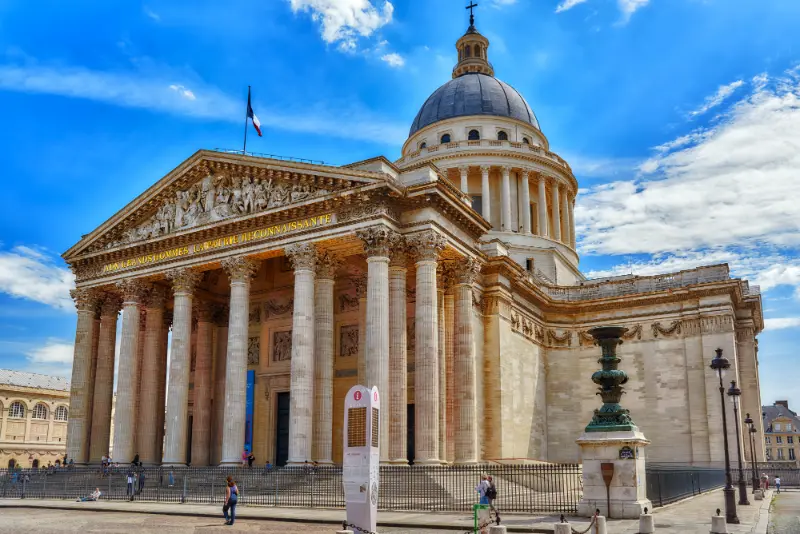
The hill around the Panthéon gives the arrondissement its strongest sense of history and learning. Allow time for the square, Saint-Étienne-du-Mont and the streets behind the monument rather than arriving only for the crypt. Spend a few minutes beyond the obvious viewpoint; the surrounding blocks often explain why this stop matters to the neighborhood.
Rue Mouffetard and Place de la Contrescarpe
This is the 5th at its most social and food-oriented. The upper section around the square is café-heavy, while the lower market street becomes more useful for food shopping. Visit in the morning for commerce and later for atmosphere. This is a good place to slow the pace and decide whether the next section needs more time or can remain a short pass-through.
Arènes de Lutèce
The Roman amphitheatre is modest compared with ancient sites in southern Europe, but its value is context: it reminds you that Paris began as a much older city than its Haussmannian image suggests. If this becomes the longest stop of the day, shorten a later section rather than rushing here; the route is designed to remain coherent after a cut.
Jardin des Plantes
The botanical garden is a full destination for families and natural-history fans. You can use the free outdoor garden as a breather or combine it with museum galleries, but do not assume every component shares the same ticket or schedule. Keep the camera away for the first few minutes and look at how people actually move through the space; it helps separate a functioning neighborhood from a tourist stop.
Musée de Cluny area
Medieval Paris becomes much easier to read around the Cluny museum and the remains of the Roman baths. This is a good choice when the weather is poor or you want a museum smaller and more focused than the Louvre. Allow enough margin for an unexpected closure or queue. The surrounding area gives you alternatives without forcing a complete itinerary change.
The Seine edge
From the eastern 5th you can connect easily to the Arab World Institute, bookstalls and views toward Notre-Dame. The river is the simplest way to close a day that began higher on the hill. The value here is context. Read the place in relation to the arrondissement’s history, scale and daily life rather than only its most photographed detail.
A practical walking route through the 5th
The sequence below is realistic for travelers who actually stop, look and eat. It avoids the common mistake of calculating only map distance and forgetting the time absorbed by Paris itself.
Step 1. Start around the Panthéon before the streets get busy, then descend toward Rue Mouffetard and the Arènes de Lutèce. Keep The Panthéon and Montagne Sainte-Geneviève as your first orientation point and avoid adding distant stops before the route has properly begun.
Step 2. Continue to Jardin des Plantes for greenery or family time, then follow the river west toward the historic Latin Quarter. The middle section is where the district’s character should become clearer; use Rue Mouffetard and Place de la Contrescarpe as a reference if you need to shorten or extend the walk.
Step 3. Finish around Saint-Michel or the Cluny area, where you can cross toward Notre-Dame or remain on the Left Bank for dinner. At the end, decide whether the day should continue into dinner or finish here. The Seine edge gives you a natural point from which to make that choice.
Where to eat and how to pace the day
Rue Mouffetard is the obvious food spine, but avoid treating every restaurant on the upper tourist-heavy stretch as equally good. For a market-style experience, walk farther south toward the food shops. Around Maubert and the Latin Quarter, compare menus before sitting down; location premiums can be substantial.
Reserve only when the meal itself is a priority. Otherwise, protect flexibility: a good bakery, market counter or neighborhood bistro close to the route is often more useful than an acclaimed address that forces a forty-minute detour.
Is the 5th arrondissement a good place to stay?
The 5th is a strong compromise between sightseeing convenience and neighborhood life. It works particularly well for families and travelers who want evening walks without relying on the metro. Hotels around Saint-Michel are busier; farther south toward Censier-Daubenton the atmosphere becomes more residential.
Before paying, simulate one typical day from the hotel: morning trip to a central sight, return after dinner, and walk with luggage. That simple check exposes inconvenient locations better than a generic ‘central’ label. You can compare hotels in Paris on Booking.com and then compare recent guest comments before booking.
Getting around the 5th
RER B at Luxembourg and Saint-Michel can be useful for airport connections, while Metro lines 7 and 10 cover much of the arrondissement. Hills matter more than the map suggests, especially with luggage around the Panthéon.
Paris buses can be scenic, but traffic makes them harder to predict. For a reservation with a fixed entry time, favor the Métro and add a walking buffer from the station. For fares, passes and connections, use our Paris Métro and public transport guide.
How much time should you allow?
Budget more time than the map suggests. Walking distances can be short, but museum queues, markets, terraces and small detours quietly turn a two-hour sketch into a four-hour visit.
When necessary, cut the farthest stop instead of speeding up everything else. Paris itineraries remain enjoyable when one section disappears; they rarely improve when every section is rushed. If you need a compact version, prioritize The Panthéon and Montagne Sainte-Geneviève, Rue Mouffetard and Place de la Contrescarpe and Musée de Cluny area.
When to visit during the day
Late morning is often the easiest starting point because cafés and shops are awake without forcing an early alarm. Continue through lunch and let the final stop determine whether the walk should end before dinner or flow naturally into the evening.
Whatever the season, verify the current opening day and reservation policy of any ticketed venue shortly before you go. Temporary exhibitions, maintenance and special events can change the best order even when the geography stays the same.
Who will enjoy this arrondissement most?
Different travel styles can use the same route: couples may linger over meals, families may prioritize parks, and solo travelers can add museums. The key is to keep the geographic order even when the stops change. In this case, the strongest fit is still history lovers, families, first-time visitors who want a lively Left Bank base, bookish travelers and anyone who enjoys mixing monuments with market streets and gardens.
Combine the 5th with nearby Paris
Useful related guides include Latin Quarter walk, Panthéon guide, Jardin des Plantes and Notre-Dame. Nearby planning works best when the second area begins where the first walk ends. The following guides were chosen with that principle in mind.
Tours and bookable experiences
If you book a tour, place it at the beginning of your time in the district. The context can make the streets that follow more meaningful, and you can revisit interesting places independently afterward.
Common planning mistakes
Mistake 1: Spending the entire visit between Saint-Michel and the Panthéon and missing Jardin des Plantes and the Roman layer.
Mistake 2: Assuming the Latin Quarter is a single student street rather than a large area crossing the 5th and 6th.
Mistake 3: Choosing a restaurant only because it is close to a landmark instead of walking one or two blocks for more choice.
Finally, do not treat the arrondissement boundary as a wall. Paris neighborhoods spill across administrative lines, and crossing one street into the next arrondissement is often the most logical way to finish the route.
Frequently asked questions
Is the 5th arrondissement good with children?
Yes. Jardin des Plantes, open spaces and shorter distances make it one of the easier central districts for families.
Is Rue Mouffetard worth visiting?
Yes, especially in the morning when food shops are active. The lower market section is more useful than simply stopping at Place de la Contrescarpe.
How long should I allow?
Half a day covers one main cluster; a full day lets you combine the Panthéon, market streets and Jardin des Plantes without rushing.
What should I combine it with?
The 4th across the Seine and the 6th around Saint-Germain are the most natural extensions.
Official information and final tip
For seasonal events and current visitor information, consult official Paris tourism information. For a ticketed museum, monument or attraction, check that venue’s own official website as well before you commit the rest of the day to a fixed entry time.
The arrondissement is easiest to remember as a sequence of connected places rather than a list of attractions. Keep the anchors, walk the transitions and allow one unscheduled stop; that is usually where the day becomes personal.