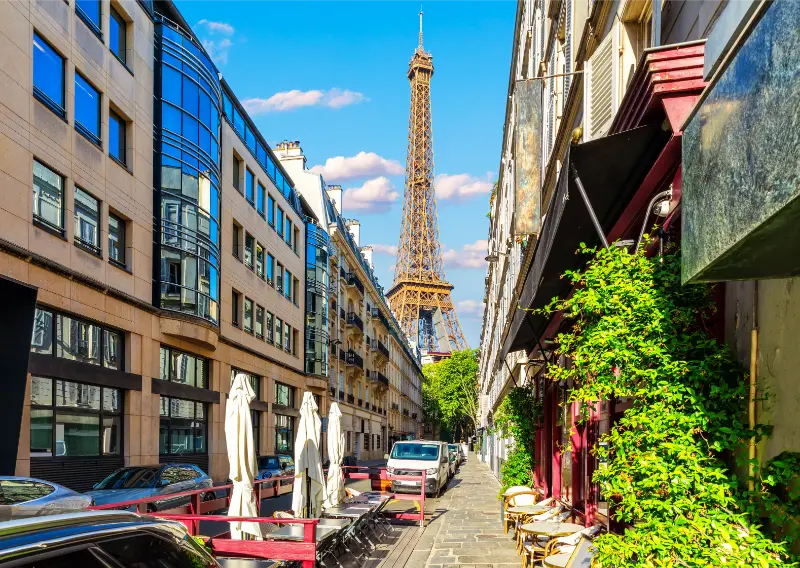
“Near the Eiffel Tower” describes several very different hotel experiences. You can stay in the 7th on elegant residential streets, in the 15th near everyday shops, across the Seine in Passy or around Trocadéro with classic viewpoints. All are close on a map, but they differ in price, noise, restaurants, hilliness and transport.
Compare hotels for your stay in Paris
Check current availability, location and prices before choosing the exact neighborhood.
Check Paris hotels on Booking.comAffiliate link: we may earn a commission at no extra cost to you.
Before paying a premium, decide what you actually want: a verified tower view from the room, the ability to walk to the monument, or a Paris base that happens to be near it. Our Eiffel Tower visit guide covers the attraction itself; this article focuses on choosing the hotel area.
This guide contains affiliate links. If you book through them, Dreaming of Paris may earn a commission at no extra cost to you.
The 7th arrondissement: the classic choice for walking to the tower
The 7th is the obvious answer if you want to leave the hotel and walk to Champ de Mars, Invalides, Rue Cler or the Seine. It is elegant, relatively calm and full of small hotels. The 7th arrondissement guide shows how the area extends far enough that “7th arrondissement” does not always mean a five-minute tower walk.
The biggest advantage is emotional rather than logistical: you can see the tower during ordinary moments—on the way to breakfast, returning after dinner, or during an early walk before crowds build. The disadvantage is that parts of the 7th become quiet in the evening and hotel prices often reflect the landmark rather than room size or facilities.
Dupleix and La Motte-Picquet in the 15th: the practical alternative
The 15th immediately south of Champ de Mars is one of the smartest alternatives for travelers who want proximity without paying only for prestige. Around Dupleix, Commerce and La Motte-Picquet–Grenelle, you have supermarkets, bakeries, restaurants and useful Metro lines in a more residential setting. See the 15th arrondissement guide for the wider district.
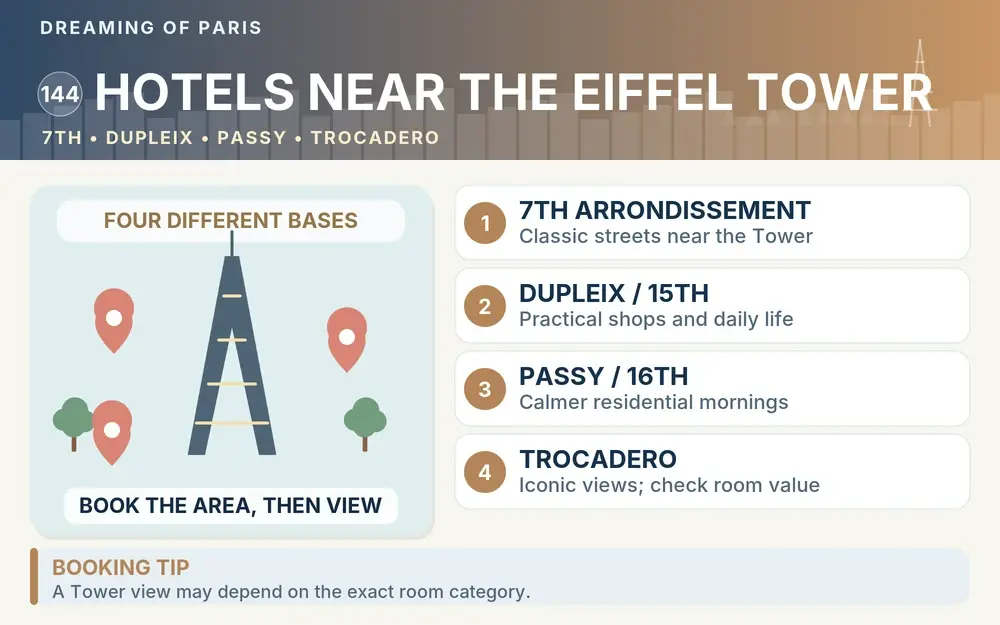
This area is particularly good for families and longer stays. You can still walk to the Eiffel Tower, but the neighborhood works even when you are not sightseeing. The view from the room is less predictable, so if a tower view is essential, verify the exact room category rather than assuming proximity creates a view.
Passy and the 16th: calm, polished and better for local mornings
Across the Seine, Passy offers a quieter residential experience with local shopping streets, cafés and access to western Paris. Our Passy and Auteuil guide explains why this side of the river feels different from the tourist-heavy tower zone.
Passy works well for couples and repeat visitors who want the Eiffel Tower nearby but do not need to sleep in its shadow. Some streets are hilly, and transport to the Marais or eastern Paris can take longer. In return, evenings are calmer and the neighborhood gives you a more lived-in base.
Trocadéro: best for iconic views, not always best for value
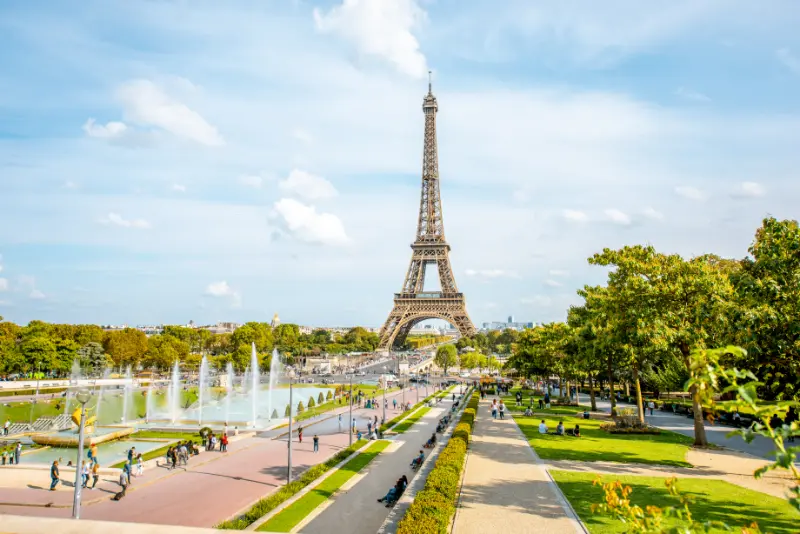
Trocadéro is where many classic tower photographs are made, and hotels around the 16th can advertise strong views. Our Trocadéro guide explains how the terraces, Chaillot museums and route across the Seine fit together.
For accommodation, the question is whether you will use that position repeatedly or simply photograph it once. Rates can be high, and the immediate area is not as strong for casual dinner choices as the Marais or 11th. If you are planning a short luxury stay centered on the tower, it can be perfect. If you want food, nightlife and neighborhood variety, consider Passy or the 15th instead.
How to judge an “Eiffel Tower view” room
Do not treat “Eiffel Tower view” as a standardized hotel category. A full frontal view from a balcony, a partial view between rooftops, a glimpse from the bathroom and access to a shared rooftop can all be marketed with similar language. Check the exact room name, floor, recent guest photos and whether the view is guaranteed or “subject to availability.”
If the view justifies a large price difference, contact the property in writing before the free-cancellation deadline. Ask whether the booked category guarantees the tower and whether scaffolding, seasonal trees or nearby construction affects the view. Paying for certainty is reasonable; paying for an assumption is not.
Transport: the tower is central on the map but not a universal hub
The Eiffel Tower area is served by several useful lines, but no single station connects directly to every major district. Bir-Hakeim, Trocadéro, École Militaire and La Motte-Picquet–Grenelle each solve different journeys. The transport guide is useful when comparing hotels on opposite sides of Champ de Mars.
This matters on a first trip. A hotel beside the tower may still require changes for Montmartre, Belleville or some train stations. If your itinerary is centered on the Left Bank and western attractions, the location is excellent. If you expect every day to end in the Marais or 11th, you may prefer a more central base and visit the tower at selected times.
Who should pay the premium to stay here?
- First-time visitors with a short trip who want the Eiffel Tower to anchor the experience.
- Couples celebrating something specific when a verified view is part of the memory they want.
- Families who value the open space of Champ de Mars and residential services in the nearby 15th.
- Travelers with mobility needs who find one major priority easier when it is walkable, provided the specific hotel is accessible.
- Repeat visitors interested in Passy, the 16th and western Paris rather than only the historic center.
Travelers focused on nightlife, the Marais or east-Paris neighborhoods should compare the premium against staying closer to their evening plans. The tower is easy to visit from many parts of Paris; your hotel does not need to be beside every attraction you love.
A better way to book: area first, room second, view last
Choose between the 7th, 15th, Passy and Trocadéro based on neighborhood style. Then compare hotels for transport, room size, lift, air-conditioning and cancellation. Only after that should you decide how much extra a tower view is worth. This order prevents the landmark from overwhelming practical details.
If you will visit the tower itself, reserve that experience separately and read our advance-booking guide before choosing a non-refundable hotel around one specific time slot.
Compare accommodation before you commit
Hotel prices in Paris move sharply with exhibitions, school holidays, fashion events and major weekends. Use Booking.com to compare current room inventory, but compare the exact street, nearest station, cancellation terms, room size and air-conditioning rather than ranking properties only by headline price. A cheaper room that adds two awkward changes to every journey is not always the cheaper trip.
Official information to check before your trip
For current accommodation listings by arrondissement, use the official Paris je t’aime directory. For the monument itself, always verify current access rules on the official Eiffel Tower website before relying on a hotel package or third-party description.
The 7th is the classic choice, the 15th is usually the practical choice, Passy is the calm residential choice and Trocadéro is the view-driven choice. All can be right. The mistake is paying “Eiffel Tower prices” without knowing which of those experiences you are buying.
If the tower is the emotional center of your trip, staying nearby can be worth more than a larger room elsewhere. Just make the premium intentional and verify the exact view, street and transport before the cancellation window closes.
One final planning check before you book
Open the map and trace the three journeys you are most likely to repeat: the first morning, the longest sightseeing day and the return after dinner. Then check the route from the station or bus stop to the hotel door, not only the station name. Paris blocks, hills, large intersections and station exits can make a short map distance feel very different with luggage or after a long day.
Compare the flexible rate with the cheapest non-refundable rate. If the saving is small, flexibility is often worth more than the discount because train times, flights, family plans and event dates can move. A good accommodation decision should still look good after the itinerary changes once or twice; that resilience is part of value, not an optional luxury.
Also check the most recent reviews for issues that are difficult to judge from official photographs: street noise after midnight, lift reliability, room temperature, construction nearby and how staff handle luggage before check-in. Look for repeated patterns rather than one angry review. When three or four recent guests mention the same practical problem, treat it as useful evidence and decide whether that compromise matters to your trip.
Finally, remember that Paris hotel pricing is highly date-sensitive. A neighborhood that looks expensive for one weekend may be competitive a week later, and the opposite can happen during trade fairs, fashion events, concerts or school holidays. Compare the same dates across several districts before deciding that one area is categorically outside your budget.
Before finalizing the plan, save the exact address, nearest transport entrance and cancellation deadline in the same trip note as your reservations. That small step makes it much easier to compare alternatives rationally and prevents a good booking from becoming inconvenient because one practical detail was overlooked. Recheck the plan a few days before travel as well: opening conditions, construction, transport works and neighborhood events can change the practical value of a location even when the address itself has not changed. A quick verification protects the time you have already invested in planning.