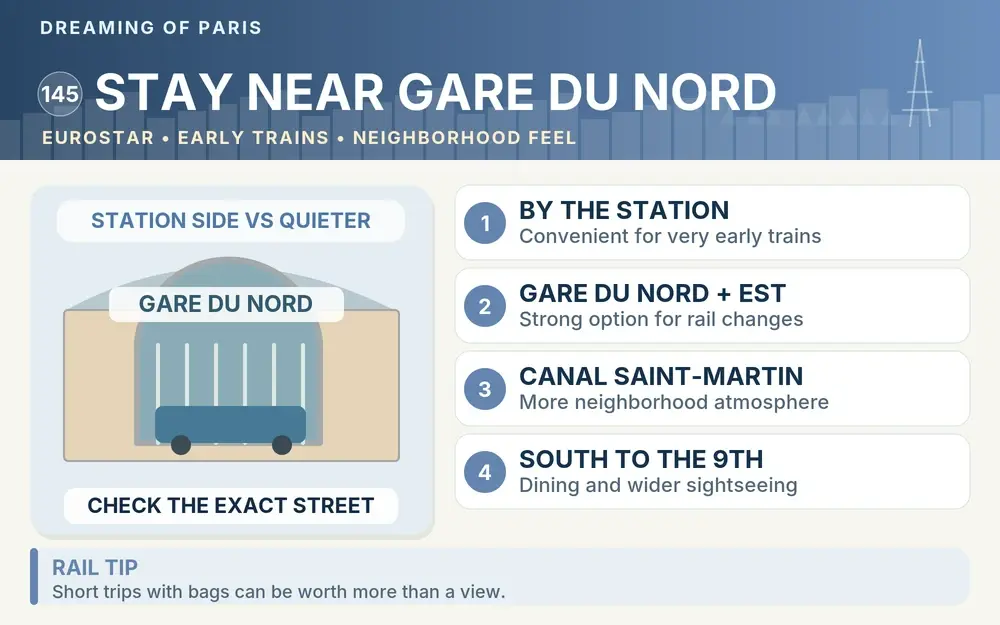
Staying near Gare du Nord can be extremely convenient, but “near the station” covers streets with very different atmospheres. The area is one of Europe’s busiest transport hubs, with international rail, suburban trains, RER and Metro connections. That convenience creates crowds, traffic, luggage and constant movement. A hotel two blocks away can feel much calmer than one facing the main frontage.
Compare hotels for your stay in Paris
Check current availability, location and prices before choosing the exact neighborhood.
Check Paris hotels on Booking.comAffiliate link: we may earn a commission at no extra cost to you.
This guide is for Eurostar travelers, passengers using Gare du Nord or Gare de l’Est, and anyone who values direct access to CDG via RER B. Read our Paris train stations guide and CDG transfer guide alongside it. The goal is to use the transport advantage without assuming the station forecourt is the only sensible place to sleep.
This guide contains affiliate links. If you book through them, Dreaming of Paris may earn a commission at no extra cost to you.
Directly beside Gare du Nord: best for very early or very late trains
A hotel within a few minutes of the station makes sense when your train timing dominates the trip: a late arrival, an early departure, heavy luggage or a one-night stop. You remove the risk of a Metro disruption or taxi delay before an international train and can walk to check-in.
The compromise is atmosphere. The streets immediately around major stations are busy, commercial and noisy. If you are staying several nights, I would not automatically choose the closest possible door. Look for double glazing, reception staffing, lift access and recent reviews that mention nighttime noise. A side street can preserve almost all of the convenience without putting the bed above the busiest traffic.
Between Gare du Nord and Gare de l’Est: the practical rail traveler zone
The short corridor between the two stations is useful if your itinerary includes both northern/international trains and eastern routes. The 10th arrondissement guide explains the geography: the station district is functional, while the canal and smaller streets to the east become more residential and social.
This area is particularly sensible for a one- or two-night rail stop. You have restaurants and services close by, but I would choose the exact street after looking at the walking route rather than booking from a map pin alone. Busy junctions can add traffic noise; quieter blocks can feel much more comfortable.
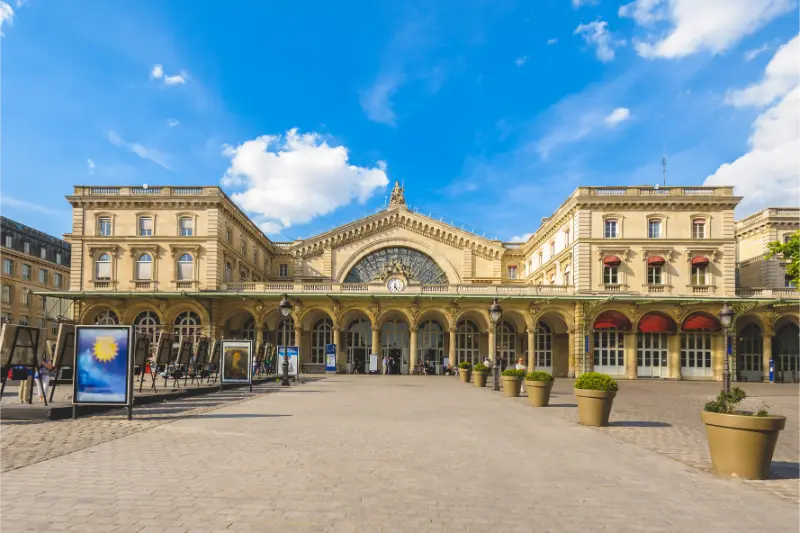
Canal Saint-Martin: the best choice if you want a neighborhood as well as a station
If you are staying three nights or more, the Canal Saint-Martin side of the 10th often gives a better balance. You remain within manageable reach of Gare du Nord but gain waterside walks, cafés and evening atmosphere. Our Canal Saint-Martin route shows how easily this connects to eastern Paris.
The walk with luggage may be longer than it looks, so decide whether you will walk, take a short Metro ride or use a taxi on arrival. For daily sightseeing, the canal area can feel far more like a Paris neighborhood than the station frontage while preserving strong transport.
South toward the 9th: better for restaurants and central sightseeing
Another strong strategy is to move south toward Rue de Maubeuge, Poissonnière and the 9th arrondissement. You remain reasonably close to Gare du Nord, but the environment becomes more connected to Opéra, Grands Boulevards and South Pigalle. The 9th arrondissement guide helps identify the best fit.
This is often my choice for a traveler arriving by Eurostar who still wants a classic city break. You give up the two-minute station walk, but gain better access to central Paris and more attractive evening routes. A short taxi to the station on departure day can be a worthwhile trade.
What about Montmartre?
Parts of the 18th are physically close to Gare du Nord, but hills and street patterns make luggage journeys less straightforward than the map suggests. If Montmartre is a priority, staying on the lower southern edge can work well. Read the 18th arrondissement guide and do not assume every “Montmartre hotel” is convenient to the station.
The advantage is atmosphere; the disadvantage is that you may exchange a flat ten-minute route for stairs or steep streets. For one romantic weekend that may be worth it. For a family carrying several suitcases, it may not.
Safety: use normal big-station habits, not exaggerated fear
Gare du Nord is crowded, and crowded transport hubs attract opportunistic theft. The practical response is the same as at other major European stations: keep phones and wallets secure, do not leave luggage unattended, ignore unsolicited offers, and know the route to the hotel before you step outside. At night, use well-lit main routes if you are unfamiliar with the area.
Our Paris scams and safety guide covers common situations without treating entire neighborhoods as dangerous. Reviews that describe the exact hotel entrance and street at night are more useful than generic statements about the whole 10th arrondissement.
Why this location is so strong for airport and onward travel
RER B makes Gare du Nord a major link for CDG, which is one reason the district can be strategically excellent on arrival or departure days. The station also connects with multiple Metro and rail services. Use the transport guide to check current routes, engineering works and ticket rules.
If your Paris stay is part of a longer rail trip through London, Belgium, the Netherlands or northern France, staying near the station can remove a lot of stress. The value is highest when you actually use the hub more than once. If you arrive once and spend six days in the Marais, proximity to the station may be less important than neighborhood fit.
Hotel features rail travelers should prioritize
- 24-hour or late reception if your train arrives in the evening.
- Lift access for luggage; older buildings may have small or partial lifts.
- Left-luggage policy on arrival and departure day.
- Soundproofing if the property faces a main road or rail approach.
- Flexible cancellation when international rail plans are not final.
- A clear walking route rather than only a short straight-line distance.
If you are catching Eurostar, check the operator’s current arrival and check-in guidance close to travel. Security and border procedures can change, and an old blog post should never determine how late you leave the hotel.
Compare accommodation before you commit
Hotel prices in Paris move sharply with exhibitions, school holidays, fashion events and major weekends. Use Booking.com to compare current room inventory, but compare the exact street, nearest station, cancellation terms, room size and air-conditioning rather than ranking properties only by headline price. A cheaper room that adds two awkward changes to every journey is not always the cheaper trip.
Official information to check before your trip
The official Paris accommodation directory currently describes the 10th around Canal Saint-Martin, Gare du Nord and Gare de l’Est as a convenient rail hub with accommodation from hostels to designer hotels. Always check your train operator’s current departure guidance separately.
For one night or a very early train, stay genuinely close to Gare du Nord. For a longer city break, move slightly toward Canal Saint-Martin or south into the 9th. You keep most of the transport advantage and gain a neighborhood that works better between train journeys.
Gare du Nord is not a single hotel district. Treat it as a transport anchor, then choose the surrounding streets according to how much you value immediate platform access versus restaurants, quiet and evening atmosphere.
One final planning check before you book
Open the map and trace the three journeys you are most likely to repeat: the first morning, the longest sightseeing day and the return after dinner. Then check the route from the station or bus stop to the hotel door, not only the station name. Paris blocks, hills, large intersections and station exits can make a short map distance feel very different with luggage or after a long day.
Compare the flexible rate with the cheapest non-refundable rate. If the saving is small, flexibility is often worth more than the discount because train times, flights, family plans and event dates can move. A good accommodation decision should still look good after the itinerary changes once or twice; that resilience is part of value, not an optional luxury.
Also check the most recent reviews for issues that are difficult to judge from official photographs: street noise after midnight, lift reliability, room temperature, construction nearby and how staff handle luggage before check-in. Look for repeated patterns rather than one angry review. When three or four recent guests mention the same practical problem, treat it as useful evidence and decide whether that compromise matters to your trip.
Finally, remember that Paris hotel pricing is highly date-sensitive. A neighborhood that looks expensive for one weekend may be competitive a week later, and the opposite can happen during trade fairs, fashion events, concerts or school holidays. Compare the same dates across several districts before deciding that one area is categorically outside your budget.
Before finalizing the plan, save the exact address, nearest transport entrance and cancellation deadline in the same trip note as your reservations. That small step makes it much easier to compare alternatives rationally and prevents a good booking from becoming inconvenient because one practical detail was overlooked. Recheck the plan a few days before travel as well: opening conditions, construction, transport works and neighborhood events can change the practical value of a location even when the address itself has not changed. A quick verification protects the time you have already invested in planning.