Disclosure: This article contains affiliate links or booking widgets. If you book through them, Dreaming of Paris may earn a commission at no extra cost to you. How our affiliate links work.
Le Marais is one of the easiest Paris neighborhoods to visit badly. You can spend two hours drifting between fashionable shops and crowded food lines and still miss the private mansions, religious history, courtyards and layered communities that make the district important. The solution is not to search for “secret Marais.” It is to walk with a sequence that explains how the neighborhood changed.
This route moves from the aristocratic Marais around Place des Vosges through museum courtyards, Jewish heritage around rue des Rosiers, medieval traces and the more contemporary northern streets. It works in roughly four hours without major museum visits, or most of a day if you enter Carnavalet or Picasso.
Why the Marais looks different from much of central Paris
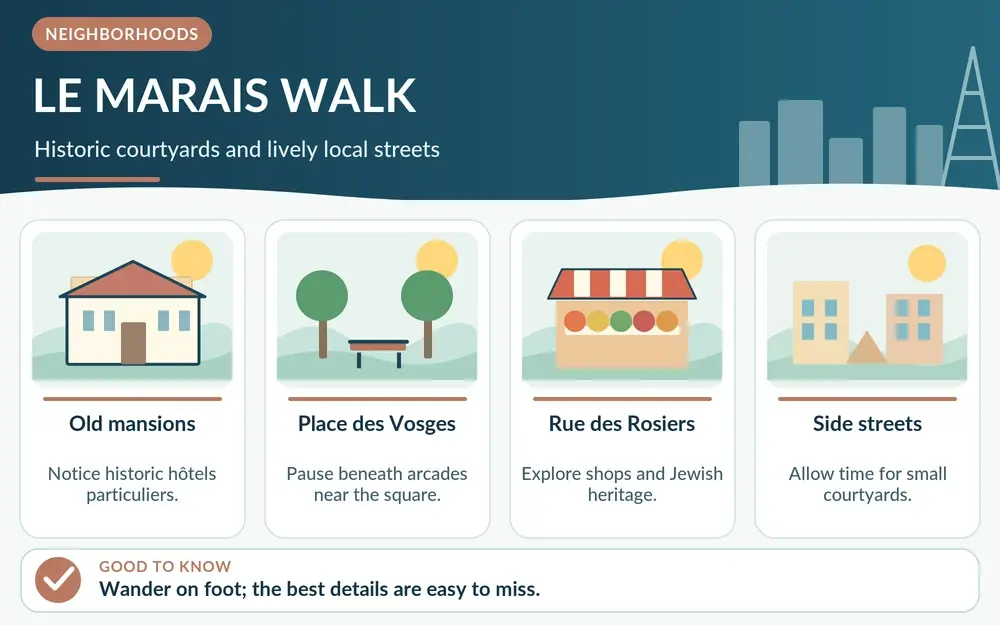
The Marais escaped some of the sweeping 19th-century transformations that remade other districts. Its street pattern therefore feels tighter and less uniform, and it preserves an exceptional concentration of hôtels particuliers—urban private mansions built for wealthy families. These are not hotels in the modern sense. Their courtyards, gates and garden arrangements are part of what gives the neighborhood its rhythm.
The official Paris tourism walking material describes the district’s aristocratic rise from the late medieval period and the great 17th-century era of private mansions. Understanding that helps you see beyond the retail layer that dominates many first impressions today.
Start at Place des Vosges before the neighborhood gets busy
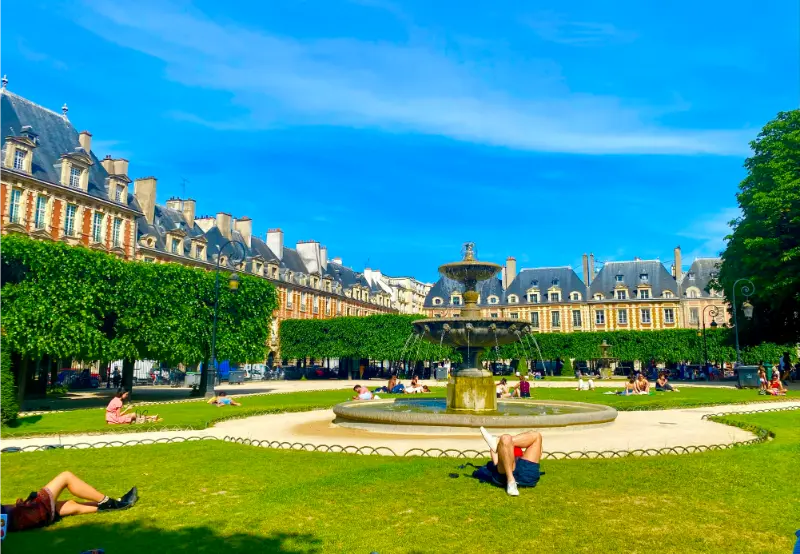
Place des Vosges is the cleanest introduction to the aristocratic Marais. The square’s regular brick-and-stone façades and arcades frame a garden that still functions as a neighborhood pause rather than only a monument. Walk under the arcades, not just across the lawn, because the architecture is designed as a perimeter experience.
Victor Hugo lived at number 6, now the Maison de Victor Hugo. If you are interested in literary Paris, the house can turn a ten-minute square stop into an hour. Otherwise, keep it for another trip and continue north through the smaller streets.
Hôtel de Sully: the shortcut most visitors rush through
From Place des Vosges, the passage through the Hôtel de Sully is one of the best small transitions in the Marais. The mansion’s courtyard and garden reveal the inward-facing logic of the neighborhood’s grand residences. Access rules can change with events, so treat it as a route to enjoy when open rather than a guaranteed shortcut.
These semi-public courtyards are a recurring Marais theme. Enter only where access is clearly permitted and do not treat residential entrances as photo sets. One of the best ways to preserve the neighborhood’s atmosphere is simply to respect the line between public and private space.
Musée Carnavalet: the museum that explains the city outside
If you choose one museum in the Marais, Carnavalet is the most useful for understanding Paris itself. Its collections cover the city’s history across archaeology, domestic interiors, signs, paintings, revolutionary material and everyday objects. The permanent collections are generally free, while temporary exhibitions may require tickets.
Even if you do not enter, look at the museum’s courtyard architecture. If you do go in, give it at least 90 minutes rather than trying to “see everything.” It pairs naturally with this neighborhood because what you learn inside changes how you read the streets outside.
Rue des Francs-Bourgeois: use it as a connector, not the destination
Rue des Francs-Bourgeois is busy and heavily commercial, but it links important parts of the district. Walk it without assuming every interesting element is at eye level. Gates, carved details and courtyard openings often tell you more about the older Marais than the storefronts.
If crowds are dense, step one or two streets north or south. The Marais changes quickly over short distances, which is why a rigid “top 10 addresses” itinerary is less useful than a good sense of direction.
Rue des Rosiers and Jewish heritage: more than a food stop
The area around rue des Rosiers is associated with the historic Jewish quarter often called the Pletzl. Synagogues, schools, memorial traces, bakeries and restaurants reflect generations of Jewish life, migration and persecution. The area is living heritage as well as a food and shopping district, with religious, historical and everyday community life overlapping in a small space.
Queues for famous falafel shops can dominate the street at peak times. If eating there matters to you, do it; if not, do not let a viral queue consume an hour of your walking day. Look at side streets and plaques, and consider the Shoah Memorial nearby if you want deeper historical context. If you enter the Shoah Memorial or another historical site, allowing enough time for the visit makes the context much easier to understand.
Jardin des Rosiers–Joseph-Migneret: a useful quiet break
This small garden, reached from rue des Rosiers, is one of the neighborhood’s best pauses when open. It links former private gardens and creates a surprisingly green interior space behind dense street façades. Opening hours vary seasonally like other city gardens, so do not build a timed plan around it.
It is valuable precisely because it demonstrates the hidden geometry of the Marais: public streets outside, deep plots and gardens behind.
Rue Vieille du Temple and the northern Marais
Continue north along or around rue Vieille du Temple and the district becomes less ceremonial. Galleries, cafés, design shops and residential buildings mix with older architecture. The Carreau du Temple area is a good turning point if you want to continue into the northern Marais rather than looping immediately back to the Seine.
The official Paris tourism Marais walk is useful for current route ideas, but leave room for detours. A doorway, courtyard glimpse or market street can be more memorable than another item on a checklist.
Marché des Enfants Rouges: lunch with strategy
Founded in 1615, Marché des Enfants Rouges is Paris’s oldest covered food market still operating. Today it combines produce and food stalls with prepared dishes from several culinary traditions. It can be excellent for lunch, but it is small and popular.
The city’s current schedule lists it closed Monday, with long opening hours Tuesday through Saturday and a shorter Sunday. Individual food vendors may keep different schedules. Arrive before the main lunch crush if you want choice, and remember that a market is not automatically cheaper than a bakery picnic.
Place Sainte-Catherine: useful, but not “undiscovered”
Place du Marché Sainte-Catherine is often described as a hidden village square. It is charming, but it is well known and ringed by restaurants. Visit for the scale and atmosphere, not because a guide promises nobody else will be there. Early morning and late afternoon reveal its shape better than peak meal times.
A 4-hour self-guided Marais route
- 0:00–0:30: Place des Vosges and arcades.
- 0:30–0:50: Hôtel de Sully area and surrounding streets.
- 0:50–1:20: Carnavalet courtyards or short museum look.
- 1:20–2:00: rue des Rosiers, Jewish quarter and memorial context.
- 2:00–2:30: garden break and side streets.
- 2:30–3:15: rue Vieille du Temple and northern Marais.
- 3:15–4:00: Marché des Enfants Rouges or café stop.
Add two hours if you seriously visit Carnavalet, Picasso Museum or the Shoah Memorial. Trying to combine all three museums in one neighborhood day misses the point of being in the neighborhood.
Shopping without letting shopping erase the Marais
The Marais is one of Paris’s major shopping districts, especially for fashion, design, beauty and independent boutiques. Decide whether shopping is a goal or a background activity. If it is a goal, reserve a separate block; otherwise you can lose the historical route one store at a time.
Sunday can be lively because many Marais shops open when other areas are quieter, but that also means denser crowds. For architecture and photography, a weekday morning is calmer.
Where to stay in the Marais
Staying here gives you walkable access to central Paris, the Seine, Notre-Dame and excellent evening atmosphere. The trade-offs are price, smaller hotel rooms in historic buildings and noise on nightlife streets. The exact micro-location matters more than the label “Marais.” Compare it with Saint-Germain, the Latin Quarter and other areas in our where to stay in Paris guide.
Compare hotels for your stay in Paris
Check current availability, location and prices before choosing the exact neighborhood.
Check Paris hotels on Booking.comAffiliate link: we may earn a commission at no extra cost to you.
How to connect Le Marais with Notre-Dame
The best pairing is geographical: start at Notre-Dame and Île de la Cité in the morning, cross via Hôtel de Ville, then spend the afternoon in the Marais. This gives you one major sacred monument, one historic island and one neighborhood day without unnecessary transport.
Le Marais with children
Use Place des Vosges as the movement break and keep museums short. Food markets can work well because everyone can choose something different, but seating is limited. Cobblestones are manageable with a stroller but not always smooth. Our Paris with kids guide includes broader pacing advice.
Common Marais mistakes
- Spending the whole visit on rue des Rosiers and rue des Francs-Bourgeois.
- Calling every courtyard “hidden” and entering private property without permission.
- Queueing an hour for one food address when the neighborhood offers many alternatives.
- Trying to visit several museums and still claiming you “walked the Marais.”
- Ignoring Jewish history while treating the Pletzl only as a lunch zone.
FAQ
How much time do you need in Le Marais?
Four hours works for a strong walk with food and short stops. A full day is better if you add a museum.
Is Le Marais good on Sunday?
Yes for atmosphere and shopping, but it is also one of the busiest days. Choose a weekday morning for a quieter architectural walk.
Is Place des Vosges free?
The square and central garden are public and free. Individual museums and businesses around it have their own rules.
What is the best metro stop for Le Marais?
There is no single best stop because the district is broad. Saint-Paul is convenient for Place des Vosges; Hôtel de Ville approaches from the southwest; Temple and République work for the north. Plan around your route rather than a generic station.
The Marais rewards curiosity more than speed. Use the famous streets as a framework, then spend your attention on courtyards, plaques, gardens and side streets. That is where the district stops feeling like an outdoor shopping center and starts making historical sense.
Two important Marais museums
Deepen the neighborhood with the free Musée Carnavalet and our focused Musée Picasso Paris guide.
Place des Vosges and the islands
Slow the route down with our Place des Vosges guide, then cross toward the historic center with the Île Saint-Louis walk.
Slow down at Place des Vosges
For a focused stop inside the Marais rather than another checklist sight, use our Place des Vosges and Maison de Victor Hugo guide.
Compare Le Marais walking and food tours
The live options below are useful if you want a guided visit, reserved experience or packaged activity for this specific part of the trip. Compare the exact inclusions, meeting point, language and cancellation terms before booking.
Two additional ways to understand the Marais
The district is central to both queer and Jewish Paris. Continue with our LGBTQ+ Paris guide and Jewish Paris guide for history, community spaces and practical planning.