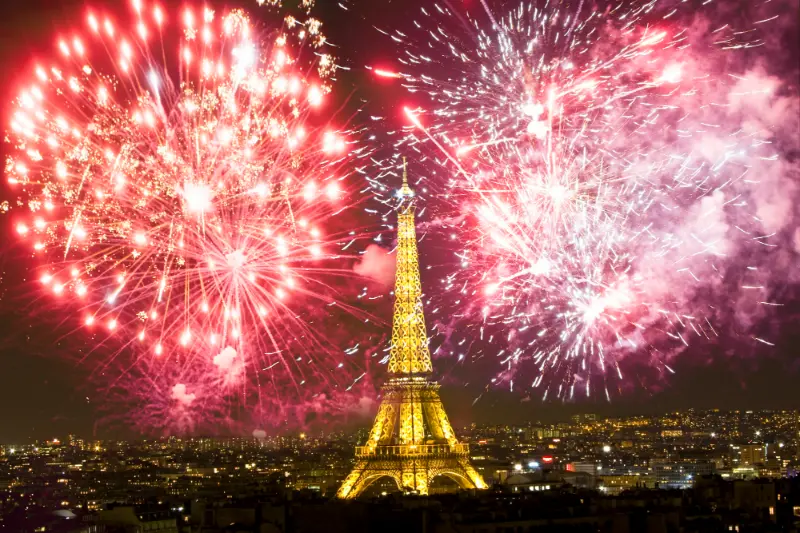
Paris is easier to plan when you treat the event calendar as part of the itinerary rather than decoration around it. A marathon can close roads, a fashion week can tighten hotel availability, Roland-Garros can reshape the western side of the city, and a free all-night arts festival can make an ordinary Saturday feel completely different. The same dates that create crowds can also produce some of the most memorable experiences of a trip.
This guide is the year-round hub for annual events in Paris. It focuses on recurring patterns, the kinds of disruption or opportunity each event creates, and the decisions that matter to a visitor: when to book, which areas become busy, whether an event is free, and how to keep a normal sightseeing plan flexible. For weather and daylight rather than events, use our best time to visit Paris guide and the dedicated seasonal articles.
How to use the Paris events calendar
The most useful question is not simply “what is on?” but “does this event change my trip?” A small exhibition may be interesting without affecting transport or accommodation. By contrast, the Paris Marathon, Bastille Day, New Year’s Eve, Paris Fashion Week and the final stage of the Tour de France can affect roads, security perimeters, restaurant demand or hotel prices well beyond the event venue.
Before booking a non-refundable hotel or a tightly timed airport transfer, check the official Paris je t’aime events calendar for your dates. For transport, use our Paris transport disruptions guide; demonstrations, engineering works and major events can all alter the easiest route.
January: winter culture, sales and fashion
January is one of the calmest months for classic sightseeing after the New Year period, but the city is not dormant. Winter sales traditionally bring heavier retail traffic to department-store areas and shopping streets, while menswear and haute couture fashion calendars create a different kind of concentration around show venues, luxury hotels and central restaurants.
This is also a strong month for museums because daylight is short and gardens are less central to the day. If your priority is monuments rather than events, January can be excellent value outside holiday weekends. Pair this month with our Paris in winter guide rather than packing a summer-style itinerary into six or seven useful daylight hours.
February: a quiet tourist month with selective peaks
February remains winter, but school holidays, Valentine’s Day weekends and major trade or fashion dates can create short demand spikes. Couples should reserve a specific restaurant because they care about it, not because every restaurant in Paris suddenly requires booking. The city is generally more flexible than its romantic reputation suggests.
For visitors, February works best when you build around indoor anchors and use clearer days for long walks. One advantage of traveling now is that many famous outdoor places are dramatically less crowded than in April, May or June.
March and April: running season, spring and the Paris Marathon
Spring does not arrive on a fixed date. March can feel wintry one week and mild the next, while April mixes bright outdoor days with rain. Major running events begin to matter, especially the Schneider Electric Marathon de Paris in April. On race day, road closures and large spectator zones affect central routes even if you have no interest in running.
If your dates overlap the marathon, treat it as either an event to enjoy or a logistics constraint to plan around. Do not schedule a cross-city taxi journey through the course and then blame Paris traffic. Our dedicated Paris Marathon guide explains spectators, route strategy and road closures.
May: long weekends, museum nights and the start of Roland-Garros
May combines excellent walking weather with French public holidays, long weekends and a denser cultural calendar. This is why a date that looks perfect on a weather chart may not be the calmest day for museums or trains. Check our Paris public holidays guide before building a schedule around 1 May, 8 May or Ascension.
Late May also brings Roland-Garros to Porte d’Auteuil. Tennis fans should plan tickets and western-Paris transport early; non-fans simply need to understand why Metro line 10, nearby streets and hotels in the 16th can feel busier.
June: one of the richest event months
June is not just “good weather season.” It is a cluster of major public events. Nuit Blanche brings contemporary art into public spaces and unusual venues. The Fête de la Musique fills streets, squares, bars and cultural spaces on 21 June. Roland-Garros often extends into early June, and the long evenings encourage a late rhythm across the city.
This is a month when flexibility matters. A free concert you did not plan may become the best hour of the trip, while a taxi itinerary can become inefficient because a street has been pedestrianized for an event. Read the dedicated Nuit Blanche and Fête de la Musique guides if your trip overlaps those dates.
July: Bastille Day and the Tour de France
July produces two of the biggest public spectacles in the city. Bastille Day celebrations combine the military parade, public ceremonies and a major fireworks event, while the Tour de France traditionally finishes in Paris later in the month. Both can create security zones, closed Metro exits, bus diversions and roads that are unusable for ordinary transfers.
In 2026, Paris made an exceptional change: the traditional fireworks were held on 13 July, while the military parade remained on 14 July. This is precisely why old “every year at the same time” blog posts are not enough. Our Bastille Day guide separates annual traditions from edition-specific details.
August: fewer headline events, more seasonal Paris
August is often described as empty Paris, which is an exaggeration. Visitors remain numerous, major attractions stay active and many restaurants operate, but independent businesses can close for holidays and the city’s daily rhythm changes. Seasonal leisure, riverbanks, outdoor cinema and park programming become more important than one single citywide event.
This is where our Paris in summer guide is more useful than an events list. Heat, opening patterns and long daylight affect your day more consistently than any one festival.
September: heritage, fashion and the return of the cultural season
September is one of the best examples of why event planning matters. The Journées Européennes du Patrimoine can open buildings that are normally inaccessible, often free of charge, but the most desirable visits may require advance booking. At the end of the month, Paris Fashion Week can increase demand around luxury hotels, restaurants, show venues and taxis.
These are very different events: one is largely public and heritage-focused, the other is an industry calendar with many invitation-only shows. Do not assume a fashion-week trip automatically gives public access to runway shows. Use our Paris Fashion Week visitor guide to understand what a normal traveler can realistically experience.
October and November: Montmartre, art fairs and a calmer city
Autumn remains active after the September peak. October often brings the Fête des Vendanges de Montmartre and a dense cultural calendar, while November is strong for photography, exhibitions and indoor programming. These events can be excellent additions without dominating the whole itinerary.
For most travelers, the larger planning factor is seasonal: shorter days, more variable rain and less pressure on the main outdoor attractions. Our Paris in autumn guide explains how to use that trade-off.
December: Christmas season and New Year’s Eve
December is a season rather than one event. Illuminations, department-store windows, temporary markets, festive menus and holiday concerts build gradually. Christmas Day has a different opening pattern from an ordinary weekday, and New Year’s Eve brings major crowd controls around the Champs-Élysées and other celebration areas.
Use the existing winter and Christmas guide for the whole month, then switch to our New Year’s Eve in Paris guide if you will be in the city on 31 December.
Events that affect hotel prices the most
Hotel pressure is highly local. Roland-Garros can make the western arrondissements more attractive to tennis visitors. Fashion Week concentrates a high-spending professional audience around central and luxury districts. New Year’s Eve increases demand across the city, especially for hotels with views or easy late-night transport. Large trade fairs can matter even when tourists barely know they are happening.
If an event is the reason for the trip, stay near the event or on a direct Metro line. If the event is not your priority, do the opposite: choose a neighborhood that avoids the busiest zone and preserves a normal evening routine.
Ticketed events: buy from the organizer first
For sporting events and limited-capacity cultural openings, the organizer’s official ticketing page should be your first reference. Resale can be restricted, prices can be dynamic and named tickets may have conditions. A generic marketplace is not a substitute for understanding the official rules.
This principle is especially important for Roland-Garros, the Paris Marathon if you are running, and reservation-only Heritage Days openings. Our Paris attractions to book in advance guide explains the same strategy for permanent attractions.
Free events still require planning
Nuit Blanche, Fête de la Musique, public Bastille Day celebrations and many Heritage Days openings can be free, but “free” does not mean frictionless. Security queues, crowd density, road closures and capacity limits can cost more time than a normal paid museum visit.
Arrive with one or two priorities, not a list of twelve venues. Know your exit route before the event peaks. Keep children close in dense public spaces, carry minimal valuables and allow extra time to reach a station because the nearest entrance may be closed.
A simple rule for building an event trip
Give the event the day it deserves, then protect the rest of the trip from it. If you are attending Roland-Garros, do not also schedule an early Louvre slot and a late cross-city dinner. If you want the Bastille Day atmosphere, accept that central transport will be less predictable. If Fashion Week is incidental, stay out of the show-zone logistics and enjoy another neighborhood.
Paris rewards travelers who distinguish between the city’s permanent strengths and temporary opportunities. Use events to deepen the trip, not to turn every day into a chase for whatever happens to be trending.