Disclosure: This article contains affiliate links or booking widgets. If you book through them, Dreaming of Paris may earn a commission at no extra cost to you. How our affiliate links work.
Père-Lachaise is best understood as more than a list of famous graves. It is an active cemetery, a major work of landscape design and one of the most atmospheric places to understand Parisian memory. The celebrity names draw visitors, but the real experience comes from the slopes, trees, monuments, divisions and the way the city of the dead mirrors social history.
A good visit therefore needs two things: a route that prevents you from getting lost for hours and enough flexibility to stop looking at a map. This guide balances famous graves with quieter sections and a few practical notes for visiting an active cemetery.
2026 opening hours
The official City of Paris Père-Lachaise page lists seasonal hours. From March 16 to November 5, 2026, the cemetery is open Monday to Friday from 8 a.m. to 6 p.m., Saturday from 8:30 a.m. to 6 p.m. and Sunday from 9 a.m. to 6 p.m. The evacuation process begins 15 minutes before closing and visitors are no longer admitted from that point.
Winter schedules are shorter, so always check the official page for your exact date. This matters because the cemetery is large and hilly; arriving 45 minutes before closing is not enough for a meaningful visit.
Which entrance should you use?
The main entrance on boulevard de Ménilmontant is the classic starting point and works well if you want a broad uphill route. Other gates can be more efficient depending on which divisions or graves matter most. The useful strategy is to plan a one-way walk rather than forcing yourself to return to the same gate.
Public transport around Père-Lachaise gives you several options, including the Père Lachaise and Philippe Auguste metro areas. Check your exit station against the entrance you intend to use.
Why the cemetery is so easy to underestimate
On a map, the paths appear orderly. On the ground, slopes, curved lanes, division walls and dense monuments make orientation slower. Grave numbers are not arranged like supermarket aisles. Download or photograph an official map before entering and mark only a few priorities.
If you spend the whole visit chasing names, you will miss the architecture. The cemetery contains elaborate chapels, sculpted tombs, family monuments and tree-lined paths that reward slow walking.
Famous graves: choose a handful
Among the widely visited names are Oscar Wilde, Jim Morrison, Édith Piaf, Frédéric Chopin, Marcel Proust, Honoré de Balzac and Colette. The exact route between them is not short. Pick three to five people who genuinely interest you rather than treating the map as a scavenger hunt.
Memorial and restoration conditions can change. The City of Paris currently notes, for example, restoration work affecting the tomb of Héloïse and Abélard through 2027. Check current notices if a particular monument is your main reason for visiting.
Oscar Wilde: why barriers and glass matter
Oscar Wilde’s tomb has long attracted lipstick marks and visitor inscriptions. Protective measures are part of the ongoing effort to preserve monuments. Do not add markings, objects or physical contact simply because others have done so in the past.
Across Père-Lachaise, photography is generally possible, but the atmosphere is very different from a conventional sightseeing attraction.
Jim Morrison: visit without turning the lane into a concert
Jim Morrison’s grave is one of the cemetery’s best-known pilgrimage points and can attract small crowds. Because the grave sits among other family plots, a quieter, less intrusive visit tends to fit the setting better.
If the area feels congested, returning a little later can make the stop more comfortable.
The Communards’ Wall and political memory
Père-Lachaise also holds major political significance. The Mur des Fédérés is associated with the final days of the Paris Commune in 1871 and became a site of political commemoration. This is one of the reasons the cemetery should not be reduced to celebrity culture.
Read about the Commune before your visit if the history is unfamiliar. A short amount of context gives far more meaning to this part of the cemetery than a name-only map.
Holocaust and war memorials
The cemetery includes memorials linked to deportation, concentration camps, resistance and war. They are usually experienced more as places of reflection than as conventional photo stops. They broaden the cemetery’s role from individual burial ground to collective memory landscape.
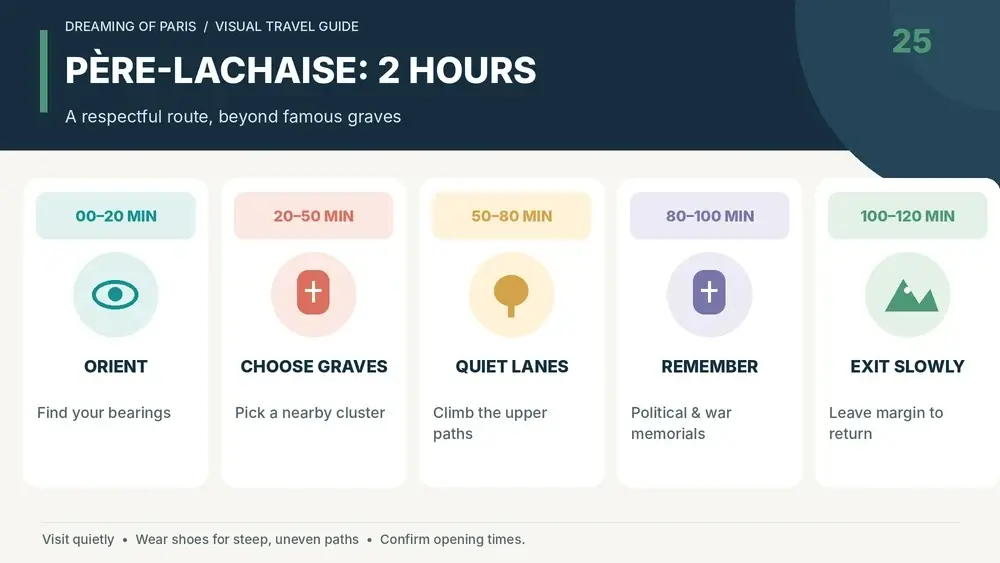
A 2-hour respectful route
- 0:00–0:20: enter, orient yourself and walk without grave hunting.
- 0:20–0:50: choose one cluster of notable graves in nearby divisions.
- 0:50–1:20: climb toward higher, quieter lanes and monumental tombs.
- 1:20–1:40: visit one political or collective memorial area.
- 1:40–2:00: descend toward your exit, allowing detours rather than racing to a final name.
For a three-hour visit, add more historical stops and longer photography breaks. Do not simply add ten more celebrity graves.
The best time of day
Morning is calmer and gives you more margin before closing. Autumn can be especially atmospheric because of foliage, but wet leaves and slopes make shoes important. Spring brings greenery and longer days. Midday in summer can be hot because some paths are exposed.
Late afternoon light is beautiful, but only if you leave enough time to reach the exit before the cemetery begins evacuation.
Photography at Père-Lachaise
Wide architectural photography is generally less intrusive than close-ups of current mourners or ceremonies. Photographing funerals, grieving families or private moments is best avoided, and the same applies to climbing on tombs or moving flowers or objects for a composition.
Barriers around memorials generally indicate where visitors are expected to remain, so they are best treated as part of the site’s current access arrangement.
Accessibility
Père-Lachaise is challenging for some visitors because of slopes, cobbles and uneven paths. Vehicle access is restricted and governed by specific rules. If mobility is limited, study the official access information before arrival and choose a shorter route concentrated near one entrance.
This is not a place where a “2 km walk” tells the whole story; elevation and surface matter.
Can you visit with children?
Yes, if you frame it around history, art and respect rather than morbidity. Older children may find sculpted monuments and stories interesting. Keep the visit shorter, avoid graphic narratives and explain that people are buried here and families still visit.
What to combine with Père-Lachaise
The cemetery fits naturally with eastern Paris. Belleville, Ménilmontant and Canal Saint-Martin are more logical companions than the Eiffel Tower. Our eastern Paris route can turn the day into a broader exploration outside the central tourist core.
If you want a very different form of Paris history, compare it with our covered passages walk on another day.
Why a guided tour can be useful
A knowledgeable guide can connect artists, revolutions, urban planning, funerary art and social history far better than a list of grave coordinates. If you book one, look for a tour that treats the cemetery as a historical site rather than promising only “dark secrets” or sensational stories.
Common mistakes
- Arriving shortly before closing.
- Trying to find twenty famous graves in two hours.
- Noise around the busiest graves.
- Using tombs as photography positions.
- Ignoring the political and memorial history of the site.
- Underestimating slopes, cobbles and walking time.
How the cemetery changes by season
Spring emphasizes new foliage and long walking light; summer gives the longest hours but can be hot on exposed climbs; autumn is visually dramatic and slippery after rain; winter is quieter but closes earlier. No season is inherently best. Match your footwear, arrival time and route length to the conditions.
After storms, staff may restrict areas for safety; posted signs define which paths remain open even when a grave appears only a short distance beyond a barrier.
How to research graves without turning the visit into homework
Before arriving, choose a few people and read one reliable paragraph about each. Knowing why someone matters makes the grave meaningful and prevents you from spending the visit staring at coordinates. For writers and artists, connect the person to a work you know; for political figures, understand the historical event; for musicians, a little context about the person and the site usually makes the stop more meaningful. This small amount of preparation creates a much richer visit than copying a list of twenty names from a travel blog.
Once inside, allow yourself to abandon the list. A sculpture, family chapel, old tree or unexpected memorial may be more memorable than the next famous marker. Père-Lachaise rewards attention to the landscape as much as successful navigation.
FAQ
Is Père-Lachaise free?
Yes, general cemetery entry is free.
How long do you need?
Two hours is a good minimum for a meaningful first visit. Three hours allows a slower route with more historical context.
Can I find graves without a tour?
Yes, but use an official or reliable map and limit your priorities. Navigation is less intuitive than it looks online.
Is Père-Lachaise safe to visit alone?
It is a public municipal cemetery visited by many people. Normal city awareness applies, but the main practical risks are getting disoriented, walking on uneven ground and misjudging closing time.
The best Père-Lachaise visit is not the one where you find the most famous names. It is the one where you leave understanding why this landscape became such an important place of personal, artistic and political memory in Paris.
Compare Père-Lachaise guided walks
The live options below are useful if you want a guided visit, reserved experience or packaged activity for this specific part of the trip. Compare the exact inclusions, meeting point, language and cancellation terms before booking.