Disclosure: This article contains affiliate links or booking widgets. If you book through them, Dreaming of Paris may earn a commission at no extra cost to you. How our affiliate links work.
Bastille is more interesting when you leave the traffic circle. The real walk begins east along streets shaped by craftsmen, furniture workshops, courtyards and the transition into the 11th and 12th arrondissements.
Check tickets and Paris experiences
Compare current tours, timed-entry tickets and experiences before fixing your itinerary.
GetYourGuideTiqetsCivitatisViatorAffiliate links: we may earn a commission at no extra cost to you.
Quick planning summary
Place de la Bastille
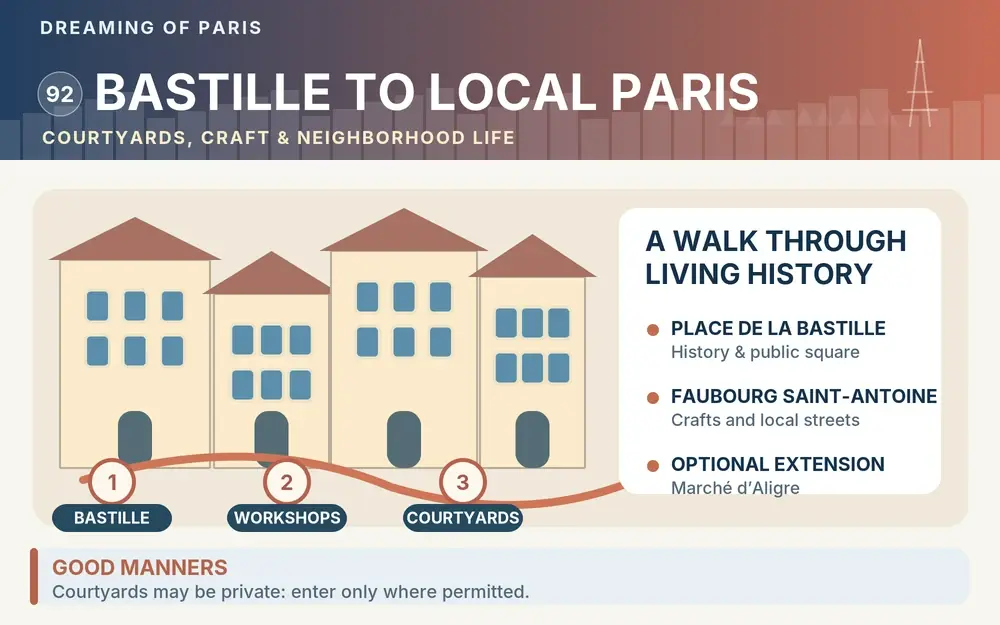
The fortress itself is gone, so the square requires imagination and historical context. The July Column commemorates the 1830 revolution, not the storming of the Bastille in 1789—a distinction worth knowing. Use the square as an orientation point rather than expecting preserved prison walls.
Port de l’Arsenal
A short detour south reveals a marina linking the Seine to the Canal Saint-Martin system. The change from traffic to water is immediate and gives families or tired walkers a quieter start. It also helps explain the infrastructure beneath and around Bastille.
Faubourg Saint-Antoine
This old axis runs toward Nation and was historically associated with craftsmen, especially cabinetmakers. The street itself is busy and commercial, but the surrounding passages and courtyards preserve fragments of workshop geography. Look beyond storefronts to understand why the district mattered.
Courtyards and privacy
Some passages such as Passage du Chantier or Cour Damoye may be visible or accessible, while others are private or secured. Access can change, and locked residential gates remain private even when a courtyard is photogenic. The district is valuable precisely because it is still lived and worked in.
Furniture and craft history
Royal privileges and the location outside old guild restrictions helped crafts flourish in the faubourg. Furniture making became particularly important. Even where workshops have disappeared, the narrow plots, yards and commercial architecture tell a different story from aristocratic western Paris.
Marché d’Aligre extension
Continue southeast toward Marché d’Aligre for food and market energy. Morning is best if the market is a priority. Combining it with Bastille creates a half-day that feels coherent: political history, working streets and food rather than isolated attractions.
Coulée Verte connection
The elevated greenway begins nearby and offers a completely different urban perspective. If the weather is good, walk a section after the streets. The greenway moves you east without returning to the same Metro station.
Evening transition
Return toward Bastille or continue into the 11th for dinner and bars. This is one of the easiest areas to turn a daytime neighborhood walk into an evening without crossing the city. Our Oberkampf guide covers the nightlife transition in more detail.
Where to eat
Avoid choosing solely around the traffic circle. Side streets east of Bastille and around Aligre generally offer a more neighborhood-oriented selection. Reserve sought-after restaurants, but keep a backup nearby because the district has enough density to improvise.
Who will enjoy this walk
It suits repeat visitors, architecture and social-history travelers, food-focused visitors and anyone who wants a bridge between central Marais and eastern Paris. It is less useful for a first-time two-day trip where Notre-Dame, Louvre and Eiffel Tower still dominate priorities.
How this article fits into the Dreaming of Paris cluster
For a deeper plan, continue with Place des Vosges, Marché d’Aligre, Coulée Verte, 11th and Oberkampf. These guides are linked because they share geography or a real planning decision, not simply because they mention Paris.
Compare current bookable experiences
Official information
For the details most likely to change, use the Paris je t’aime Faubourg Saint-Antoine page. Recheck it shortly before the visit rather than relying on a screenshot saved weeks earlier.
Practical checklist before you leave the hotel
- Recheck opening hours, closures or transport work.
- Save the exact entrance or meeting point, not only the attraction name.
- Carry water and keep enough phone battery for navigation.
- Know one nearby alternative in case the main plan changes.
- Allow more time if you have luggage, children or reduced mobility.
- Avoid scheduling another major timed attraction immediately afterward.
Is there anything left of the Bastille prison?
The fortress itself was demolished after 1789; the square is primarily a historical site and transport hub today.
What is Faubourg Saint-Antoine known for?
It has a long association with craftsmen and furniture makers, with workshops, passages and courtyards shaping the district.
Can tourists enter the courtyards?
Some are open, others private or secured. Gate access can change, especially in residential courtyards.
What should I combine with Bastille?
Place des Vosges, Marché d’Aligre, Coulée Verte and the 11th arrondissement all connect naturally.
Final planning advice
The best way to use this guide to Bastille Paris is to place it inside a coherent day rather than treat it as an isolated checklist item. Paris becomes easier when every reservation has a reason, every journey has a nearby second purpose and at least one part of the day remains flexible. That approach protects you from queues, weather changes and simple fatigue while leaving space for the unplanned café, street or view that often becomes the strongest memory.
Look for the old craft geography behind modern storefronts
Faubourg Saint-Antoine was shaped by furniture makers and craftspeople who benefited historically from a location outside some guild restrictions. The surviving courtyards and passages make more sense when you know that workshops needed depth behind the street frontage. Today many spaces have changed use, but the urban pattern still explains why the area feels different from a grand boulevard.
Start at Bastille for orientation, then move east. Do not spend too long searching for physical remains of the destroyed prison; the square’s current monuments and street layout tell a later story. The Port de l’Arsenal offers a quieter detour before the walk becomes more commercial and residential.
Courtyards require judgment
Some passages are public or contain businesses; others are private residential entrances. If a gate is closed or signage indicates private property, stay outside. Even when an entrance is open, avoid treating residents’ homes as a hidden-attraction scavenger hunt. The best visible courtyards can be appreciated quickly without creating friction.
Continue to Marché d’Aligre for a morning food extension or join the Coulée Verte near Bastille for a green route east. The 11th/12th border works especially well when you keep the entire half-day local instead of commuting to another major monument at lunch.
A practical decision check for Bastille and Faubourg Saint-Antoine
Bastille/Faubourg Saint-Antoine is for urban history travelers who enjoy reading courtyards, workshops and street patterns rather than monuments. Before you give it a fixed slot, compare that reason with the strongest alternative already on your itinerary. If the alternative matters more, move this stop to an optional block instead of forcing both into the same half-day. That simple choice keeps the article useful for different travelers rather than implying that every reader needs the same Paris.
A realistic way to fit it into the day
Start at Bastille, detour to Port de l’Arsenal, walk east along Faubourg Saint-Antoine and choose either Aligre or Coulée Verte as the endpoint. Keep the previous and following stops close enough that a delay of twenty or thirty minutes does not create a cascade of missed reservations. Paris days become much easier when the route can absorb a longer lunch, a queue or a weather change without requiring a taxi across the city.
The trade-off worth making explicit
The trade-off is hidden detail versus access. Some of the most interesting spaces are private, so the route must work even when a gate is closed. Making that trade-off deliberately is more useful than adding another item to a checklist. Ask what you would remove if this experience takes longer than expected; if the answer is “nothing,” the day is probably already too full.
Small details that prevent avoidable problems
Businesses and public passages provide legitimate entry points, while locked residential courtyards remain private. Save the exact address or entrance you intend to use, keep enough phone battery for the return route and recheck any time-sensitive information on the official site. These are small steps, but they protect the part of the experience that actually matters from being swallowed by logistics.
Where it belongs in the wider Paris cluster
Aligre adds food, Coulée Verte adds greenery, and the 11th/Oberkampf adds evening atmosphere. Treat that pairing as a geographic or thematic cluster, not an obligation to complete everything. One strong connection is enough to make the day coherent; two or three distant add-ons usually reduce the value of the place you came to see.
Why the route is better on foot
The history sits in the spacing between façades, passages and side streets. Taking the Metro from Bastille to Aligre saves little useful time and removes the evidence that connects the old furniture district to today’s mixed-use neighborhood. Walk the main axis, detour only when something is genuinely public, and use transport after the route has finished rather than inside it. If your feet are tired, shorten the route at a logical street junction instead of skipping the connective streets entirely. Even a shortened version should preserve the walk from Bastille into the old craft axis, because that transition is the article’s main historical point.