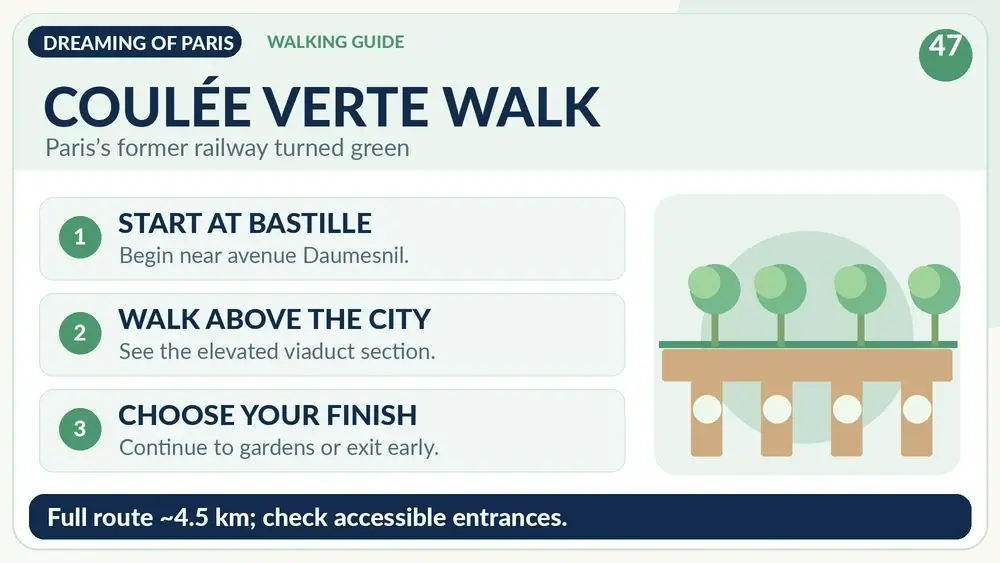
Years before New York’s High Line became internationally famous, Paris had already turned a former rail corridor into an elevated green walk. The Coulée Verte René-Dumont runs about 4.5 km through the 12th arrondissement, beginning near Bastille and changing form as it heads east. Parts are elevated above streets; other sections descend, pass gardens or continue at ground level. It is best approached as a linear walk with multiple exit points, not as an all-or-nothing attraction.
Start near Bastille for the clearest elevated section
The western beginning gives the most immediate experience of walking above avenue Daumesnil. Planting, brick viaduct arches and views into upper floors create a perspective that ordinary street walking cannot provide.
The route changes character
Do not expect one continuous identical promenade. The path transitions between elevated, ground-level and garden-like sections. Those changes are part of the design and make the full route more interesting than simply walking out and back on the famous first segment.
Access points are not all equivalent
Stairs and lifts vary by location and operational status. If step-free access is essential, check the City of Paris access information close to your visit rather than assuming every entrance shown on a map will work for you.
How far should you walk?
You can sample the first elevated kilometre or continue much farther toward eastern green spaces. A one-way route is usually smarter than returning on the same path. Use metro or bus from your chosen endpoint.
Combine it with Aligre or Bastille
A morning at Marché d’Aligre followed by the greenway is a particularly coherent pairing. Alternatively, begin after exploring Bastille and use the walk as a transition away from the busy center.
Season and weather
Spring and autumn are comfortable for a longer walk; summer shade varies, and wet surfaces can be slippery. Winter exposes more architecture through bare planting. The route is worthwhile in different seasons, but clothing and daylight affect how far you will enjoy walking.
Useful connections on Dreaming of Paris
Start with Marché d’Aligre. Compare another reused rail corridor in our Petite Ceinture guide.
How long is the Coulée Verte René-Dumont?
The City of Paris describes the route as about 4.5 km.
Do I have to walk the whole route?
No. Multiple access points make shorter one-way sections easy.
Is it accessible without stairs?
Some access points have lifts or gentler access, but conditions vary. Check current official access information if step-free routing is essential.
A final planning note
The Coulée Verte works because it gives you movement and perspective rather than a single destination. Walk as much as feels enjoyable, exit when your attention drops and use eastern Paris as the continuation rather than retracing your steps.
For Coulée Verte René-Dumont, one more practical point is worth keeping in mind. Shoes matter more than they appear on a map. Cobblestones, slopes, stairs, gravel and wet surfaces can all occur within a short walk. If mobility is a concern, check entrances and accessible alternatives before setting out; several greenways and heritage spaces have access points that are not equivalent. Use this as a decision rule rather than a rigid instruction: the best version of the day is the one that keeps the route coherent and leaves enough energy for the place itself.
For Coulée Verte René-Dumont, one more practical point is worth keeping in mind. Use public transport to connect the beginning and end rather than forcing the walk into a loop. That preserves energy for the interesting section and makes it easier to combine the route with another neighborhood without retracing the same streets. Use this as a decision rule rather than a rigid instruction: the best version of the day is the one that keeps the route coherent and leaves enough energy for the place itself.
For Coulée Verte René-Dumont, one more practical point is worth keeping in mind. This route is best treated as a sequence of short discoveries, not as a distance challenge. Paris is dense, and a detour of one or two streets can change the atmosphere completely. Build in time to sit, look back and change direction rather than measuring the day only by kilometres covered. Use this as a decision rule rather than a rigid instruction: the best version of the day is the one that keeps the route coherent and leaves enough energy for the place itself.
Start the greenway from Bastille
Before the elevated walk, explore the craft-history streets in our Bastille and Faubourg Saint-Antoine guide.
Choose a stopping point before you start
The Coulée Verte René-Dumont is not a route you need to “complete.” The most distinctive elevated section begins near Bastille above avenue Daumesnil, while farther east the path changes level and character. Decide in advance whether you want a one-hour elevated walk, a longer green corridor or a route that connects to Bois de Vincennes. That prevents the common problem of reaching the less dramatic eastern sections tired and wondering where the famous viaduct went.
For most first-time visitors, begin near the Viaduc des Arts and walk east. Look down into the avenue, notice planted arches and residential views, then leave the path when your interest starts to fall rather than when the map tells you the route is finished. Access points involve different combinations of ramps and stairs, so visitors with mobility requirements should check the specific entrance they intend to use.
Make the walk part of a 12th-arrondissement day
The strongest combination is with Marché d’Aligre in the morning or Bastille and Faubourg Saint-Antoine. Those places are close enough that the greenway becomes connective tissue rather than a separate excursion.
Season changes the walk. Spring and early summer bring planting and shade but also more users; wet leaves can make surfaces slippery in autumn; hot afternoons can feel exposed in sections with little shade. Cyclists, runners and walkers may share nearby routes even where the promenade itself has restrictions, so keep children close at access points and crossings.
If you want another reused-infrastructure walk, compare the experience with the Petite Ceinture. The Coulée Verte is a designed linear park; the Petite Ceinture preserves more of the former railway character. They are not interchangeable, and seeing both explains two very different ways Paris has reused obsolete transport infrastructure.
A practical decision check for Coulée Verte René-Dumont
The Coulée Verte is best for walkers who want greenery woven into the city rather than a destination park. The elevated western section is the signature experience. Before you give it a fixed slot, compare that reason with the strongest alternative already on your itinerary. If the alternative matters more, move this stop to an optional block instead of forcing both into the same half-day. That simple choice keeps the article useful for different travelers rather than implying that every reader needs the same Paris.
A realistic way to fit it into the day
Begin near Bastille, walk east for about an hour, then choose whether to descend for Aligre, continue farther or stop for lunch. Decide the exit before everyone is tired. Keep the previous and following stops close enough that a delay of twenty or thirty minutes does not create a cascade of missed reservations. Paris days become much easier when the route can absorb a longer lunch, a queue or a weather change without requiring a taxi across the city.
The trade-off worth making explicit
The trade-off is continuity versus variety. The farther you go, the more the path changes character; the photogenic viaduct is only one part of the route. Making that trade-off deliberately is more useful than adding another item to a checklist. Ask what you would remove if this experience takes longer than expected; if the answer is “nothing,” the day is probably already too full.
Small details that prevent avoidable problems
Check the specific access if stairs are a concern. A path can be generally accessible while the nearest entrance on your map is not the best one for reduced mobility. Save the exact address or entrance you intend to use, keep enough phone battery for the return route and recheck any time-sensitive information on the official site. These are small steps, but they protect the part of the experience that actually matters from being swallowed by logistics.
Where it belongs in the wider Paris cluster
Pair with Bastille/Faubourg Saint-Antoine or Aligre. Compare with Petite Ceinture if reused infrastructure is a special interest. Treat that pairing as a geographic or thematic cluster, not an obligation to complete everything. One strong connection is enough to make the day coherent; two or three distant add-ons usually reduce the value of the place you came to see.
What makes the elevated section special
The viaduct places you at roughly upper-floor height beside apartments and trees, so the experience alternates between urban views and planted enclosure. That unusual perspective is the reason to begin near Bastille. Once the path returns closer to street level, the walk becomes more like a conventional green corridor; some visitors love the continuity, while others are satisfied after the elevated portion.