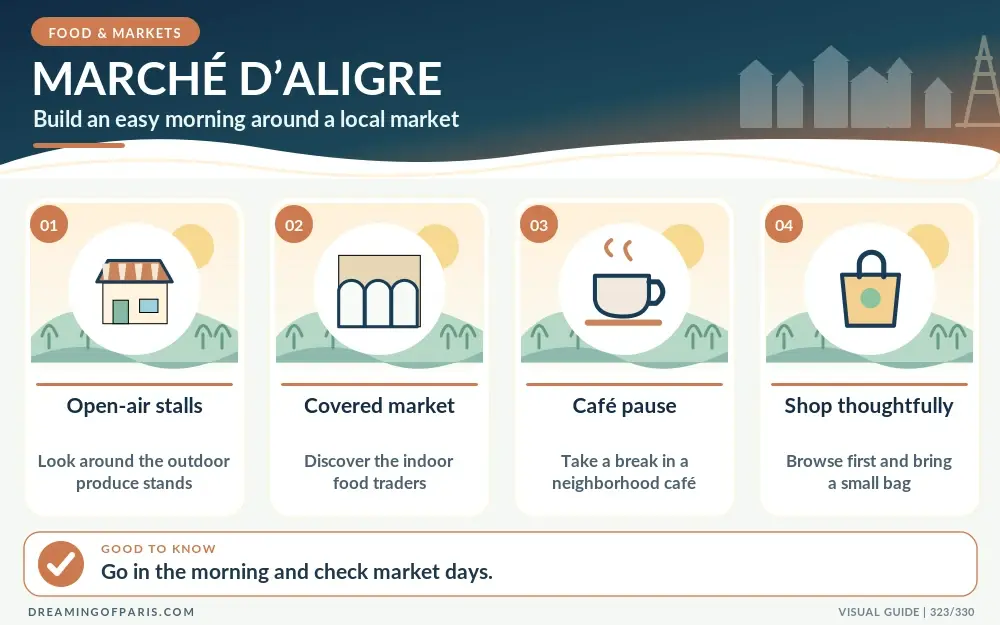
Marché d’Aligre is not one market experience but several compressed into a few streets. The open-air produce stalls along rue d’Aligre, the covered Marché Beauvau and the surrounding food shops create a compact morning that feels more useful when you understand the rhythm. The City of Paris currently lists the outdoor market Tuesday to Friday 7:30–13:30 and Saturday–Sunday 7:30–14:30, with Monday closed; individual covered-market businesses may follow their own patterns.
Start outside before going indoors
Walk the outdoor stalls first. You will understand what is seasonal, compare prices and see which end feels busiest. Then enter Marché Beauvau for permanent food counters and specialist shops. Reversing the order is fine, but the outside-first approach makes the market easier to read.
When to arrive
Early is calmer and produces the most orderly browsing. Later in the morning the atmosphere becomes more animated and, on some days, sellers begin thinking about closing. If photography matters to you, avoid blocking narrow passages and ask before making close portraits of vendors.
What to buy as a visitor
Fruit, bread, simple prepared foods and small pantry items are easier than ingredients that need refrigeration. If you are staying in an apartment, the market becomes more useful because you can actually cook what you buy. Hotel guests should focus on food they can eat the same day.
The streets around Place d’Aligre
Do not leave as soon as you exit the market. The surrounding streets contain cafés, wine shops, bakeries and everyday retail that make the visit more than a single hall. A short loop toward rue du Faubourg Saint-Antoine also places the market in the historic eastern-city axis.
Combine Aligre with the Coulée Verte
From the market area it is easy to continue toward Bastille and the beginning of the Coulée Verte René-Dumont. That pairing works because the market is strongest in the morning while the greenway is pleasant later, after the shopping crowds have thinned.
A few practical market notes
Markets are working retail spaces. Keep bags close, move aside before stopping to decide, and do not handle delicate produce without invitation. A greeting before ordering and patience during busy moments goes a long way. The goal is to participate in the rhythm rather than interrupt it.
Useful connections on Dreaming of Paris
Continue with our Paris markets and food streets guide. After the market, walk the Coulée Verte René-Dumont.
Is Marché d’Aligre open on Monday?
The City of Paris currently lists the outdoor market as closed on Monday.
What are the current outdoor-market hours?
The City currently lists Tuesday–Friday 7:30–13:30 and Saturday–Sunday 7:30–14:30. Check again close to your visit because municipal schedules can change.
Do I need cash?
Cards are common in Paris, but a backup payment method remains useful at markets and for small purchases.
A final planning note
A good Aligre visit is compact: arrive with one or two things you actually want to buy, walk both outdoor and indoor sections, then continue through the 12th instead of treating the market as an isolated attraction.
For Marché d’Aligre Paris, one more practical point is worth keeping in mind. For a useful neighborhood comparison, notice who is shopping around you and what is being sold for everyday use. A place can be famous and still function locally, but the balance between residents, visitors and destination shoppers tells you when to linger and when to move on. Use this as a decision rule rather than a rigid instruction: the best version of the day is the one that keeps the route coherent and leaves enough energy for the place itself.
For Marché d’Aligre Paris, one more practical point is worth keeping in mind. Carry a reusable bag and a small amount of payment flexibility. Many places accept cards, but small purchases, market stalls and temporary technical problems are easier when you have a backup. Tastings vary by stall, and it is usually best to check before handling produce or photographing a stall at close range. Use this as a decision rule rather than a rigid instruction: the best version of the day is the one that keeps the route coherent and leaves enough energy for the place itself.
For Marché d’Aligre Paris, one more practical point is worth keeping in mind. Treat food stops as part of the route rather than a list to collect. Paris streets change character by the hour: produce markets are strongest earlier, lunch counters can become crowded quickly, and specialty shops may close between services. A flexible sequence usually works better than reserving every bite in advance. Use this as a decision rule rather than a rigid instruction: the best version of the day is the one that keeps the route coherent and leaves enough energy for the place itself.
How to build a market morning instead of just photographing stalls
The outdoor Marché d’Aligre and the covered Marché Beauvau reward slightly different behavior. Outdoors, walk once before buying so you can see where produce, flowers and lower-cost stands are concentrated. Indoors, slow down: permanent traders make the hall better suited to cheese, meat, prepared foods and products that need more explanation. The City of Paris currently lists the outdoor market from 7:30 a.m. to 1:30 p.m. on regular weekdays and later on weekend market days, while Beauvau has its own split opening pattern on several days. Because market schedules can change around holidays, confirm the day before rather than relying on an old travel article.
A practical first-visit window is mid-morning. Too early and some visitors will find the neighborhood only beginning to settle into its rhythm; too late and the best produce may be picked over while cleanup starts. If you want lunch ingredients, buy bread last so it is not crushed under fruit and bottles. If you are only tasting, choose one ready-to-eat item and one product you can take away; eating repeatedly while standing in narrow aisles makes it harder for traders and regular customers to move.
A simple 90-minute plan
- Walk the outdoor market once without buying.
- Enter Marché Beauvau and choose one specialist stall.
- Return outside for fruit, vegetables or flowers if you need them.
- Continue through rue d’Aligre and the surrounding streets rather than leaving immediately by Metro.
The best extension is geographical, not thematic. From Aligre you can walk toward Bastille and join the Coulée Verte René-Dumont, or continue through the craft-history streets covered in our Bastille and Faubourg Saint-Antoine guide. Both choices keep the day in the 12th arrondissement instead of wasting time crossing Paris.
For travelers in an apartment, this is one of the rare sightseeing stops that can improve dinner as well as fill the morning. Buy only what you can store safely, remember that raw products may not be convenient without a kitchen, and ask before handling produce. Those small habits make the experience feel like shopping in a neighborhood rather than consuming a market as an attraction.
A practical decision check for Marché d’Aligre
Aligre is best for travelers who enjoy seeing a market function as part of a neighborhood. It is less useful if you only want a photogenic display and have no interest in buying or comparing products. Before you give it a fixed slot, compare that reason with the strongest alternative already on your itinerary. If the alternative matters more, move this stop to an optional block instead of forcing both into the same half-day. That simple choice keeps the article useful for different travelers rather than implying that every reader needs the same Paris.
A realistic way to fit it into the day
Arrive mid-morning, walk the outdoor stalls once, enter Beauvau, make one or two purchases and then leave through rue d’Aligre toward Bastille. Ninety minutes at the market plus a neighborhood walk is enough for most visitors. Keep the previous and following stops close enough that a delay of twenty or thirty minutes does not create a cascade of missed reservations. Paris days become much easier when the route can absorb a longer lunch, a queue or a weather change without requiring a taxi across the city.
The trade-off worth making explicit
The covered and outdoor sections have different rhythms; rushing one because the other looks busier misses the point. Weekend energy is higher, while weekday mornings can be easier for conversation and shopping. Making that trade-off deliberately is more useful than adding another item to a checklist. Ask what you would remove if this experience takes longer than expected; if the answer is “nothing,” the day is probably already too full.
Small details that prevent avoidable problems
Check the municipal schedule close to the visit, especially around public holidays. Market closing means active breakdown, so arriving near the end is not equivalent to arriving for the final hour of a museum. Save the exact address or entrance you intend to use, keep enough phone battery for the return route and recheck any time-sensitive information on the official site. These are small steps, but they protect the part of the experience that actually matters from being swallowed by logistics.
Where it belongs in the wider Paris cluster
Pair Aligre with Bastille, Faubourg Saint-Antoine or the Coulée Verte. That geographic cluster is stronger than crossing to Montmartre or the Eiffel Tower immediately after lunch. Treat that pairing as a geographic or thematic cluster, not an obligation to complete everything. One strong connection is enough to make the day coherent; two or three distant add-ons usually reduce the value of the place you came to see.