Disclosure: This article contains affiliate links or booking widgets. If you book through them, Dreaming of Paris may earn a commission at no extra cost to you. How our affiliate links work.
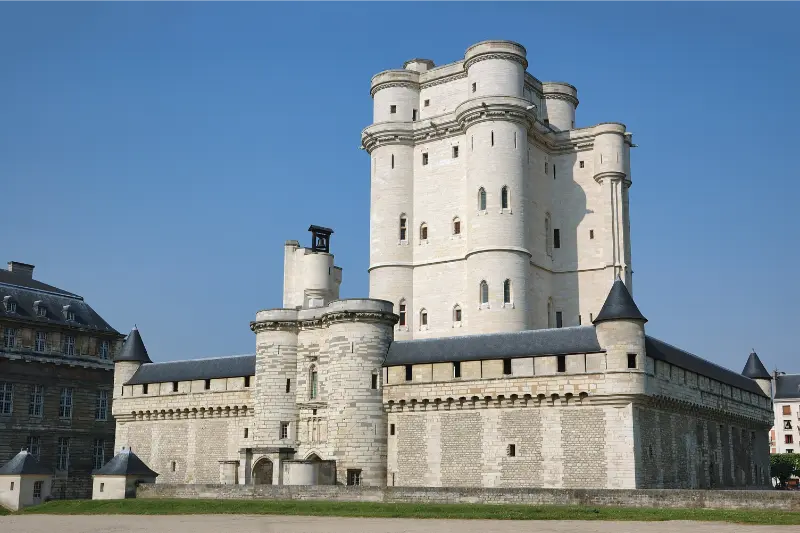
Château de Vincennes is the answer to a useful Paris question: where can you see a serious medieval royal fortress without turning the day into a long excursion? The castle sits at the eastern end of Metro Line 1, directly beside the Bois de Vincennes, and its surviving donjon and Sainte-Chapelle make it very different from Versailles.
Check tickets and Paris experiences
Compare current tours, timed-entry tickets and experiences before fixing your itinerary.
GetYourGuideTiqetsCivitatisViatorAffiliate links: we may earn a commission at no extra cost to you.
This is not a substitute for Versailles. Versailles is about Bourbon court spectacle and an enormous formal estate. Vincennes is about fortification, royal power, imprisonment and a vertical 14th-century keep. The experiences belong to different centuries and different moods.
2026 practical information
| Item | Details |
|---|---|
| Metro | Line 1, Château de Vincennes; about 300 m |
| Alternative | RER A to Vincennes |
| 21 May–21 Sep | 10:00–18:00 |
| 22 Sep–20 May | 10:00–17:00, with later weekend/holiday hours in part of spring |
| Typical self-guided time | About 1.5 hours |
| Core visit | Donjon + Sainte-Chapelle |
Why the donjon matters
The keep is the reason to come. It is one of the most imposing surviving medieval royal donjons in Europe and still communicates what a fortified royal residence felt like far better than a detached museum display. Climbing through its levels makes the defensive logic legible: walls, circulation, controlled access and the separation of royal space from the outside world.
Do not expect rooms furnished like a Loire château. The value is architecture and scale. Travelers who need furniture and decorative interiors may prefer Fontainebleau or Chantilly.
Sainte-Chapelle at Vincennes is not the one on Île de la Cité
Paris has another, much more famous Sainte-Chapelle on Île de la Cité. The Vincennes chapel is later and serves a different royal complex. That comparison is precisely why it is interesting: you can see how the Sainte-Chapelle idea was reused in a fortress-residence context.
If you enjoy architecture, look at proportions and light rather than entering with a checklist. The chapel and donjon together explain the dual nature of Vincennes—defensive stronghold and royal residence.
The best pairing is the Bois de Vincennes
The castle and Bois de Vincennes share a Metro stop and naturally form one half- or full-day cluster. A strong plan is castle first, then lunch and a long walk in the wood. Families can continue toward other Bois attractions depending on energy and season; walkers can simply use the greenery as a complete change of rhythm after the stone interiors.
This pairing is also weather-flexible. If rain arrives, keep more time for the monument; if the day is beautiful, give the afternoon to the park. That is better planning than booking two rigid indoor attractions on opposite sides of Paris.
A half-day route from central Paris
- 09:15: take Line 1 east; it runs directly through major central stations including Châtelet and Bastille.
- 10:00: enter the château near opening, when the donjon is easier to experience quietly.
- 11:30–12:00: finish the Sainte-Chapelle and exterior circuit.
- Lunch: eat around Vincennes rather than returning immediately underground.
- Afternoon: continue into the Bois de Vincennes or return via Bastille and the Coulée Verte.
Families: better than another giant museum?
For school-age children who respond to castles, towers and prisons more strongly than painting galleries, Vincennes can be an excellent swap. The official program also runs family activities on selected dates, including storytelling and workshops. These are date-specific and should be checked separately rather than assumed to be daily.
With toddlers, the historic stairs and circulation require more thought. Pairing the castle with open space in the Bois can still work, but read our Paris with babies and toddlers guide before designing the day.
Accessibility and physical effort
The donjon and Sainte-Chapelle involve historic levels and stairs. The Centre des monuments nationaux’s professional guide notes two floors in the donjon and one in the chapel; accessibility varies by space. Travelers with mobility needs should use the monument’s current accessibility page rather than assuming every part of a medieval fortress can be reached step-free.
When Vincennes is better than a classic day trip
Choose Vincennes when you have only half a day, dislike long regional rail journeys, want medieval rather than Renaissance/Baroque history, or need a plan that can expand into a park walk. Choose one of the larger day trips when the journey itself and a full destination day are part of the experience.
Official information
Official Château de Vincennes website. Opening hours vary seasonally and exceptional closures occur, so check your exact date.
Bottom line
Vincennes is one of Paris’s highest-value historical detours because the logistics are almost trivial: Metro Line 1 delivers you to a real fortified royal complex, and the Bois is beside it. For travelers who want specific history rather than another generic “hidden gem,” that combination is unusually strong.
Frequently asked questions
Is Château de Vincennes a full-day trip?
Not necessarily. The monument itself commonly fits into about 90 minutes; the day becomes longer if you add the Bois de Vincennes.
Is it like Versailles?
No. Vincennes is a medieval fortified royal complex; Versailles is a later palace-and-gardens court environment.
What is the simplest transport?
Metro Line 1 to Château de Vincennes is the easiest option for most central-Paris visitors.
Why Line 1 changes the value calculation
Many “day trips” require reaching a mainline station, buying regional tickets and protecting a return schedule. Vincennes removes most of that friction. Line 1 is a normal Metro journey from central hubs, so you can decide that morning to spend only half a day there. Low logistical cost is part of the attraction’s value.
What makes Vincennes genuinely unusual
The headline is the keep. Construction of the main tower began in 1361 and, under Charles V, the fortress became both a protected royal residence and a political statement. The donjon rises about 50 metres and is described by the monument as the highest medieval keep in Europe. It was not designed as a romantic ruin: council, royal apartments, manuscripts and objects of value all belonged to a functioning center of power.
The building later became a prison. The official history names high-profile prisoners including Nicolas Fouquet, the Marquis de Sade and Mirabeau. That afterlife is useful because it prevents a simplistic “castle = kings and battles” reading. Rooms that represented royal security later represented royal confinement.
The Sainte-Chapelle is not a copy of the one on Île de la Cité
Charles V founded the Vincennes Sainte-Chapelle in 1379, inspired by the royal chapel on the Île de la Cité and intended for relics connected to the Passion. But construction stretched far beyond his lifetime and was completed in the Renaissance. That long chronology is visible in the building and makes it an excellent comparison after Sainte-Chapelle in central Paris.
There is an important practical wrinkle: the Vincennes Sainte-Chapelle can close temporarily around midday, with the exact closure window varying. The official site explicitly tells visitors to check the day’s opening information. If the chapel is essential to you, do not arrive at 12:30 assuming every part of the monument follows one continuous schedule.
2026 tickets, opening and what the standard ticket actually covers
The official 2026 practical page lists the individual full ticket at €13 and states that it covers the Sainte-Chapelle and the lower floors of the keep. From 21 May to 21 September the monument normally runs 10:00–18:00; from 22 September to 20 May, 10:00–17:00, with earlier closing on 24 and 31 December. It closes on 1 January, 1 May and 25 December. Always recheck on your date because chapel access can vary.
A Revelacio tablet is included with admission on presentation of identification, with adult, family and reduced-mobility routes and English among the available languages. That is genuinely useful here because the castle’s empty stone spaces make more sense when you can reconstruct their former function.
A 90-minute visit that does not feel rushed
- 0–15 minutes: cross the enclosure slowly and understand the scale before entering the keep.
- 15–55 minutes: explore the standard lower keep route, using the tablet selectively rather than stopping at every screen.
- 55–80 minutes: visit the Sainte-Chapelle if open and compare its vertical glass-and-stone language with the military geometry outside.
- 80–90 minutes: walk the courtyard and exterior defenses before leaving toward the Bois de Vincennes.
When the special upper-level tour changes the visit
The normal ticket does not mean every high level of the donjon is always open independently. The monument runs special guided access to upper levels on selected dates, as well as occasional roof-structure visits in the Sainte-Chapelle. These tours are generally in French and have their own schedule. If panoramic access is the reason you are coming, check the official activity calendar rather than assuming it is part of every self-guided ticket.
Vincennes vs Versailles vs Fontainebleau
Choose Vincennes for medieval fortification, a short Metro journey and a half-day format. Choose Versailles for court spectacle, formal gardens and the scale of Louis XIV’s monarchy. Choose Fontainebleau for a long sequence of royal interiors across many reigns and a true out-of-Paris excursion. They answer different historical questions, so “which castle is best?” is the wrong comparison.
The best pairing: Bois de Vincennes
After the stone enclosure, walk into the Bois de Vincennes rather than racing back underground. A picnic, lake walk or simply 45 minutes of green space creates an effective contrast and makes the journey east feel intentional. Families can decide on the day whether they have energy for more; repeat visitors can spend the rest of the afternoon exploring the park.
A weather-based decision
Vincennes is particularly useful on a mixed-weather day because the keep and chapel provide substantial indoor content while the courtyard and park can expand or contract. In heavy rain, make it a focused monument visit and return to Paris. In good weather, let the Bois turn it into a half-day or longer. That flexibility is harder to achieve on a prebooked regional train excursion.