Bois de Vincennes is too large to visit as if it were a normal city park. The City of Paris lists the eastern woodland at about 995 hectares, with four lakes and multiple gardens and facilities. The woods themselves are broadly open around the clock, while contained attractions and gardens follow their own schedules. The right strategy is to choose one zone or theme rather than trying to circle the entire area on foot.
Choose a purpose before choosing an entrance
A lake walk, family day, botanical visit and long run all require different starting points. Look at the specific place you want first, then choose the closest transport. ‘Bois de Vincennes’ on a map covers far more ground than a visitor often expects.
Lakes create the easiest first visit
The four lakes give the woodland strong reference points. A route around or between selected lakes is easier to understand than wandering without orientation. Do not assume you need to see all four; one lake plus another nearby attraction can already fill a relaxed half-day.
Contained attractions have separate rules
The zoo, Parc Floral and other facilities are not simply always-open parts of the woods. Check their own tickets, opening hours and event calendars. This matters especially when a concert, floral event or family attraction is the main reason for traveling east.
Picnic and family planning
Large green space makes Vincennes appealing for a picnic, but Paris park rules still apply where relevant and local signage takes priority. Families should plan toilets, play breaks and transport home before walking deep into the woods.
A full day should have structure
For a longer visit, combine one active element, one seated meal or picnic, and one specific garden or attraction. Without that structure, the size can turn into aimless distance. It is perfectly reasonable to spend three hours and leave.
Return to Paris efficiently
After a long green-space day, use the nearest practical metro, RER or bus rather than walking back to the original entrance. A one-way route keeps the day interesting and reduces unnecessary fatigue.
Useful connections on Dreaming of Paris
If you are packing lunch, read our Paris picnic guide. For a shorter linear green walk, choose the Coulée Verte.
How big is Bois de Vincennes?
The City of Paris lists it at about 995 hectares.
Is Bois de Vincennes open at night?
The general woodland is listed as open 24/7, but specific gardens, attractions and facilities have their own schedules and gates.
Can I see it all in one day?
You could cover a lot, but there is little reason to. A focused zone with one or two objectives makes a better visit.
A final planning note
Treat Bois de Vincennes as a landscape, not a checkbox. Choose the lake, garden or activity that matters to you, build a one-way route around it and leave enough time to enjoy the scale instead of fighting it.
For Bois de Vincennes, one more practical point is worth keeping in mind. Shoes matter more than they appear on a map. Cobblestones, slopes, stairs, gravel and wet surfaces can all occur within a short walk. If mobility is a concern, check entrances and accessible alternatives before setting out; several greenways and heritage spaces have access points that are not equivalent. Use this as a decision rule rather than a rigid instruction: the best version of the day is the one that keeps the route coherent and leaves enough energy for the place itself.
For Bois de Vincennes, one more practical point is worth keeping in mind. Use public transport to connect the beginning and end rather than forcing the walk into a loop. That preserves energy for the interesting section and makes it easier to combine the route with another neighborhood without retracing the same streets. Use this as a decision rule rather than a rigid instruction: the best version of the day is the one that keeps the route coherent and leaves enough energy for the place itself.
For Bois de Vincennes, one more practical point is worth keeping in mind. This route is best treated as a sequence of short discoveries, not as a distance challenge. Paris is dense, and a detour of one or two streets can change the atmosphere completely. Build in time to sit, look back and change direction rather than measuring the day only by kilometres covered. Use this as a decision rule rather than a rigid instruction: the best version of the day is the one that keeps the route coherent and leaves enough energy for the place itself.
Add the medieval castle at the edge of the wood
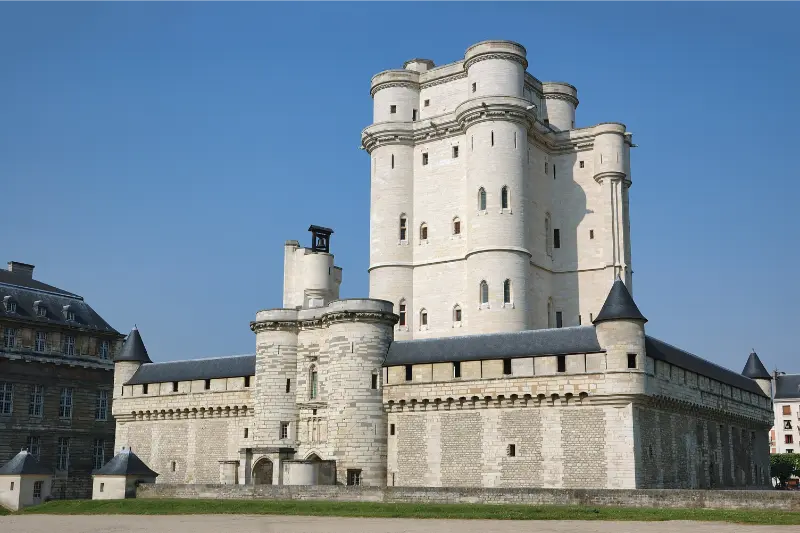
The natural pairing for this park is Château de Vincennes, reached by the same Metro terminus and easy to combine in one half-day.
Choose one side of the Bois for a half-day
Bois de Vincennes is too large to approach as a single park attraction. A half-day works best when you choose one anchor and stay in that zone: Lac Daumesnil for an easy scenic walk, Parc Floral for gardens and events, the zoo for a ticketed family visit, or Château de Vincennes at the western edge. Crossing repeatedly between these areas can consume more energy than the attractions themselves.
For a first visit without tickets, Lac Daumesnil is the simplest anchor. Walk part of the lake, stop on a bench or permitted picnic area and add one nearby garden or path. A full circuit plus extra detours can take longer than expected, especially with children. Bring water and check toilet locations before moving deeper into the wood.
Castle plus green space
The most efficient cultural combination is Château de Vincennes followed by a shorter walk in the Bois. The castle gives the day a fixed historical core; the park then becomes flexible. This is much more realistic than planning the château, zoo, lakes and Parc Floral in one day.
Metro line 1 makes the western side unusually easy to reach from central Paris, but your return station may differ if you walk far east or south. Check the exit route before losing phone battery. In warm weather, shade and distance matter; in winter, daylight can disappear while you are still far from the Metro.
Bois de Vincennes is most rewarding when it replaces—not supplements—another major sightseeing block. Use it for a recovery half-day after museums, a family outdoor day or a local contrast to formal central gardens. If your goal is simply one beautiful park inside central Paris, Luxembourg, Monceau or Buttes-Chaumont may deliver more with much less travel.
A practical decision check for Bois de Vincennes
Bois de Vincennes is best treated as a district-size landscape with separate attractions. Choose lake, zoo, floral park, castle or long walk as the anchor. Before you give it a fixed slot, compare that reason with the strongest alternative already on your itinerary. If the alternative matters more, move this stop to an optional block instead of forcing both into the same half-day. That simple choice keeps the article useful for different travelers rather than implying that every reader needs the same Paris.
A realistic way to fit it into the day
For a half-day, pair Château de Vincennes with nearby green space or choose Lac Daumesnil alone. For a full day, add only one ticketed attraction plus lunch. Keep the previous and following stops close enough that a delay of twenty or thirty minutes does not create a cascade of missed reservations. Paris days become much easier when the route can absorb a longer lunch, a queue or a weather change without requiring a taxi across the city.
The trade-off worth making explicit
The trade-off is breadth versus transport simplicity. Seeing every named feature creates long internal walks; staying in one zone gives a calmer outdoor day. Making that trade-off deliberately is more useful than adding another item to a checklist. Ask what you would remove if this experience takes longer than expected; if the answer is “nothing,” the day is probably already too full.
Small details that prevent avoidable problems
In hot weather, carry water and use shaded routes. In winter, work backward from daylight because a long park walk can end farther from the Metro than expected. Save the exact address or entrance you intend to use, keep enough phone battery for the return route and recheck any time-sensitive information on the official site. These are small steps, but they protect the part of the experience that actually matters from being swallowed by logistics.
Where it belongs in the wider Paris cluster
The château is the natural history pairing. Families can choose zoo or Parc Floral. For a smaller central park experience, Buttes-Chaumont or Luxembourg is more efficient. Treat that pairing as a geographic or thematic cluster, not an obligation to complete everything. One strong connection is enough to make the day coherent; two or three distant add-ons usually reduce the value of the place you came to see.
A good recovery-day option
After two dense museum days, the Bois can work as a deliberate low-intensity day: late breakfast, one lake or garden area, picnic or simple lunch, and an early return. This is often a better use of the park than placing it after a morning at the Louvre. Large green spaces are most restorative when they replace sightseeing pressure rather than being added to it.