Disclosure: This article contains affiliate links or booking widgets. If you book through them, Dreaming of Paris may earn a commission at no extra cost to you. How our affiliate links work.
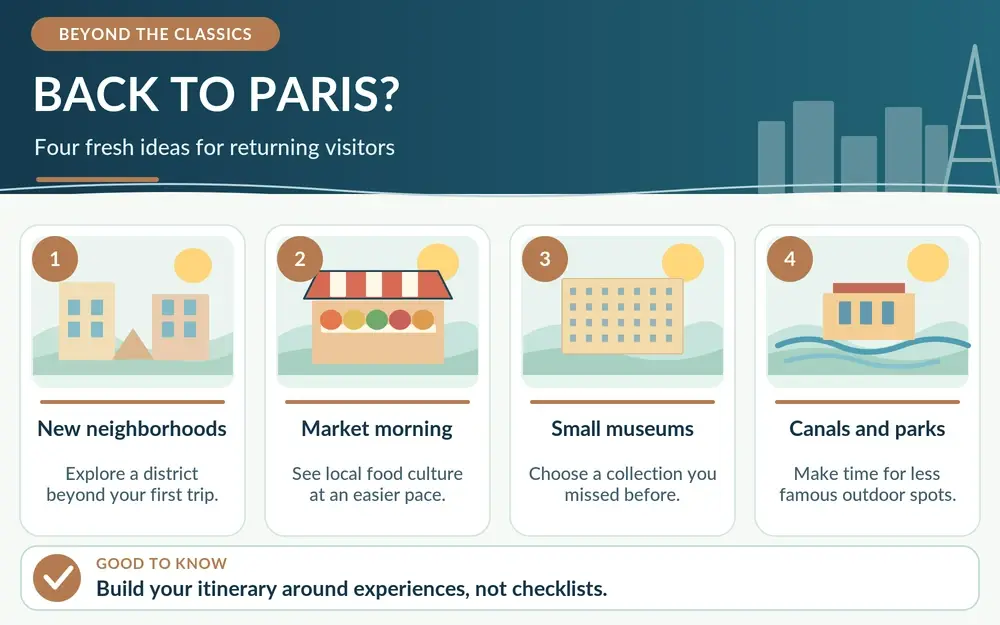
Your second trip to Paris should not be a weaker version of your first. The goal is not to avoid famous places on principle; it is to use the freedom that comes from having already seen the Eiffel Tower, Louvre and Notre-Dame. You can return to one icon you genuinely loved, then spend the rest of the trip on neighborhoods, small museums, markets and day trips that would have felt like luxuries the first time.
Book the practical parts of your Paris trip
Compare accommodation first, then check tickets and experiences for the fixed parts of your itinerary.
Check Paris hotelsGetYourGuideTiqetsCivitatisAffiliate links: we may earn a commission at no extra cost to you.
Start by listing what you do not need to repeat
If the Louvre exhausted you, do not return because a generic itinerary says every Paris trip needs it. If you loved it, return with a single wing or theme in mind. The same applies to the Eiffel Tower, Montmartre and Versailles. A repeat trip becomes personal when the itinerary reflects what you learned about your own travel style.
Build the trip around neighborhoods, not monuments
Choose two or three areas you barely touched: Batignolles, Passy and Auteuil, Belleville, Canal Saint-Martin, Butte-aux-Cailles, the quieter 14th or outer parts of the 12th. Then add one cultural anchor in or near each area. Our Batignolles guide and Passy and Auteuil guide are deliberately written for this kind of trip.
Use small museums as reasons to explore
Municipal museums make repeat visits easy because many permanent collections are free. Carnavalet can deepen Le Marais; Cernuschi can pull you toward Parc Monceau; Bourdelle can reshape a Montparnasse day; Maison de Balzac makes Passy more meaningful. See our small museums guide for neighborhood pairings.
Give one full day to eastern Paris
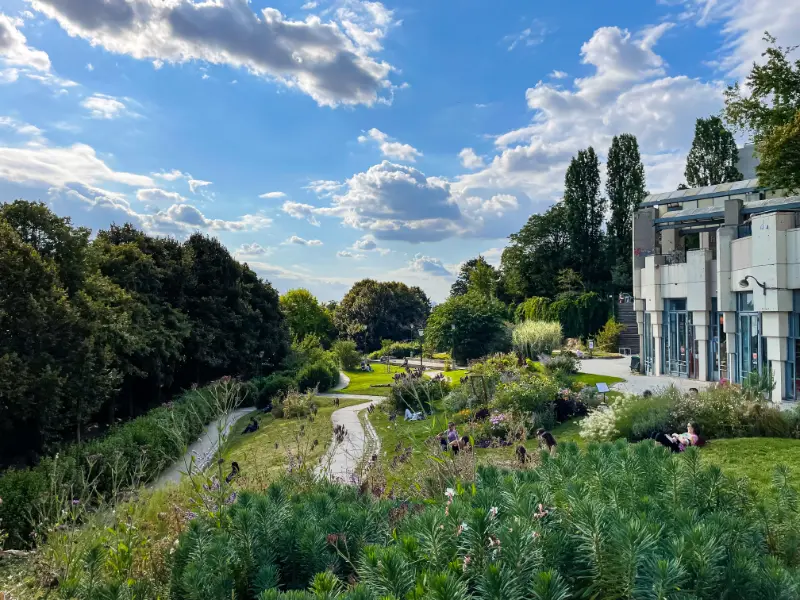
Canal Saint-Martin, Belleville and Buttes-Chaumont can occupy a complete day without a blockbuster attraction. Add street art, a market or Père-Lachaise depending on your interests. This is the kind of day that feels “too minor” on a rushed first trip and exactly right on a second one.
Choose a day trip you skipped the first time
If Versailles consumed your first excursion slot, choose Giverny, Fontainebleau, Reims or Provins now. They reveal different landscapes and histories and make the Paris region feel much broader. Use our day trips comparison to pick by interest and season.
Eat by area, not by social-media fame
On a repeat trip, food becomes easier because you are less afraid of “missing” the famous places. Explore a market street, choose lunch near the neighborhood you are already in and leave room for spontaneous bakeries or wine bars. Our markets and food streets guide is designed around that geography-first approach.
Stay somewhere different
Changing neighborhood can make Paris feel like a different city. If you stayed near the Louvre before, consider Saint-Germain, the Canal area, Batignolles or the 16th depending on your priorities. The trade-off is transport, so use our where to stay guide and compare current accommodation on Booking.com instead of choosing novelty for novelty’s sake.
A five-day second-trip framework
- Day 1: return to one favorite area + one new small museum.
- Day 2: Batignolles, Parc Monceau and a long neighborhood lunch.
- Day 3: full day trip: Giverny, Fontainebleau, Reims or Provins.
- Day 4: eastern Paris: Canal Saint-Martin, Belleville, street art and Buttes-Chaumont.
- Day 5: Passy/Auteuil or another residential district, then a final Seine evening.
What to repeat intentionally
Repeat the things that change with time or that you could only skim: a seasonal garden, a market, the Seine at a different hour, a museum collection with a new theme, Montmartre early rather than midday. Repetition is not failure. The difference is that now you know why you are returning.
What to stop doing
- Stop counting sights per day.
- Stop crossing Paris for one photo.
- Stop treating every dinner as a reservation project.
- Stop assuming “hidden” means better.
- Stop avoiding famous places just to prove you are a repeat visitor.
Frequently asked questions
What should I do on a second trip to Paris?
Focus on neighborhoods you missed, smaller museums, markets and one new day trip, while repeating only the famous places you genuinely want to see again.
How many days are good for a second visit?
Four to six days gives enough time for deeper neighborhoods and one excursion without recreating a first-trip checklist.
Where should I stay on a repeat visit?
Consider a different neighborhood that matches your current interests, but keep transport convenience in the decision.
Should I revisit the Louvre?
Only if you want to. A repeat visit can be excellent when focused on one collection or wing rather than another attempt to see everything.
What is the best less-touristy area?
There is no universal winner. Batignolles, Passy/Auteuil, Belleville and parts of eastern Paris offer different kinds of local atmosphere.
How this fits into our Neighborhood & Repeat Paris cluster
This guide is designed to connect with the rest of the site rather than sit alone. Continue with Batignolles, Passy and Auteuil, street art and small museums. Internal links are placed where the next decision naturally appears, so you can move from transport to neighborhood, attraction, season or day trip without rebuilding the plan from scratch.
The decision that matters most
A second Paris trip is successful when it feels more specific to you, not simply more obscure. Keep one or two things you loved, replace obligation with curiosity, and let whole neighborhoods become the attraction.
How to walk a neighborhood well
For second trip to Paris, begin with two anchor points and leave the streets between them flexible. Do not follow navigation turn by turn unless you need a specific address. The value of a residential district is often the sequence of façades, shops, schools, markets and parks that disappears when you stare at the phone. Check the route occasionally, then look up.
Best time of day
Neighborhoods change by hour. Markets belong in their operating window, residential streets are calmer in the morning, cafés gain energy around lunch, and parks become more local in late afternoon. If the district is near a famous attraction, arriving early or late can also separate you from the heaviest visitor flow. Choose timing for atmosphere, not merely for daylight.
What not to expect
“Less touristy” does not mean empty, cheap or untouched. People live and work here, rents can be high, and popular restaurants may still require reservations. The goal is not to find a secret Paris that nobody knows. It is to see a different function of the city—residential, artistic, commercial or recreational—than the monument-centered core.
Where to eat
Use the neighborhood itself as the filter. Look at current menus, opening hours and where locals are actually sitting rather than commuting to a famous address on the other side of Paris. One flexible meal is especially valuable on a walking day because the pace of exploration is hard to predict. Reserve only when a specific restaurant is a genuine priority.
Accessibility and walking load
Quiet districts can still include hills, cobbles, stairs or long gaps between metro entrances. Check elevation and step-free transport if mobility is a concern. A neighborhood walk is easy to shorten: identify one central café or park as the point where you can decide whether to continue. This is much more forgiving than a timed museum or excursion.
How to combine it with a famous sight
Use the quieter district as the second half of an icon day. After the Eiffel Tower, continue into Passy rather than crossing the city. After Montmartre, move toward Batignolles. After Canal Saint-Martin, continue to Belleville. This is the basic cluster logic: one famous anchor gives orientation, then the adjacent neighborhood adds depth without another transport-heavy move.
When to stay in the neighborhood
For a repeat trip or longer stay, sleeping in a quieter district can be rewarding. For a short first visit, transport convenience may matter more. Compare the morning journey to your likely first activity and the evening walk from dinner back to the hotel. The best base is not the neighborhood with the most attractions; it is the one that makes your actual trip easiest.
How to make the walk your own
Use second trip to Paris as a framework, not a compulsory route. Mark one starting point, one ending point and two places you genuinely care about in between. Everything else can be discovered at walking pace. If a market is quiet, move on; if a small museum catches your attention, stay longer. This flexibility is what makes neighborhood and cultural travel different from a timed attraction. You are not failing the itinerary when you change it—you are using the neighborhood the way it is meant to be used.
The role of cafés and parks
A café, square or park is not filler between “real” sights. It is where you notice how the area works and where your feet recover enough to keep enjoying the afternoon. Plan one deliberate pause instead of waiting until exhaustion forces a bad choice. In quieter districts, that pause can also help you decide whether to extend the walk, add a museum or finish early and move to dinner. The most memorable neighborhood days usually contain more looking and less rushing than first-time sightseeing days.
When this belongs on a first trip
second trip to Paris can absolutely fit a first Paris visit when it matches your interests, but it should not displace a dream attraction merely because it sounds more “local.” A traveler who has wanted to see the Louvre for years should see the Louvre. The deeper neighborhood or cultural stop becomes powerful when it complements that icon and shows another side of the city. This is the philosophy behind the cluster structure: famous Paris provides orientation; quieter Paris provides texture.
Modern art during the Pompidou closure
The historic Beaubourg building is closed for renovation in 2026. Use our Centre Pompidou closure guide for current alternatives and the Constellation program.
Modern Paris beyond the center
For a completely different urban landscape, use our La Défense architecture and public-art walk, with the Grande Arche and more than 60 outdoor artworks.
Go deeper by neighborhood on a second Paris trip
For street art and steeper local streets use Butte-aux-Cailles or Ménilmontant/Belleville. For café and nightlife history compare Montparnasse with the 11th/Oberkampf and Bastille/Faubourg Saint-Antoine. Architecture fans can follow the Art Nouveau walking guide.
For green or waterside local Paris, add Buttes-Chaumont and the Bassin de la Villette. For a classic square approached more slowly, use Place des Vosges and Maison de Victor Hugo. For a close but under-visited historic excursion, see the Basilica of Saint-Denis.