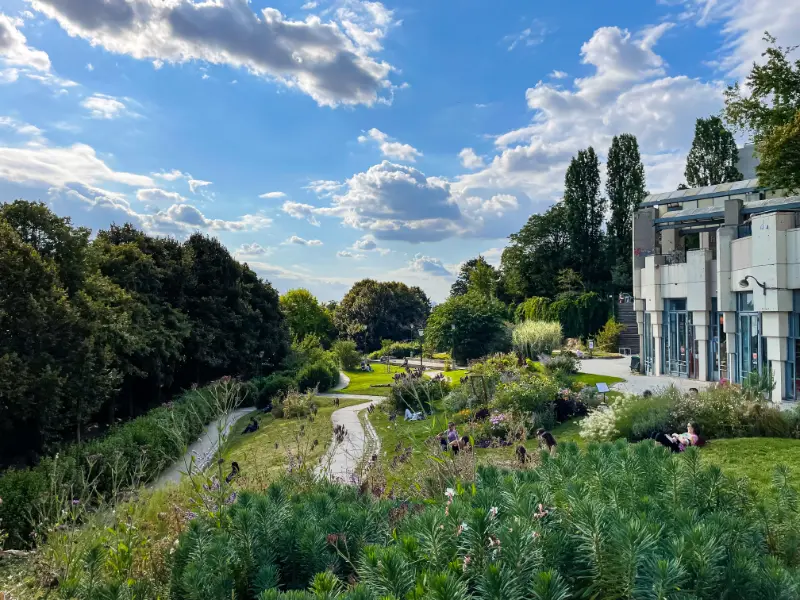
Belleville is often reduced to a viewpoint and Ménilmontant to a name visitors pass on the metro. Together they form one of the most rewarding hilly areas for travelers who want to understand eastern Paris beyond polished central neighborhoods. The route is less about monuments and more about slopes, immigrant histories, street art, ordinary commerce and the way the city opens into unexpected views.
Start with the hill, not the checklist
The topography is part of the experience. Build the route so the steepest climb happens while you are fresh, or reverse it if knees matter more than views. Stairways and sloped streets reveal sightlines that disappear if you only travel between metro stations.
Belleville Park and the wider panorama
Parc de Belleville offers a broad city view and a natural orientation point. Instead of taking one photograph and leaving, use the panorama to understand how far east you are and how the dense roofs lead back toward central Paris.
Street art changes the walk
Murals, tags and temporary works appear throughout the broader area, but they are not a fixed museum collection. Look for relationships between artwork and architecture rather than following an old list of pieces that may no longer exist.
Ménilmontant feels different block by block
The area shifts between busy axes, quieter residential streets, cultural venues and cafés. That unevenness is the reason to walk it. A single adjective such as ‘bohemian’ or ‘gritty’ flattens a neighborhood with multiple communities and very different micro-areas.
Connect to Père-Lachaise
Finishing near Père-Lachaise creates a logical geographic link, but do not squeeze a full cemetery visit into the final hour of a tiring neighborhood walk. Either give the cemetery its own focused visit or choose only a short respectful section if opening time and energy allow.
Food and evening atmosphere
The district’s eating and drinking options reflect a wider mix than the classic tourist center. Choose places based on current reviews and what is busy with local customers, not on a fixed list that can date quickly. Evening brings more energy but less architectural detail.
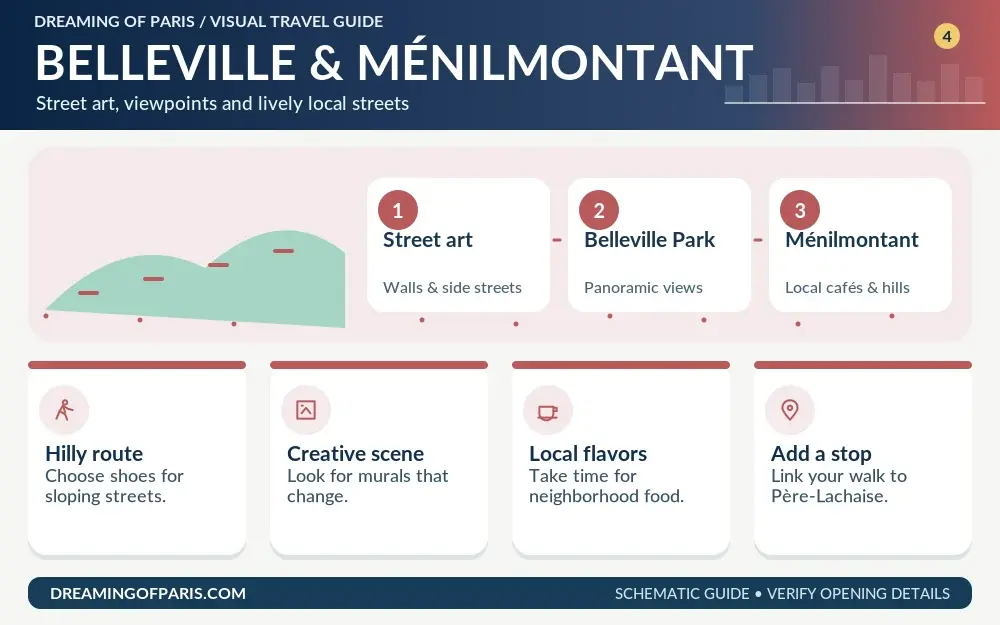
Useful connections on Dreaming of Paris
See changing visual culture in our Paris street-art guide. If you end near the cemetery, use our Père-Lachaise guide.
Are Belleville and Ménilmontant safe to visit?
They are active urban neighborhoods. Use normal city awareness, especially at night, and judge individual streets and situations rather than treating an entire district as one risk level.
Is the walk very steep?
Some sections are. Use metro or bus to reduce climbing if mobility or heat makes slopes uncomfortable.
How long do I need?
Three to four hours allows a relaxed route with one viewpoint and a café stop; add separate time for Père-Lachaise.
A final planning note
The best way to appreciate Belleville and Ménilmontant is to resist simplifying them. Walk slowly enough to notice changes in slope, language, architecture and street life, and accept that the route is the attraction.
For Ménilmontant and Belleville, one more practical point is worth keeping in mind. Visit at a time that matches the character you want. Residential streets can feel empty in the middle of a workday, while market zones or bar streets become much more animated later. There is no single ‘best’ hour; there is a best hour for the version of the neighborhood you want to see. Use this as a decision rule rather than a rigid instruction: the best version of the day is the one that keeps the route coherent and leaves enough energy for the place itself.
For Ménilmontant and Belleville, one more practical point is worth keeping in mind. Homes, schools, religious sites and memorials can sit alongside the route, so quieter photography and less intrusive stops tend to fit these areas better. Many of the places that make lesser-known Paris rewarding are ordinary lived-in spaces rather than purpose-built attractions. Use this as a decision rule rather than a rigid instruction: the best version of the day is the one that keeps the route coherent and leaves enough energy for the place itself.
For Ménilmontant and Belleville, one more practical point is worth keeping in mind. A neighborhood guide works best when you walk through it rather than commute between isolated pins. Start at one edge, follow a clear direction, and let cafés, small parks and ordinary shopping streets become part of the experience. The point is to understand how the area connects, not to claim every landmark. Use this as a decision rule rather than a rigid instruction: the best version of the day is the one that keeps the route coherent and leaves enough energy for the place itself.
Use elevation to structure the walk
Belleville and Ménilmontant make more sense when you treat the hill as part of the itinerary. Start higher if you want to conserve energy and work gradually downhill; start lower if the climb and changing views are part of the experience. Either way, avoid zigzagging between isolated pins. The reward comes from seeing how one block shifts from busy commercial streets to stairs, small houses, workshops and sudden viewpoints.
Parc de Belleville is the clearest orientation point. Stop long enough to understand the slope toward central Paris, then continue into streets where the skyline disappears and everyday neighborhood life takes over. Street art is abundant but temporary, so use it as a reason to look closely rather than a checklist of specific pieces.
Where Ménilmontant changes the mood
Moving south and west, Ménilmontant becomes less about panoramic views and more about small streets, bars, music venues and traces of former working-class Paris. The transition is one of the most interesting parts of the walk. Do not judge the district by a single busy boulevard; turn into side streets where the scale is more revealing.
Père-Lachaise is the natural endpoint if you still have two hours and enough energy. Entering the cemetery exhausted at the end of a long hill walk, however, is a poor trade. If graves and funerary architecture are a priority, use our Père-Lachaise guide and visit it first or on a separate morning.
Evening can work well here because food and bars are part of the neighborhood, but choose a clear route back to the hotel and do not confuse liveliness with a need to wander aimlessly after midnight. For green space before dinner, add Buttes-Chaumont on another half-day rather than extending this walk indefinitely.
A practical decision check for Ménilmontant and Belleville
Belleville and Ménilmontant reward travelers who want contemporary neighborhood life, elevation changes and street art more than polished monuments. Before you give it a fixed slot, compare that reason with the strongest alternative already on your itinerary. If the alternative matters more, move this stop to an optional block instead of forcing both into the same half-day. That simple choice keeps the article useful for different travelers rather than implying that every reader needs the same Paris.
A realistic way to fit it into the day
Start near a high point, use Parc de Belleville for orientation, move through side streets toward Ménilmontant and finish near a food/bar area or Père-Lachaise if energy remains. Keep the previous and following stops close enough that a delay of twenty or thirty minutes does not create a cascade of missed reservations. Paris days become much easier when the route can absorb a longer lunch, a queue or a weather change without requiring a taxi across the city.
The trade-off worth making explicit
The trade-off is spontaneity versus fatigue. Wandering works here, but the hills punish unnecessary backtracking. Keep a general downhill direction even when taking detours. Making that trade-off deliberately is more useful than adding another item to a checklist. Ask what you would remove if this experience takes longer than expected; if the answer is “nothing,” the day is probably already too full.
Small details that prevent avoidable problems
Some streets change character after dark. That does not make the area off-limits, but late-night visitors should know their transport route and avoid turning a neighborhood walk into aimless exploration. Save the exact address or entrance you intend to use, keep enough phone battery for the return route and recheck any time-sensitive information on the official site. These are small steps, but they protect the part of the experience that actually matters from being swallowed by logistics.
Where it belongs in the wider Paris cluster
Buttes-Chaumont is the best green-space pairing on another half-day. Père-Lachaise can be the endpoint if the cemetery is itself a priority. Treat that pairing as a geographic or thematic cluster, not an obligation to complete everything. One strong connection is enough to make the day coherent; two or three distant add-ons usually reduce the value of the place you came to see.
If the hills are a concern
Do not abandon the neighborhood automatically. Start from a higher Metro or bus approach, keep the route broadly downhill and use a café break before the final descent. A map that optimizes distance may still choose steep stairs, so compare the walking profile rather than trusting the shortest line. This is especially useful after rain, when steps and sloping pavements can feel more demanding.