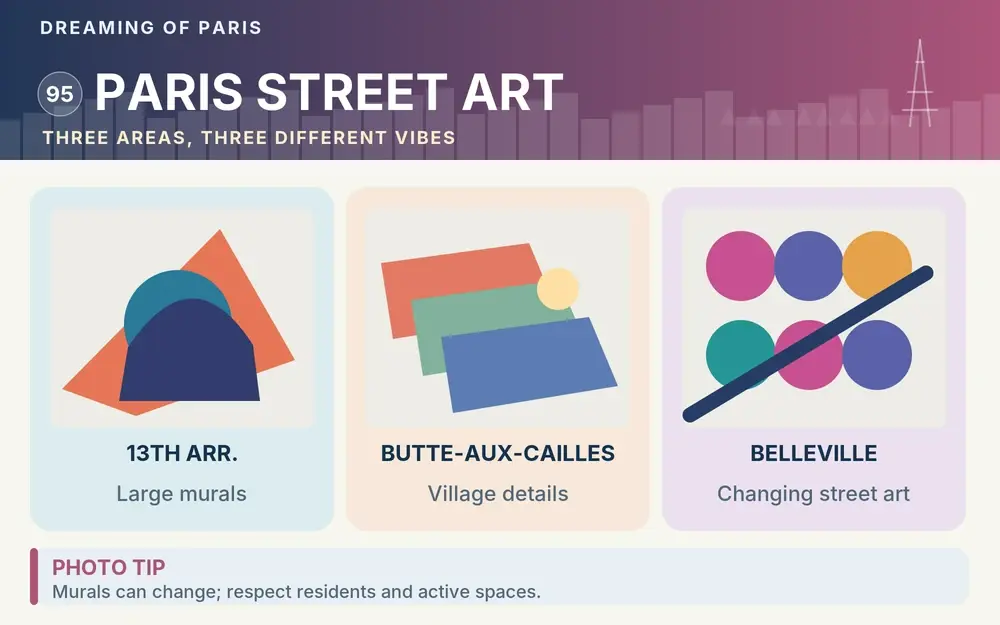
Paris street art is not concentrated in one “street art district,” and that is exactly what makes it interesting. Large murals in the 13th arrondissement, changing walls in Belleville and Ménilmontant, canal-side works and smaller interventions across the city all belong to different contexts. A useful route therefore needs to explain where large commissioned murals are likely to remain and where ephemeral work changes too quickly for a fixed checklist.
The 13th arrondissement: best for large murals
The 13th is the most reliable area if your priority is monumental wall art. Around Boulevard Vincent-Auriol and nearby streets, large-scale murals have become part of the district’s identity. Because these are often major commissioned works, the route is more stable than hunting small paste-ups. Start near a metro stop that lets you walk a logical line rather than zigzagging after individual artist pins.
Butte-aux-Cailles: smaller scale, more neighborhood texture
The nearby Butte-aux-Cailles area mixes village-like streets, independent businesses and smaller street-art interventions. This is where the route becomes less monumental and more exploratory. Works change, so avoid expecting an exact image you saw online months ago. The neighborhood itself should still be worth the walk if a particular piece has disappeared.
Belleville and Ménilmontant: expect change
Belleville has a long association with street culture and contemporary artistic activity, but walls can change rapidly. This is a better area for visitors who enjoy discovery than for those trying to recreate a fixed Instagram itinerary. Combine it with our Canal Saint-Martin, Belleville and Buttes-Chaumont day rather than making street art the only reason to cross the city.
Rue Dénoyez and the problem with outdated guides
Street-art coverage ages faster than museum guides because legal walls, construction sites and painted surfaces change. A route that promises the exact same mural forever is usually misleading. Use named streets and districts as discovery zones, then accept that the art is temporary. This is one of the few Paris subjects where “outdated” can mean only a few months.
How to photograph respectfully
Many works sit on residential buildings, shutters or local businesses. The easiest viewpoints are usually from public space without lingering in entrances, while close-up portraits of residents are better approached with permission. If an artist signature is visible, note it rather than assuming every colorful wall is anonymous.
A 13th-arrondissement street-art route
- Begin around the large-mural corridor near Boulevard Vincent-Auriol.
- Walk south/east through adjacent streets rather than chasing distant pins.
- Continue toward Butte-aux-Cailles for smaller work and lunch.
- Finish near a metro line that returns directly to your next neighborhood.
A Belleville route
Start lower in Belleville, move through side streets with your attention on walls and shutters, then continue toward Parc de Belleville for a change of scale and city view. If energy remains, extend toward Buttes-Chaumont. This makes street art part of an urban walk rather than a scavenger hunt.
Street art with children
This can be one of the easiest art experiences for children because there is no museum behavior requirement and works are large. Turn the walk into a visual game: find animals, faces, lettering styles or repeated artist marks. Keep traffic awareness high because the art often appears along real streets rather than pedestrianized tourist zones.
When street art is not worth a special trip
If you have only two days in Paris and no strong interest in contemporary urban art, do not force a distant route. You will see smaller works naturally in many neighborhoods. For a first trip, the 13th or Belleville becomes more valuable when paired with food, parks or local streets rather than treated as a standalone “must-see.”
Frequently asked questions
Where is the best street art in Paris?
The 13th arrondissement is especially strong for large murals, while Belleville and Ménilmontant are better for changing, more exploratory street art.
Is Paris street art permanent?
Some major commissioned murals are relatively stable, but smaller works can change, be covered or disappear quickly.
Is street art free to see?
Yes, public street art is visible from public streets at no admission cost.
Is the 13th arrondissement worth visiting beyond street art?
Yes. It includes Butte-aux-Cailles, local food areas, modern architecture and easy links to other southern Paris neighborhoods.
Can I combine Belleville with Buttes-Chaumont?
Yes. They pair naturally and are already linked in our eastern Paris route.
How this fits into our Hidden & Cultural Paris cluster
This guide is designed to connect with the rest of the site rather than sit alone. Continue with east Paris route, free Paris and second-trip guide. Internal links are placed where the next decision naturally appears, so you can move from transport to neighborhood, attraction, season or day trip without rebuilding the plan from scratch.
The decision that matters most
Treat street art as a living layer of Paris, not a permanent outdoor museum. The best route still works when one mural disappears because the neighborhood, scale and chance of discovery remain worthwhile.
Choose depth over collection
For Paris street art, decide what you want to notice rather than how many places you want to collect. One artist, one historical period or one neighborhood theme gives the day a memory structure. The strongest cultural itineraries alternate looking with walking, because streets, architecture and food give your brain time to process what you just saw.
Use free or small venues differently
A free permanent collection does not need to become a three-hour commitment. Enter for one floor or one room that interests you, then leave while curiosity is still high. Small museums are valuable precisely because they can fit into an ordinary neighborhood day. This creates space for spontaneous discoveries and avoids the feeling that every ticket must be “maximized.”
What to research before visiting
Read only enough to recognize the context: the artist, the period, the building’s original use or why the neighborhood matters. Ten minutes of focused background is more useful than reading a long encyclopedia entry on your phone while standing in the gallery. Save detailed research for after the visit if something captures your attention.
Photography without losing the experience
Check whether photography is allowed and whether flash or tripods are restricted. Take a few images that help you remember scale and detail, then spend time looking without the screen. For street art, residential doors and local businesses remain functional spaces, so the easiest compositions are those that keep entrances clear and avoid close-up portraits of residents without permission.
Pair culture with food or green space
After a dense museum, choose a market, park or relaxed meal rather than another collection. The contrast improves retention and keeps the day enjoyable for companions with different interests. In Paris, many of the best small museums sit close to excellent neighborhood walks, which is one reason the cluster approach works so well.
Repeat visits and temporary change
Cultural Paris is never fixed. Temporary exhibitions change, street art disappears, museums renovate and collections rotate. A second visit is not redundant if the context has changed or your interest has become more specific. Use current official listings for temporary shows and treat any street-art photograph as a snapshot in time rather than a promise.
A better measure of success
Do not judge the day by the number of museum names or murals checked off. Ask whether you can describe one work, one street, one historical connection and one unexpected detail afterward. That is a much stronger outcome than returning to the hotel with hundreds of photos and no clear memory of where they were taken.
How to make the walk your own
Use Paris street art as a framework, not a compulsory route. Mark one starting point, one ending point and two places you genuinely care about in between. Everything else can be discovered at walking pace. If a market is quiet, move on; if a small museum catches your attention, stay longer. This flexibility is what makes neighborhood and cultural travel different from a timed attraction. You are not failing the itinerary when you change it—you are using the neighborhood the way it is meant to be used.
The role of cafés and parks
A café, square or park is not filler between “real” sights. It is where you notice how the area works and where your feet recover enough to keep enjoying the afternoon. Plan one deliberate pause instead of waiting until exhaustion forces a bad choice. In quieter districts, that pause can also help you decide whether to extend the walk, add a museum or finish early and move to dinner. The most memorable neighborhood days usually contain more looking and less rushing than first-time sightseeing days.
When this belongs on a first trip
Paris street art can absolutely fit a first Paris visit when it matches your interests, but it should not displace a dream attraction merely because it sounds more “local.” A traveler who has wanted to see the Louvre for years should see the Louvre. The deeper neighborhood or cultural stop becomes powerful when it complements that icon and shows another side of the city. This is the philosophy behind the cluster structure: famous Paris provides orientation; quieter Paris provides texture.
Two deeper street-art neighborhoods
Use our Butte-aux-Cailles and 13th guide and Ménilmontant and Belleville walk for longer neighborhood routes.