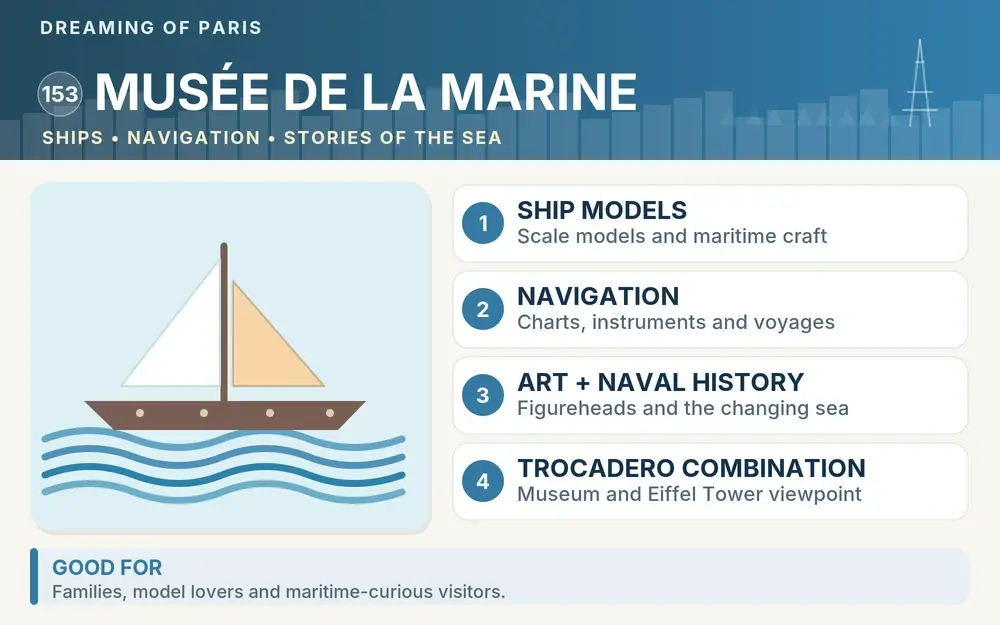
The Musée National de la Marine is one of the most transformed major museums in Paris. After a long renovation, its Palais de Chaillot galleries now present maritime history through ship models, navigation, art, naval power, trade, shipwrecks, technology and the contemporary challenges of the sea. It is not a museum only for naval specialists: the strongest sections work because they connect objects to human movement, engineering, risk and the way oceans shape everyday life.
Its Trocadéro location is another advantage. You can combine the museum with the Eiffel Tower area without repeating the same subject matter, and the museum’s windows and café place you in direct visual dialogue with western Paris. The result is a good choice for families, engineering-minded travelers, history lovers and anyone looking for a substantial indoor attraction that is easier to navigate than the Louvre.
Check tickets and Paris experiences
Compare current tours, timed-entry tickets and experiences before fixing your itinerary.
GetYourGuideTiqetsCivitatisViatorAffiliate links: we may earn a commission at no extra cost to you.
Opening hours, tickets and address in 2026
The Paris museum is at 17 place du Trocadéro, 75016 Paris, inside the Palais de Chaillot. It is currently open 11:00 to 19:00 every day except Tuesday. On the first Thursday of each month, it stays open until 22:00. Last admission is one hour before closing and the museum begins clearing galleries before the doors shut.
Current standard admission is €15 full price and €12 reduced, with free admission for several eligible groups including visitors under 18, qualifying EU residents aged 18–25, and visitors with disabilities plus one companion under the museum’s published rules. The museum explicitly notes that it is not free for everyone on the first Sunday of the month, so do not assume the common Paris “first Sunday” rule applies here.
What changed with the redesigned museum
The visitor route was rebuilt around a thematic journey rather than a simple chronological line of naval objects. The museum describes more than 1,000 items in the Paris route, restored as part of the major project. You move through four “stopovers” and three “crossings,” with sections on ship models, navigation, maritime sculpture, port painting, global shipping, storms and shipwrecks, and France as a naval power.
This structure matters because it gives non-specialists a reason to keep going. A model ship is not presented only as a miniature; it becomes evidence of how officers learned, how vessels were designed and how maritime knowledge was transmitted. A lighthouse lens or chart is not simply technical equipment; it explains how humans solved the problem of finding a path across dangerous water.
The ship models are a genuine highlight
The model collection is one of the museum’s most distinctive strengths. Some pieces were made for instruction, technical planning or official representation rather than as decorative toys. Looking closely at rigging, hull construction and scale gives you a far more concrete sense of historical ships than a flat diagram can provide.
Do not rush these rooms because “models” sound less prestigious than paintings. They are among the objects most likely to interest children and adults at the same time. If you are visiting as a family, ask younger visitors to compare how different ships solve the same practical problems: stability, propulsion, cargo, defense and life on board.
Navigation, figureheads and Vernet’s ports
Another strong sequence explores how sailors found their way before satellite navigation. Charts, compasses, optical systems and other instruments turn an abstract subject into a visible history of problem-solving. Nearby, monumental maritime sculpture and figureheads show how ships communicated identity, prestige and political power.
The museum also displays Joseph Vernet’s famous views of French ports. These large eighteenth-century paintings are useful both as art and as historical documents, because the waterfronts are full of workers, vessels and commercial activity. Spend time at the edges of the compositions rather than looking only for the grand central view.
The modern sea: trade, technology and environmental questions
One reason the renovated museum feels relevant is that it does not stop at heroic naval history. Sections on Le Havre and global consumption make the maritime economy visible in ordinary life: containers, ports, energy, passenger traffic and the enormous logistical systems behind the products we buy. This creates a bridge from historical collections to present-day questions.
The museum also addresses the sea as a place of danger and rescue. The shipwreck and storm section uses immersive design alongside objects and testimony. If you are sensitive to intense sound or large projections, move at your own pace; the scenography is meant to be experiential, not just visual.
How long do you need?
Two to three hours is a realistic first visit. You can see the principal themes in about two hours if you keep moving, but three hours gives time for the models, navigation displays and interactive elements without turning the final galleries into a sprint. Families may need longer because the hands-on and digital features encourage stopping.
If you are also booking the Eiffel Tower on the same day, put the timed tower ticket first in your planning and let the museum occupy the flexible slot. Security, elevators and weather can make Eiffel Tower timing unpredictable. Our Eiffel Tower guide explains why a generous buffer is more valuable than squeezing another attraction between reservations.
A good museum for children and teenagers
The museum’s mix of large objects, models, immersive spaces and technology makes it more family-friendly than many traditional history collections. A free web-based visitor tool called La Boussole adds interactive features without requiring a separate app download. The museum also has practical services such as toilets and baby-changing facilities.
For children, focus on questions rather than dates. How did sailors know where they were? Why were figureheads so large? How do containers change global trade? What makes a ship stable? A few strong questions create a better family visit than trying to read every panel aloud.
Temporary exhibitions: check what is on before choosing your date
The museum runs a substantial temporary-exhibition program. In autumn 2026, its Paris site is preparing Into the Deep. An Undersea Adventure from Antiquity to the Present Day, scheduled from 14 October 2026 to 4 April 2027. Programs like this can increase demand and can also justify a longer visit than the permanent route alone.
Temporary exhibitions change, so this is one part of the article you should always verify. If the special show is the main reason you are going, book for that program rather than assuming a standard permanent-collection ticket guarantees the exact experience you want.
How to combine the museum with Trocadéro
The museum belongs naturally in a western-Paris day. Start with the galleries, then walk through Trocadéro and toward the Seine, or reverse the sequence if you want morning outdoor light for photographs. Our 16th arrondissement guide gives a broader route through Passy, Auteuil and the surrounding museum district.
Do not schedule the Cité de l’Architecture, Guimet, the Marine museum and Palais de Tokyo all in one day simply because they are geographically close. Each deserves attention. Choose one major museum, perhaps one smaller cultural stop, and protect time for the neighborhood itself.
Accessibility, bags and arrival strategy
The museum publishes accessibility information for motor, visual, hearing and cognitive disabilities, and the renovated setting was designed with contemporary visitor access in mind. As always, specific needs are best checked directly before travel. The closest Metro is Trocadéro on lines 6 and 9, and there are multiple bus connections.
The museum warns that scooters and lithium batteries associated with scooters or e-bikes cannot be brought into the building. This is easy to overlook if you are moving around Paris with personal mobility equipment. Large luggage is also a poor idea for any museum visit; solve luggage storage before arriving.
Who should prioritize this museum?
- Families looking for a museum with large objects, stories and interactive interpretation.
- Maritime, military and engineering enthusiasts who want more than a conventional art museum.
- First-time visitors who already plan to spend time around Trocadéro and want one substantial indoor attraction.
- Repeat visitors who may remember the old museum and want to see the redesigned route.
- Travelers with little interest in ships can still enjoy the sections on ports, global trade, art and ocean challenges, but should check the collection themes before committing several hours.
Compare nearby bookable experiences
Trocadéro is surrounded by timed attractions and tours, so compare start times carefully. If you add a Seine cruise or Eiffel Tower experience, leave enough time to exit the museum, cross the gardens and pass through the next attraction’s security.
Official information
Check the official practical-information page before visiting. The 11:00–19:00 schedule, Tuesday closure, first-Thursday late opening and €15/€12 admission figures in this guide were verified against the museum’s current September 2026 information.
Frequently asked questions
Is the Musée de la Marine only about military history?
No. Naval history is important, but the route also covers ship models, ports, navigation, trade, ocean travel, art, shipwrecks, science and contemporary maritime issues.
Is it good on a rainy day?
Yes, but the Trocadéro location is valuable precisely because you can also add outdoor views if the weather improves. Avoid assuming rain guarantees shorter queues; other visitors may make the same choice.
Can I do it before an Eiffel Tower time slot?
Yes if you leave a large buffer. A two-hour museum visit can easily become three, and you still need to cross the Trocadéro area and clear security at the next attraction.
Does the first Sunday mean free entry?
Not automatically. The museum explicitly states that it is not free for all visitors on the first Sunday of the month. Check eligibility rather than assuming the general rule applies.
Final planning advice
Treat the Musée National de la Marine as a real museum visit, not a rainy-day add-on to the Eiffel Tower. Give it at least two hours, choose the sections that match your interests, and use the redesigned thematic route to connect art, technology and history. The strongest visits leave enough time afterward to step outside, look across Trocadéro and see the city with a new awareness of how rivers, ports and oceans connect Paris to a much wider world.